
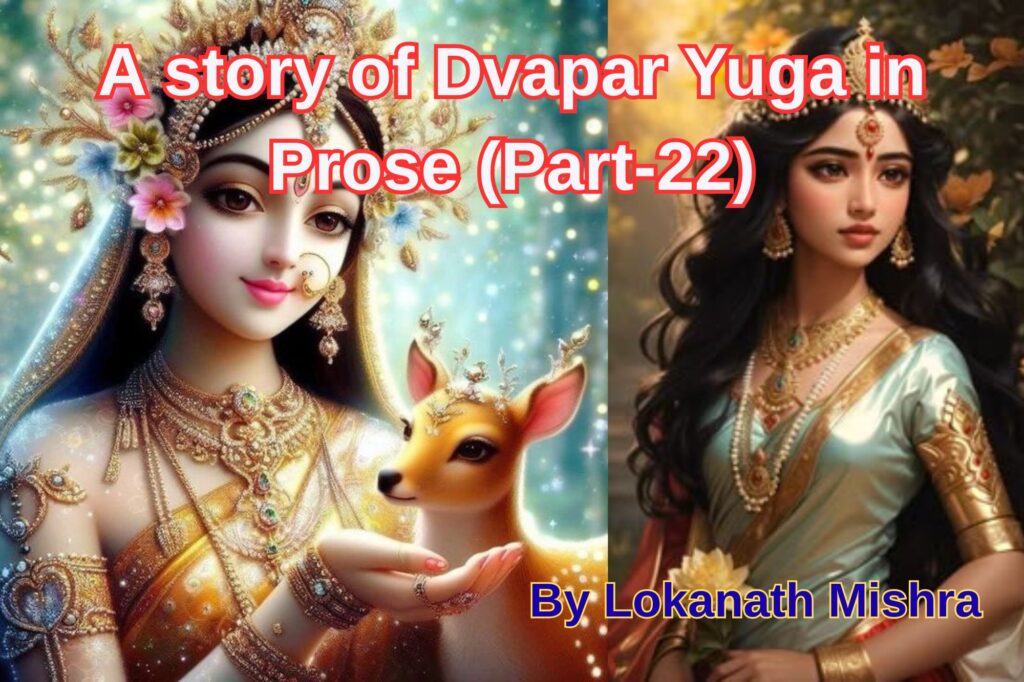
A story of Dvapar Yuga in Prose (Part-22)
By Lokanath Mishra
Uddhava in Vrindavan : The Triumph of Divine Love Over Knowledge
When Uddhava arrived in Vrindavan carrying Krishna’s message, Vrushabhānunandinī (Radha) spoke with trembling emotion:

“Uddhava, tell our beloved Gopinath that the small signet ring once adorning His tender little finger has now become a heavy bracelet around my weary arm. My body has grown frail from the fire of separation. I survive only with the hope that one day He will return.
Seeing you brings us immense joy.
Tell me—how is He? Has the Moon of Vrindavan forgotten how to steal? While stealing butter and curd He stole our hearts too. How does He live now, remembering or forgetting everything?”
The gopīs gathered around Uddhava, each narrating the countless pastimes of Krishna—how He laughed, where He played, where He hid, how He climbed trees to break pots with His slings, where He danced the divine Rasa-Līlā.
The entire youth of Vrindavan surrounded Uddhava, overwhelmed in remembrance.
When the gopīs described His enchanting form—
the peacock plume on His crown,
the yellow silken cloth adorning His waist,
the swinging earrings,
the jeweled necklace across His chest,
the flute resting in His hand,
the sweet smile glistening on His lips,
and His graceful threefold bending posture—
their voices trembled, but they never tired of describing Him.
Uddhava was moved beyond measure by their unconditional devotion. Some gopīs, unable to bear the pain of separation, called Krishna “cruel”, expressing their anguish:
“A friend is won by affection,
an enemy by strategy,
a greedy one by wealth,
and the playful by offering pleasures.
But how can anyone bind one who is untouched by illusion?
If Krishna is the radiant moon, we are merely moon-birds ever waiting for His light.
If He is the bee, we are but flowers.
If He is the sun, we are lotuses.
Our destiny is only to long for Him.
If He wishes, He will come; if not, we shall still wait.”
Uddhava tried to counsel them with philosophical teachings—detachment, the inevitability of separation, the transient nature of worldly ties:
“All relationships in this world must one day part.
None belongs to anyone forever.
Conquer your mind; embrace detachment, and grief will cease.
Those who are close today may be far away tomorrow due to duty and life’s demands.”
The gopīs listened—and gently smiled.
“O messenger of Shyam,
one who has seen the moon-like face of Kanha—what else can they behold?
One who has heard the melody of His flute—what more is there to hear?
One who has walked the groves of Vrindavan—why wander elsewhere?
Do not teach us philosophy.
Whether He will return or not is not our concern.
He lives in our thoughts, in our breath, in our very soul.
Even the pain of separation from Him is sweet to us.
We are ridiculed by the world, yet we do not care.
We have offered this life entirely to Him.
Tell Him only this—we shall wait for Him till our last breath.”
Radha’s tears flowed endlessly.

“Uddhava,” she said, “you are wise and learned in scriptures,
but you have not yet studied even the half-syllable of Love.
In love, union and separation, joy and sorrow are all accepted.
But taking the mind away from the beloved is impossible.
One who claims to do so is either lying or has never truly loved.
Above knowledge, above devotion, above liberation—Love alone reigns supreme.”
Uddhava spoke more from the scriptures, but all proved useless in front of the simple and pure devotion of the gopīs.
At last, knowledge bowed before love.
Uddhava surrendered, promising:
“I shall bring Krishna back to you.”
For the first time, a faint smile appeared on Radha’s worn face.
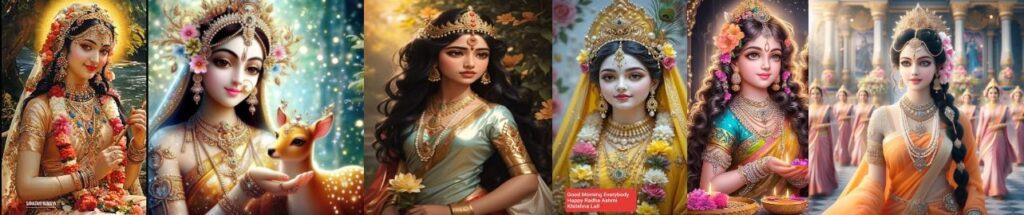
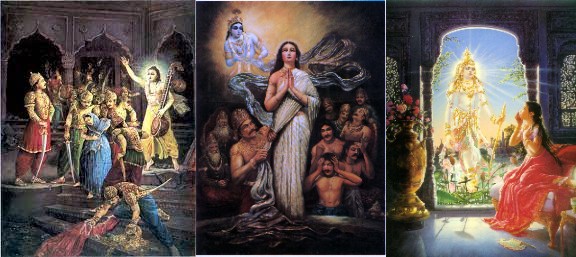
Before his departure, Radha gave Uddhava her head ornament and a jeweled necklace for Akrura as offerings for Krishna. The other gopīs, too, placed various gifts in Uddhava’s hands. Taking leave of all the residents of Vraja, Uddhava returned to Mathura.
He told Krishna:
“O Lord, all the gopas and gopīs await You.
Their hearts have solidified into a stone-like devotion for You.
My limited understanding cannot melt the love they hold.
I have realized that love stands above every form of worship and knowledge.
I promised them I would bring You.
Kindly help me fulfill that vow.”
Krishna entrusted Mathura to Balarama and prepared to return to Vrindavan.
Krishna Returns to Vrindavan

As Krishna’s chariot entered Vrindavan, thousands of cows ran toward Him lowing in joy. Their bells jingled sweetly. Krishna leapt from the chariot and embraced them. Calling them by their names, He stroked their faces as they rubbed lovingly against Him.
From afar, the cowherd boys—Śrīdāma and others—recognized their beloved friend and rushed to Him. Krishna embraced each one.
The news reached Nanda. With conch shells, drums, and trumpets sounding, the people of Vrindavan—young and old—marched in a grand procession to welcome Him. Nanda, Upananda, and the family of Vrushabhanu were all present.
Flower petals lined the streets.
Gopīs in new garments stood at each doorway ringing conches.
Krishna bowed to the elders, embraced His companions, blessed the children, and walked with everyone to Nanda’s house.
There, Yashoda and Rohini waited anxiously.
They had prepared countless dishes.
Yashoda wept tears of joy, smothering Krishna with kisses, feeding Him with her own hands, lamenting repeatedly that her Kanha had grown so thin.
Once His parents calmed, Krishna went to see Radha. She had decorated her home for His arrival. After their sweet reconciliation, they went together to the forest groves.
The gopīs gathered, and for the last time, the divine Rasa-Līlā was performed.
Vrindavan’s aching hearts were soothed.
Promising to visit often, Krishna took leave of Radha, the gopīs, Nanda, Yashoda, Rohini, and all the residents, and returned to Mathura.
Kunti’s Letter and Jarasandha’s Threat
Vasudeva had five sisters—of whom Pritha (Kunti), Shrutadeva, and Shrutashrava are notable.
Childless King Kuntibhoja had adopted Pritha and named her Kunti, who later married King Pandu.
After Pandu’s death, Dhritarashtra brought Kunti and her sons to Hastinapura. Later, after the dice-game, they were sent to Indraprastha.
But Duryodhana and his brothers viewed the Pandavas as obstacles to their ambitions, and conspiracies arose constantly.
The wise Vidura advised Kunti to write to Krishna seeking help.
A messenger carried her letter to Mathura.
At the same time, another messenger arrived—from King Jarasandha of Magadha—bringing a threatening message to King Ugrasena.
His daughters Asti and Prapti, widows of Kamsa, blamed Krishna and Balarama for their fate and urged Jarasandha to avenge them.
Jarasandha wrote:

“King Ugrasena, we are bound by familial ties.
Preserve its honor.
Surrender Krishna and Balarama to me within seven days,
and enjoy your kingdom in peace.
If you refuse, I shall attack Mathura and wipe out the entire Yadava clan.”
Ugrasena immediately convened a closed council with Krishna, Balarama, ministers, and military chiefs…
The Siege of Mathura and Krishna’s Departure to Dwaraka
After hearing Jarasandha’s threatening letter, King Ugrasena grew worried. The council chamber fell into deep silence. Only Krishna’s calm voice broke it:
“O King, do not fear.
Jarasandha’s pride is built on sand.
Righteousness is with us.
Let him come.”
Balarama smiled, twirling His plough weapon:
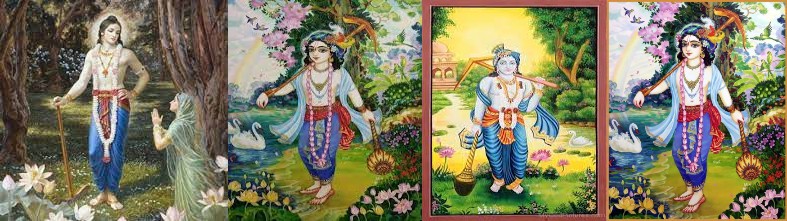
“Brother, this Magadha king has grown arrogant.
Let him learn the strength of Vrishni arms.”
The ministers, however, warned that Jarasandha possessed a vast army—chariots, cavalry, elephants, and infantry in countless numbers. His generals were seasoned warriors. He had defeated many kings already and expanded his empire greatly.
Mathura, though heroic, was much smaller in comparison.
Before the council could finalize a plan, scouts arrived breathless:
“Maharaj, the Magadha army has crossed the Ganga!
Their elephants darken the plains; their torches light the night sky.
Jarasandha marches toward Mathura!”
Drums of war echoed from every direction.
Within days, Mathura was surrounded.
Elephants shook the earth.
Conches blared.
The citizens trembled.
Krishna and Balarama assured them:

“Fear not. As long as we stand, no harm shall reach Mathura.”
At dawn, the brothers mounted their chariots.
Jarasandha laughed on seeing Krishna:
“Cowherd boy! You killed my son-in-law by trickery!
Today, I shall crush your kingdom!”
Balarama roared back:
“Enough of your boasting, Magadha king!
Face us if you dare!”
A fierce battle commenced.
Elephants charged; chariots raced; arrows showered like rain.
But where Krishna and Balarama stood, the enemy collapsed like leaves before a storm.
Krishna cut down Jarasandha’s warriors with unmatched precision.
Balarama shattered chariots with His plough and mace.
The sight of the two brothers fighting side-by-side was like watching the sun and moon blaze in the same sky.
At last, Jarasandha himself confronted them.
Balarama engaged him in a duel, overpowering him.
But before he could be slain, Krishna signaled to let him go.
Balarama asked:
“Brother, why spare this tyrant?”
Krishna smiled:
“For a great purpose yet to unfold.
Let him return, gather strength, and come again.
Each defeat will weaken his pride and strengthen our destiny.”
Jarasandha fled, humiliated.
But this was only the first of seventeen battles.
Each time he returned with new armies, and each time Krishna and Balarama defeated him.
Mathura became weary of constant war.
Amid this turmoil, Kalyavana, a powerful Yavana king known for his cruelty, received a prophecy that he would be killed by a descendant of Yadus.
Burning with anger, he marched toward Mathura with millions of soldiers.
Seeing two great armies approaching from different directions—
Jarasandha from the east
and Kalyavana from the west—
Krishna warned:
“If Mathura remains here, our people will perish in endless war.
This land is sacred but vulnerable.
We must protect our citizens.”
He called Vishwakarma, the divine architect:
“Build a city on the western sea—
impregnable
beautiful
prosperous
safe.”
Thus began the creation of Dwaraka, a heavenly fortress-city built upon the ocean itself.
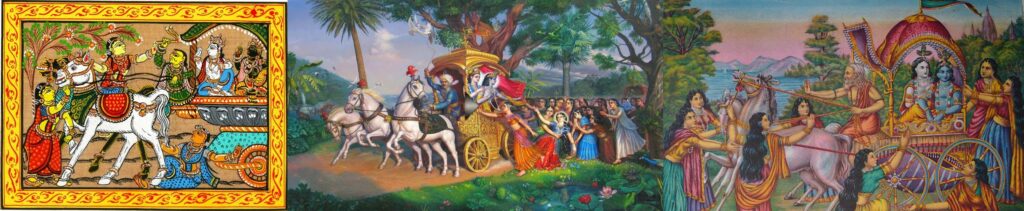
Krishna Departs Mathura
When the city was completed, Krishna relocated all Yadavas overnight through divine power, carrying them safely across the sea while they slept.
By morning, Mathura awoke empty, and Dwaraka shone like a jewel upon the waters.
But Krishna Himself remained behind momentarily to face Kalyavana.
Kalyavana challenged Him:
“Cowherd! I have heard of your valor.
Why do you flee before me?”
Krishna did not answer.
He simply smiled and walked away.
Enraged, Kalyavana chased Him.
Krishna led him into a lonely mountain cave where the ancient king Muchukunda lay asleep under a boon:
Whoever disturbs his slumber will be burned to ashes by his gaze.
Mistaking Muchukunda for Krishna in the dim light, Kalyavana kicked him.
Muchukunda opened his eyes—
and Kalyavana turned to ash instantly.
The cave glowed with divine light as Krishna appeared before Muchukunda:
“O noble king, your long penance is rewarded.
Seek liberation now, O righteous one.”
Muchukunda bowed deeply and went to the Himalayas to meditate.
Jarasandha’s Final Defeat and Krishna’s Return to Dwaraka
After Kalyavana’s death, Krishna came out of the cave—
only to be met again by Jarasandha, who had returned with another vast army.
Krishna and Balarama decided not to fight.
Instead, they climbed a high mountain.
Jarasandha encircled it and set it ablaze.
The flames rose like fiery waves, but the brothers leapt from the mountain peak to the plains below—
completely unharmed—
and disappeared into the forests.
Jarasandha assumed they had died in the fire and returned to Magadha.
Krishna and Balarama reunited with the Yadavas in Dwaraka, where the citizens rejoiced.
The city prospered, safe from enemies, filled with gardens, palaces, and lotus-filled lakes.
It became one of the most glorious cities ever to exist.
( to be continued)