
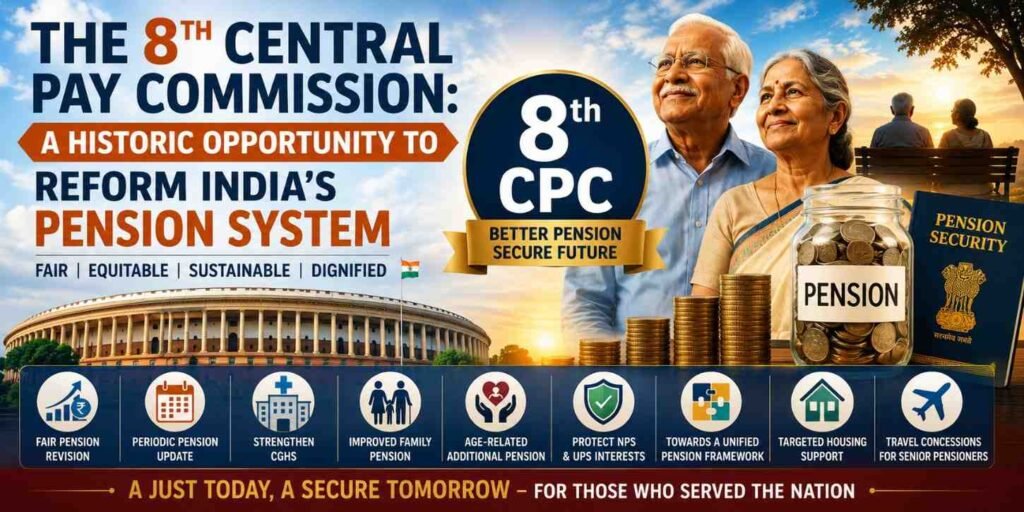
The 8th Central Pay Commission : A Historic Opportunity to Reform India’s Pension System:
By Lokanath Mishra, MA, LLB, IRS (Retired)
The constitution of the Eighth Central Pay Commission (8th CPC) has generated great expectations among nearly one crore Central Government employees and pensioners. While every Pay Commission is expected to recommend improvements in pay and allowances, this Commission has an even greater responsibility—to create a pension system that is fair, equitable, financially sustainable and capable of providing dignity to retired public servants.
The 8th CPC has invited representations from employees, pensioners, service associations and individuals. Various organisations, including the All India Pensioners Association of the Central Board of Indirect Taxes and Customs (CBIC), the National Council (JCM) Staff Side and other pensioners’ bodies, have submitted memoranda covering pension revision, medical facilities, family pension, periodic updation of pension and the removal of long-standing anomalies. These submissions demonstrate that pension reform is now one of the most important issues before the Commission.
Pension is not a charity. It is deferred compensation earned through decades of dedicated public service. A government servant retires from service, but never retires from the need for food, shelter, healthcare and a dignified life. Indeed, advancing age usually increases expenditure on medicines, medical treatment and personal care. Therefore, the primary objective of pension policy must be to protect retired employees from financial insecurity during the later years of life.
Over the years, India’s pension landscape has undergone major changes. Employees recruited before 1 January 2004 are generally covered under the Old Pension Scheme (OPS), while those recruited thereafter are covered by the National Pension System (NPS). More recently, the Government has introduced the Unified Pension Scheme (UPS) for eligible Central Government employees as another option within the contributory pension framework.
As a result, three different pension systems now coexist. Although each system was designed to meet different policy objectives, their simultaneous operation has created understandable concerns regarding equity, retirement security and administrative complexity. Employees performing identical duties may eventually receive significantly different retirement benefits simply because they joined government service in different years.
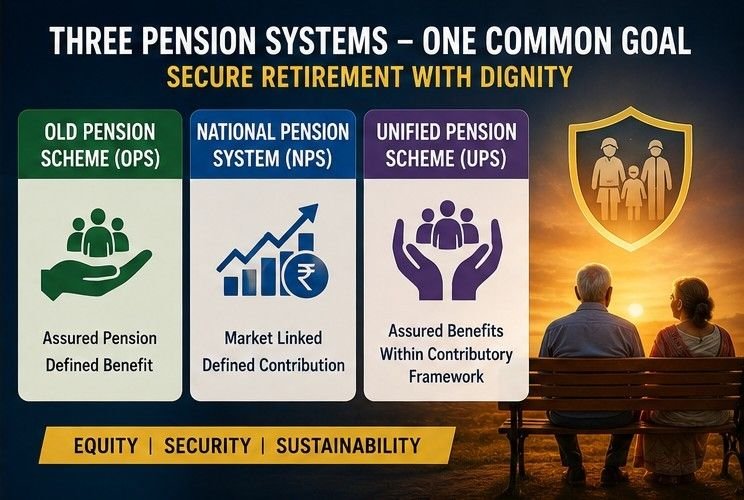
The 8th Central Pay Commission has an opportunity to examine whether India should continue with multiple pension systems or gradually move towards a more uniform pension framework that provides assured retirement income while remaining fiscally responsible. Such a review would require careful financial analysis and broad political consensus, but it deserves serious consideration in the interest of fairness and simplicity.
One issue that deserves particular attention is the method of revising pensions for existing pensioners. During the implementation of the Seventh Central Pay Commission, one of the approaches examined for pension revision was popularly known as Option-1, under which pension could broadly correspond to the notional pay of a serving employee holding the same post and pay level. Although this approach was not ultimately adopted by the Government, many pensioners’ organisations have continued to advocate that the principle should be reconsidered because it would reduce disparities between past and future retirees.
The Eighth Central Pay Commission should carefully examine whether a similar notional pay-based methodology, suitably modified if necessary, can provide a more equitable system of pension revision. Such an approach would better reflect the principle that pension should bear a reasonable relationship to the pay of corresponding serving employees while also considering the Government’s fiscal capacity.
Dearness Relief (DR) has protected pensioners from inflation, but inflation is only one part of the problem. Medical expenses have risen much faster than general inflation. The cost of medicines, diagnostic tests, specialised treatment and long-term healthcare continues to increase with age. Consequently, periodic revision of the basic pension remains essential. Waiting ten years between Pay Commissions may no longer be adequate in an economy where prices and healthcare costs change rapidly. The Commission should therefore consider a mechanism for automatic pension updation at fixed intervals, such as every five years.
Medical security deserves equal priority. Expansion of the Central Government Health Scheme (CGHS), wider availability of cashless treatment, empanelment of more hospitals and simplified reimbursement procedures would significantly improve the quality of life of retired employees and their families.
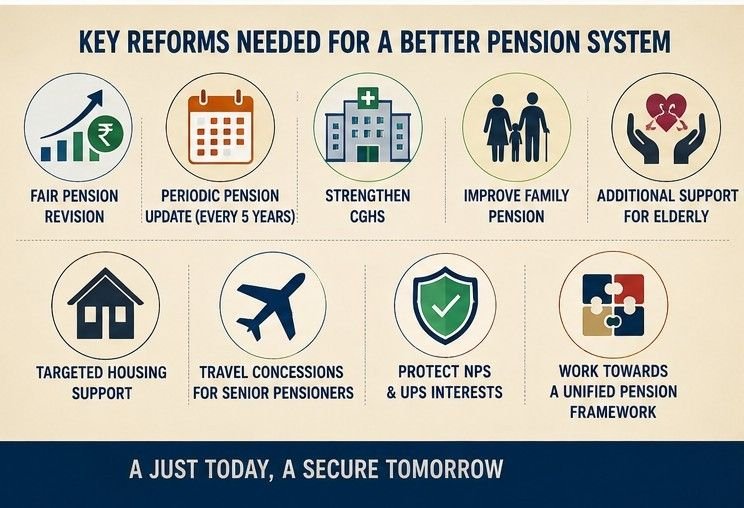
The Commission should also examine whether elderly pensioners deserve additional support through enhanced age-related pension, simplified family pension procedures and greater assistance for widows and dependent family members. These measures would strengthen the social security net without altering the fundamental structure of pension administration.
Certain post-retirement welfare measures also deserve thoughtful examination. While House Rent Allowance (HRA) is intended for serving employees, the rising cost of housing after retirement cannot be ignored. Instead of extending HRA itself, the Government may consider targeted housing support for financially vulnerable pensioners. Similarly, although Leave Travel Concession (LTC) is a service benefit, the Commission may explore whether limited travel concessions for senior pensioners could promote active ageing and social well-being.
The interests of employees covered under NPS and UPS must also be protected. They require greater certainty regarding retirement income, adequate protection against inflation, transparent pension calculations and effective safeguards against market fluctuations. A successful pension system should inspire confidence among employees throughout their careers as well as after retirement.
Ultimately, pension reform should not become a debate between different generations of employees. Every government servant contributes to the administration of the nation and deserves retirement with dignity. The objective of the 8th Central Pay Commission should therefore be to create a pension policy that is equitable across generations, financially prudent and socially just.

A balanced way forward may include the following:
- A fair and meaningful revision of pensions for all existing pensioners.
- Serious examination of a notional pay-based pension revision formula similar in principle to the Seventh CPC’s Option-1 approach.
- Periodic pension revision at intervals shorter than ten years.
- Strengthening of CGHS and comprehensive medical care.
- Improved family pension and age-related additional pension.
- Protection of retirement income for employees under NPS and UPS.
- Careful examination of whether a unified pension framework can eventually replace the present multiple pension systems while balancing employee welfare with fiscal sustainability.
The Eighth Central Pay Commission is not merely an exercise in revising salaries. It is an opportunity to redefine retirement security for millions of public servants. A just pension system reflects the values of a compassionate nation. The decisions taken today will shape the confidence of future generations entering public service and determine whether those who devoted their lives to serving the nation can live their retired years with dignity, security and peace.