

The Great Complaint Box of Gokulpur
By Lokanath Mishra, Jenamath Lane, Puri
In the peaceful little town of Gokulpur, there lived a young woman named Kamala and her husband Raghunath.
Now, Kamala was famous for two things:
- Making excellent pakoras.
- Finding faults in her husband faster than a detective finds clues.
Poor Raghunath worked as an accountant in a private company. Every morning he left home carrying:
- one office bag,
- one lunch box,
- and the invisible burden of the entire household.
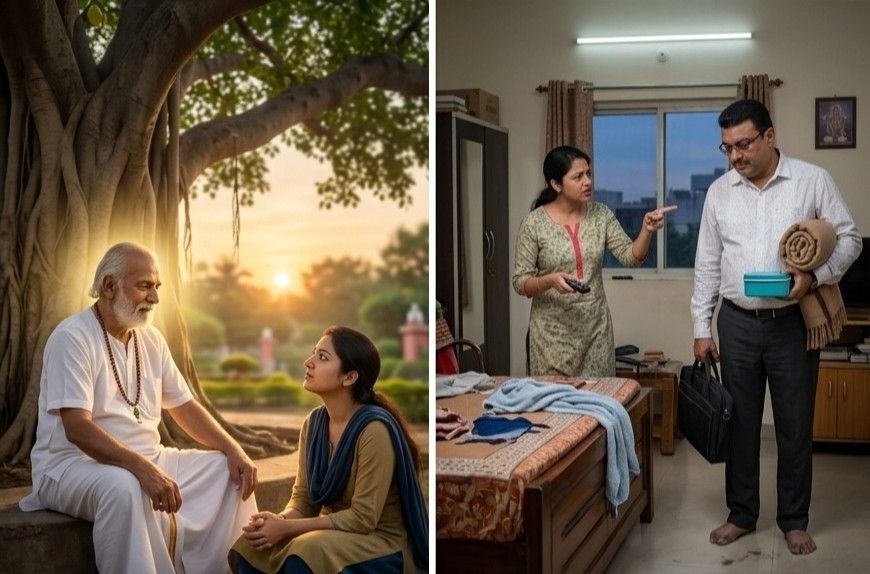
Yet every evening, as soon as he entered the house, Kamala’s “Complaint Machine” would start automatically.
“Why are you late?”
“Why didn’t you buy coriander leaves?”
“Why do you snore like a tractor?”
“Why do you keep the TV remote under the pillow?”
One evening, after a particularly dramatic argument about missing socks, Kamala stormed out of the house and sat angrily in the town garden.
There, beneath a giant banyan tree, sat an old sage-like man named Hari Baba. He wore simple white clothes, held a tulsi mala in his hand, and looked so peaceful that even mosquitoes avoided disturbing him.
Hari Baba smiled gently.
“My child,” he asked, “why is your forehead twisted tighter than a jalebi?”
Kamala burst out immediately.
“Baba! My husband is impossible! He forgets things, leaves wet towels on the bed, drinks tea noisily, and yesterday he called my handmade curtain a ‘bedsheet with ambition!’”
Hari Baba nodded wisely.
“Ah… very serious national issues indeed.”
Kamala paused.
The old man continued calmly:
“Tell me, child… who is the servant in your house?”
Kamala frowned.
“What kind of question is that?”
Hari Baba smiled.
“Who takes care of the family’s needs?”
“My husband,” she replied reluctantly.
“Who worries about food, clothing, medicines, school fees, electricity bills, gas booking, and the leaking tap that magically starts leaking only on Sundays?”
“My husband.”
“Who faces angry bosses, irritating customers, traffic jams, rising prices, and still comes home pretending everything is fine?”
“My husband.”
“Who travels long distances, sacrifices comfort, and tolerates endless stress so the family can live peacefully?”
“My husband.”
Hari Baba leaned forward dramatically.
“And who gets blamed when the Wi-Fi stops working?”
Kamala sighed.
“My husband.”
“And when it rains too much?”
“My husband.”
“And when the pressure cooker whistles loudly?”
Kamala couldn’t help laughing.
“My husband!”
Hari Baba raised his finger like a philosopher discovering the meaning of life.

“Exactly! Husbands are the official shock absorbers of family life.”
Kamala chuckled despite herself.
Then the old man asked softly:
“Has your husband ever asked for a salary for all he does?”
“Never.”
“Has he stopped caring for you when you were ill?”
“No.”
“Does he stand beside you when difficulties arise?”
“Yes.”
Hari Baba’s eyes became compassionate.
“My child, human beings have strange eyesight. We notice one grain of salt missing in the curry but forget the hundred grains already present.”
Then he quoted from the sacred Bhagavad Gita:
“He who sees with wisdom looks beyond faults and recognizes the deeper truth.”
He continued:
“In marriage, love is not merely romance. It is seva — selfless service.”
Again he recited gently from the Ramayana:
“A home prospers where husband and wife walk together with respect, patience, and dharma.”
Kamala lowered her head thoughtfully.
Hari Baba smiled mischievously.
“Besides, child, do you know why husbands forget things?”
“Why?”
“Because their brains are overloaded with EMI calculations, office tension, grocery lists, school fees, insurance reminders, and remembering whether they switched off the bathroom light.”
Kamala laughed loudly for the first time that day.
The old man continued:
“A husband may argue with his wife, but if anyone else criticizes her, suddenly he transforms into a lion protecting his kingdom.”
“That is true,” Kamala admitted.
Hari Baba nodded.
“Outsiders will only listen to your complaints for entertainment. But your husband is the one who will stand beside you at midnight during illness, difficulty, fear, and uncertainty.”
Then he quoted a timeless principle from the Mahabharata:
“The strength of a family lies not in perfection, but in mutual sacrifice.”
Kamala’s anger slowly melted like butter on hot rotis.
Just then, Raghunath arrived at the garden, panting heavily.
“Kamala! I was searching everywhere for you!”
In one hand he held her forgotten shawl.
In the other hand…
…a packet of hot samosas.
Hari Baba whispered:
“See? Even after being blamed for the missing socks, the man still brings snacks.”
Kamala burst into laughter.
Raghunath looked confused.
“What happened?”
Kamala smiled warmly for the first time in weeks.
“Nothing… I just realized that I married a good man… although slightly foolish.”
Raghunath grinned.
“And I realized I married a wonderful woman… although slightly dangerous.”
Hari Baba laughed heartily.
Then he blessed them both:
“Marriage is not about finding a flawless person. It is about learning to see the divine effort hidden inside ordinary human imperfections.”
As the couple walked home together sharing samosas, Hari Baba closed his eyes peacefully beneath the banyan tree.
And from that day onward, whenever Kamala became angry, she followed one simple spiritual practice:
Before complaining…
…she first counted her husband’s virtues.
Though admittedly, she still blamed him whenever the TV remote disappeared.