

The Lanterns Across the Corridor
By Lokanath Mishra
In the old riverside town of Chandipur, the monsoon winds carried every sound from one apartment to another. Children’s laughter, pressure cookers whistling, radios singing forgotten melodies—everything traveled through the damp evening air.
On the third floor of Shanti Residency lived Meera Sen with her husband Arvind and their six-year-old daughter, Tara.
Directly across the narrow corridor lived a group of traveling folk performers. They wore bright scarves, silver anklets, and loud smiles that echoed through the building. Most residents avoided them, whispering behind closed doors. People called them strange names, though among themselves they were a family.
Their eldest was a tall, soft-spoken person named Nilofer.
Tara, however, knew nothing about prejudice.
Every afternoon, she sat near the corridor railing and chatted happily with them. Sometimes they taught her songs. Sometimes they folded paper birds for her. Sometimes they simply listened to her endless stories about school.
One winter evening, Meera returned from the market carrying vegetables and medicines. As she reached her door, she froze.
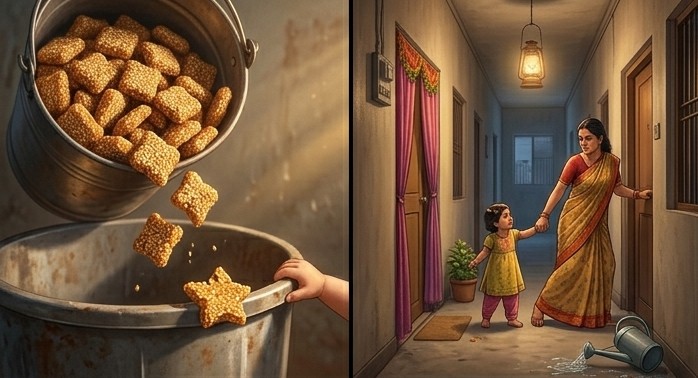
Tara stood near Nilofer, happily eating jaggery-coated sesame sweets from a steel plate.
The moment the performers noticed Meera, the corridor became silent.
Nilofer immediately lowered the plate.
“We are sorry,” they said gently. “The child was watching us make sweets, so we offered her some.”
Meera’s face hardened.
Without saying a word, she grabbed the plate from Tara’s tiny hands and emptied it into the dustbin near the staircase.
The sweets scattered like broken stars.
Tara’s lips trembled.
Nilofer quietly stepped back.

That night, Meera locked the corridor door from inside.
“No more talking to those people,” she warned her daughter.
“But why?” Tara asked innocently.
“Because some people bring darkness into a home.”
The little girl did not understand what darkness meant.
Days passed.
Yet children are drawn toward kindness the way flowers turn toward sunlight.
One afternoon, while watering plants near the corridor, Meera overheard Tara speaking softly.
“Auntie Nilofer… my mother says I shouldn’t speak to you. Did you do something wrong?”
Silence lingered for a moment.
Then Nilofer smiled sadly.
“Sometimes, little one, people fear what they do not understand.”
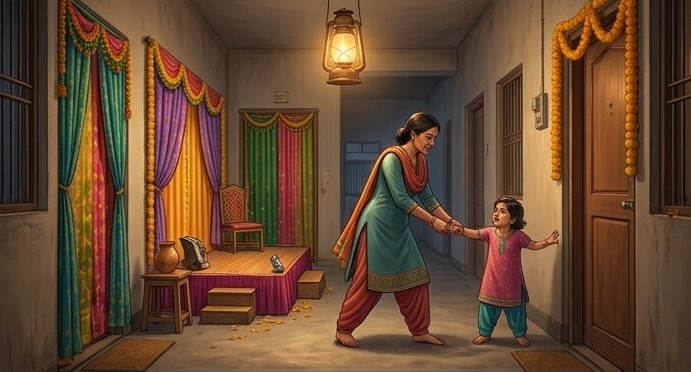
Before another word could be spoken, Meera stormed outside.
She pulled Tara away so sharply that the watering can crashed to the floor.
“I warned you!” she shouted.
Turning toward the performers, she added coldly, “Stay away from my child.”
One of the younger performers stepped forward angrily, but Nilofer raised a hand to stop them.
Instead, Nilofer simply said,
“A child’s heart has no walls. Adults build them later.”
Meera slammed the door shut.
Months rolled by.
Summer arrived with unbearable heat.
By then, Meera was heavily pregnant.
One scorching afternoon, Arvind had gone out of town for work. The maid had taken leave. The building elevator had stopped working again.
And then the labor pains began.
At first, Meera tried to endure them quietly.
But soon the pain became unbearable.
“Tara…” she whispered weakly.
The frightened child began crying.
Meera reached for her phone, but it slipped from her sweating fingers and disappeared beneath the sofa.
Outside, thunder growled across the sky.
Then suddenly—
A loud knock.
Before Meera could respond, the door opened.
Nilofer stood there with three others beside them.
Tara had run across the corridor for help.
Without hesitation, they rushed inside.
One brought water.
Another gathered clothes and documents.
Nilofer supported Meera carefully while speaking calmly:
“Breathe slowly. We’re taking you to the hospital.”
Rain poured like a waterfall outside the building.
No taxi wished to stop.
Finally, one of them ran barefoot through the flooded lane and brought an old auto-rickshaw.
The performers shielded Meera with their shawls as they carried her downstairs.
Hours later, under the white lights of the hospital, a baby boy entered the world crying loudly.
The next morning, Meera woke to find Arvind sitting beside her.
“You should rest,” he said softly.
Then he hesitated before adding,
“They stayed here all night.”
Meera turned toward the corridor outside her room.
There they were.
Nilofer and the others sat on the cold hospital floor, exhausted but smiling.
Something inside Meera cracked open.
Not pride.
Not fear.
Something heavier.
Shame.
When they entered the room, Meera’s eyes filled with tears.
“I spent so much time judging you,” she whispered. “Yet when I needed help, you were the ones who came first.”
Nilofer smiled faintly.
“Pain does not ask who deserves kindness,” they replied.
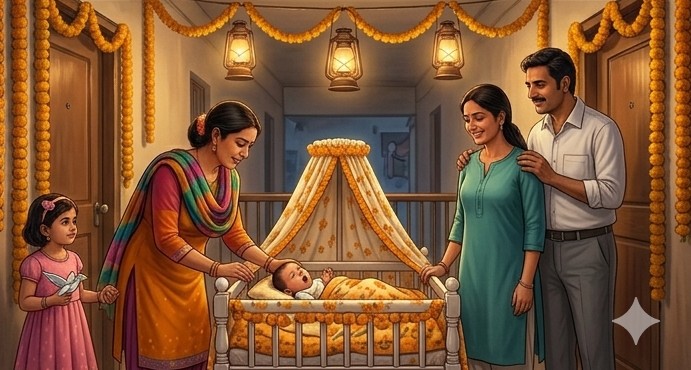
A week later, Arvind organized a small celebration at home for the newborn child.
To everyone’s surprise, he personally crossed the corridor and invited the performers.
Many neighbors stared from half-open doors as they entered the apartment nervously, unsure whether they truly belonged there.
In the center of the room rested the baby’s cradle decorated with marigolds.
Arvind looked at Nilofer and said,
“We would like you to name our son.”
The room fell silent.
One of the performers covered their mouth in disbelief.
Nilofer’s eyes glistened.
“You trust us with that honor?” they asked quietly.
Arvind nodded.
“Human dignity is not decided by society,” he said. “It is revealed by compassion.”
Nilofer walked slowly to the cradle.
The baby yawned softly in his sleep.
After a long pause, Nilofer whispered,
“His name shall be Aarush… because he arrived like the first sunlight after a storm.”
And for the first time since moving into Shanti Residency, the corridor between the two homes no longer felt narrow at all.