
Mahabharata in Prose – Part 51 (continued)
A Story of Dvapara Yuga in Prose by Lokanath Mishra
After receiving the divine Pashupatastra from Lord Shiva, Arjuna remained for some time upon the sacred slopes of the Himalayas.
The mountains around him stood silent and majestic, as though guarding the secret of what had transpired there. The icy winds no longer felt harsh to him. His mind had attained a new stillness, and his spirit carried the strength of divine blessing.
Yet Arjuna knew his journey was not complete.
Lord Shiva himself had spoken:
“The gods shall aid your path.”
Those words echoed within him.
And soon, they would come true.
The Arrival of the Celestial Chariot
One evening, as the western sky blazed with crimson light and the snowy peaks glimmered like silver, a strange radiance appeared in the heavens.
The air became fragrant.
Soft celestial music drifted through the mountains.
Arjuna looked upward.
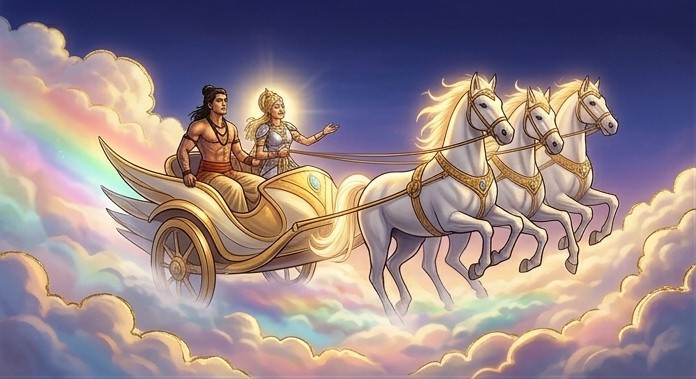
Descending from the sky was a magnificent chariot, shining like the sun itself. It moved without touching the earth, drawn by divine horses of unmatched beauty.
Upon the chariot stood a radiant figure clad in celestial armor.
It was Matali, the divine charioteer of Indra.
The chariot halted before Arjuna.
Matali bowed respectfully.
“O son of Pandu,” he said, “Lord Indra summons you to Amaravati, the celestial kingdom. The gods wish to receive you.”
Arjuna folded his hands in reverence.
“My father calls—I shall obey.”
With calm dignity, he ascended the divine chariot.
At once, it rose into the sky.
The Journey Through the Heavens
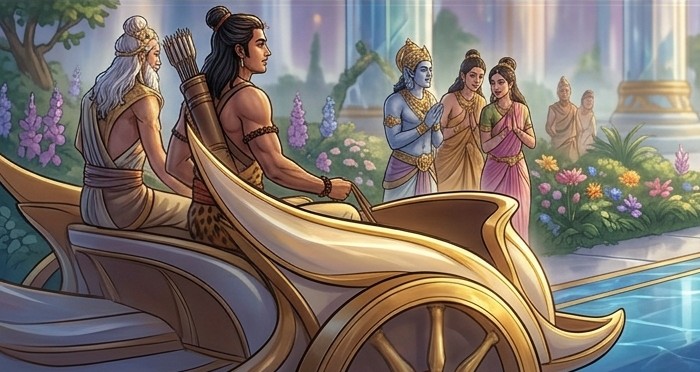
As the chariot soared upward, Arjuna beheld wonders unseen by mortal eyes.
The earth below grew distant.
Clouds shimmered with golden light. Rivers appeared like silver threads winding through the world. Mountains seemed small beneath the vastness of the heavens.
The air itself glowed with purity.
Celestial beings crossed their path—Gandharvas singing divine melodies, Siddhas immersed in meditation, and radiant Apsaras moving like streams of light.
Arjuna gazed in awe, yet his mind remained disciplined.
Matali observed him carefully.
“Many mortals lose themselves in wonder upon entering the heavens,” he said. “But your mind remains steady.”
Arjuna replied humbly,
“A warrior who forgets his purpose becomes weak, whether on earth or in heaven.”
Matali smiled with approval.
Amaravati – The City of the Gods
At last, the celestial city of Amaravati came into view.
Its splendor surpassed all imagination.
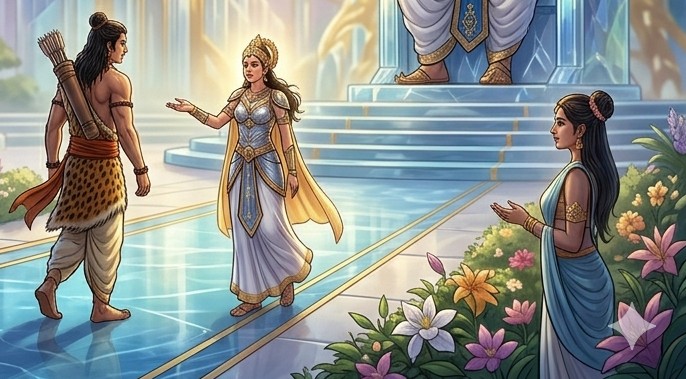
Palaces of crystal and gold stretched across the heavens. Gardens bloomed with flowers untouched by decay. Rivers of pure light flowed beside jeweled pathways. Music filled the air—not loud, but harmonious, like the rhythm of the universe itself.
There was no sorrow there, no hunger, no darkness.
As Arjuna entered the city, divine beings turned their gaze toward him.
Some whispered among themselves:
“This is the son of Indra.”
“The mortal destined to shape the age.”
“The warrior favored by Shiva himself.”
Yet Arjuna walked with humility, neither proud nor intimidated.
Matali led him into the great assembly hall of the gods.
There, seated upon a radiant throne, surrounded by devas and sages, was Lord Indra.
His form shone like lightning, majestic and powerful.
Arjuna immediately bowed low.
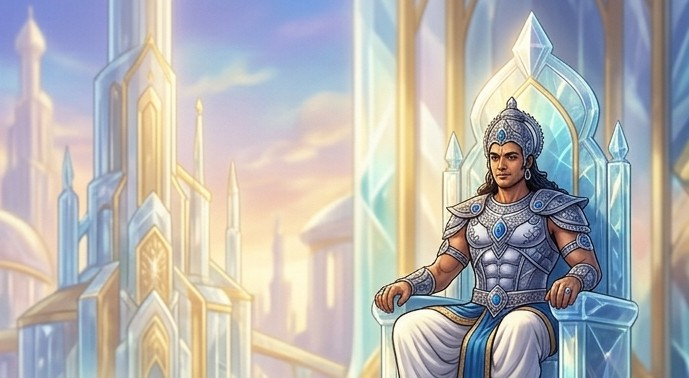
Father and Son
Indra descended from his throne and embraced Arjuna warmly.
“Welcome, Partha,” he said. “You have endured hardship, conquered pride, and earned divine favor. You are worthy of standing among the celestials.”
Though Arjuna knew Indra was his divine father, he remained respectful and composed.
“All glory belongs to the gods,” he replied. “I am but a servant of dharma.”
The devas praised his humility.
Indra then addressed the assembly:
“The time approaches when adharma shall rise greatly upon the earth. For that purpose, this warrior must be prepared beyond all mortals.”
Turning to Arjuna, he continued:
“You shall remain here for some time. The devas themselves will instruct you in celestial weapons, warfare, music, and divine knowledge.”
Arjuna accepted with folded hands.
⸻
Training Among the Gods
Thus began a new chapter in Arjuna’s journey.
In the heavenly realms, he learned the use of divine astras from celestial masters. Weapons of fire, wind, water, thunder, and illusion were revealed to him.
Each required not only skill, but purity of mind.
For celestial weapons obeyed not merely strength—but discipline and spiritual focus.
Arjuna trained tirelessly.
Even among the gods, his dedication stood unmatched.
When others rested, he practiced.
When lessons ended, he continued refining his concentration.
Indra watched with satisfaction.
“This determination,” he thought, “is why destiny has chosen him.”
⸻
The Hall of Music and Dance
Yet heaven was not only a realm of warfare.
One day, Indra summoned Arjuna and said:
“A complete warrior must understand not only destruction, but also harmony. Strength without refinement becomes brutality.”
He then entrusted Arjuna to the Gandharvas and celestial musicians.
There, Arjuna learned music, rhythm, singing, and dance.
At first, the Pandava prince found this unusual.
But gradually he understood.
Music calmed the mind. Rhythm sharpened awareness. Grace brought balance to strength.
The Gandharva king Chitrasena became his instructor and companion.
Under his guidance, Arjuna mastered arts rarely known among warriors.
These skills, though seemingly unrelated to battle, would one day serve an unexpected purpose during the Pandavas’ final year of exile.
But that destiny still lay ahead.
⸻
A Shadow in Heaven
Though honored among the gods, Arjuna’s journey in heaven was not free from trial.
For beauty and desire also dwelt in Amaravati.
And soon, a celestial encounter would place Arjuna before yet another difficult test—not of strength, but of character.
A test where restraint would prove greater than passion.
And where a curse, born from misunderstanding, would later become a hidden blessing.
⸻
Thus, Arjuna entered the celestial realms not merely as a warrior,
but as a seeker being shaped by divine hands for the great destiny awaiting him on earth.
⸻
(Continued in Part 52…)