

THE GIRL WHO CHOSE THE HORIZON
A Historical Novel By Lokanath Mishra
Chapter Three
Forty Days on Foot
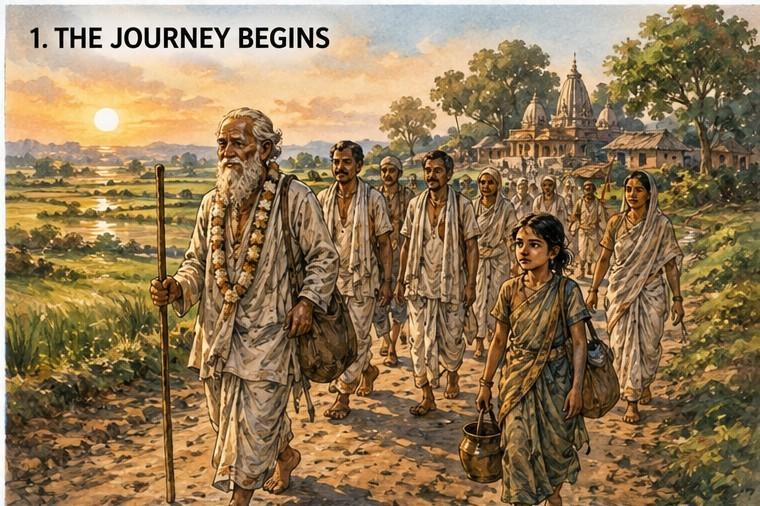
The journey to Calcutta began at sunrise.
The forty devotees gathered their belongings, rolled up their bedding, and prepared for another day on the road. The air was cool, and a golden light spread across the eastern sky.
Bhakti Charan Das led the procession.
As they walked, the devotees sang bhajans.
Their voices echoed across fields, villages, and riverbanks.
“Hare Krishna, Hare Krishna,
Krishna Krishna, Hare Hare…”
The sacred chanting gave them strength.
For Madhabi, the journey was unlike anything she had ever experienced.
Every day brought new sights.
Every mile revealed a different world.
They passed through fishing villages where boats rested on sandy shores.
They crossed fertile farmlands where peasants worked under the hot sun.
They walked through dense groves of mango and banyan trees.
Sometimes villagers welcomed them with food and water.
At other places they were viewed with suspicion.
Yet the devotees continued steadily.
Madhabi quickly became an indispensable member of the group.
Each morning she helped prepare breakfast.
Each evening she cooked rice, lentils, and vegetables for nearly forty people.
The older women grew fond of her.
Among them was an elderly widow named Sarojini Dasi.
She treated Madhabi like a granddaughter.
One evening while cooking beside a river, Sarojini asked gently,
“Child, have you never wished to return home?”
Madhabi stared into the fire.
For several moments she remained silent.
Then she replied softly,
“My home no longer exists.”
Sarojini understood that painful memories lay behind those words.
She never asked again.
Days passed into weeks.
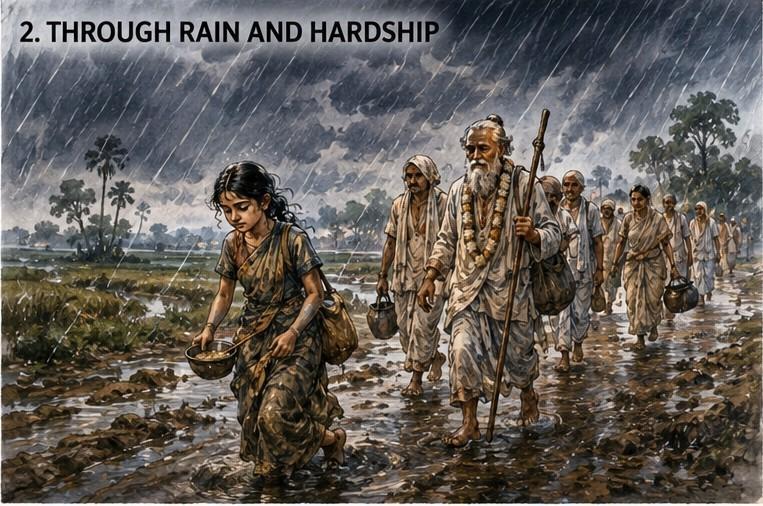
The monsoon rains arrived unexpectedly.
Dark clouds gathered overhead.
Thunder shook the sky.
Powerful winds swept across the countryside.
The pilgrims struggled through muddy roads and flooded pathways.
One afternoon torrential rain forced them to seek shelter in an abandoned warehouse near Balasore.
Water leaked through the roof.
The floor became wet and slippery.
Several elderly devotees developed fever.
Among them was Sarojini Dasi.
She shivered uncontrollably.
Her forehead burned with heat.
The others became worried.
There was no doctor nearby.
No medicine.
No hospital.
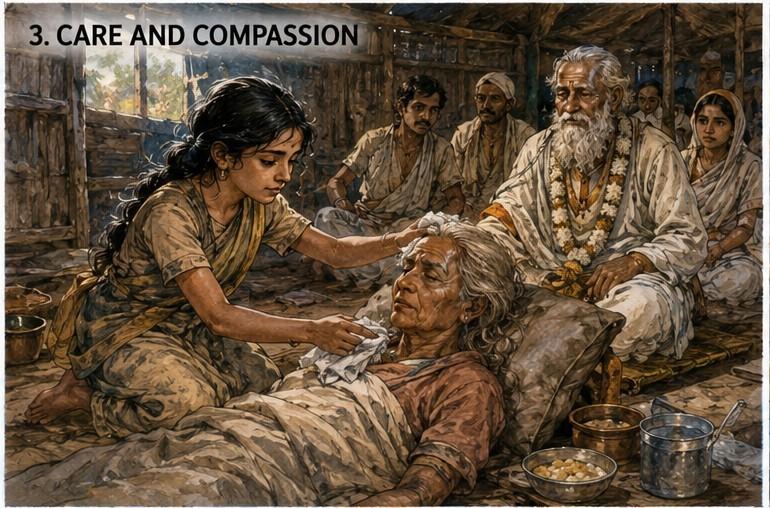
Madhabi remained beside the old woman throughout the night.
She fetched cool water.
Placed wet cloths on her forehead.
Prepared warm rice gruel.
Encouraged her to drink.
By morning Sarojini’s condition had improved.
Bhakti Charan Das watched quietly.
Later he called Madhabi aside.
“You cared for her with great patience.”
Madhabi lowered her eyes.
“I only did what anyone should do.”
The monk smiled.
“No, child. Many people feel sympathy. Few take action.”
His words remained in her memory.
Unknown to her, the first seeds of a future physician were already being planted.
The journey continued.
One afternoon the group encountered a patrol of British Indian police officers.
The officers stopped the pilgrims and demanded explanations.
The leader was a stern Anglo-Indian sergeant named Robert Henderson.
He examined the group suspiciously.
The British authorities often feared gatherings of people because revolutionary movements were spreading across India.
The Civil Disobedience Movement launched by national leaders had inspired unrest throughout the country.
Large travelling groups attracted official attention.
Henderson questioned Bhakti Charan Das.
“Where are you going?”
“To Calcutta.”
“What is the purpose?”
“Pilgrimage and devotional singing.”
The sergeant inspected the travellers carefully.
When his eyes fell upon Madhabi, he frowned.
“Who is this girl?”
For a moment her heart stopped.
Had her family reported her disappearance?
Would she be arrested and sent back?
Bhakti Charan Das answered calmly.
“She is under our care.”
The officer studied her face.
Madhabi lowered her eyes respectfully.
After several tense minutes, the police finally allowed the group to proceed.
Only when they had gone far down the road did she breathe normally again.
That night she slept very little.
The fear of being discovered remained with her.
She began using a different name whenever strangers asked about her identity.
Sometimes she called herself Meera.
Sometimes Gauri.
Sometimes Radha.
The habit of living under false names became a shield protecting her from the past.
Weeks passed.
The landscape gradually changed.
The language spoken in villages became increasingly Bengali.
The roads became busier.
Bullock carts crowded the highways.
Steam-powered trains could occasionally be seen in the distance, their whistles piercing the air.
Madhabi stared at them with fascination.
She had never seen such machines before.
To her they represented another world—a world of progress, education, and opportunity.
One evening the pilgrims camped beside a large river.
As darkness descended, Bhakti Charan Das gathered everyone around a fire.
He spoke about courage.
“The greatest prison,” he said, “is fear.”
The devotees listened attentively.
The monk continued.
“A person who conquers fear becomes truly free.”
Those words struck Madhabi deeply.
For months she had been living in fear.
Fear of capture.
Fear of hunger.
Fear of loneliness.
Fear of the unknown.
Yet she realized something important.
She had survived.
She had crossed rivers.
Endured storms.
Escaped danger.
Helped the sick.
Cooked for dozens of travellers.
The frightened child who had fled from Puri was slowly changing.
A new confidence was emerging.
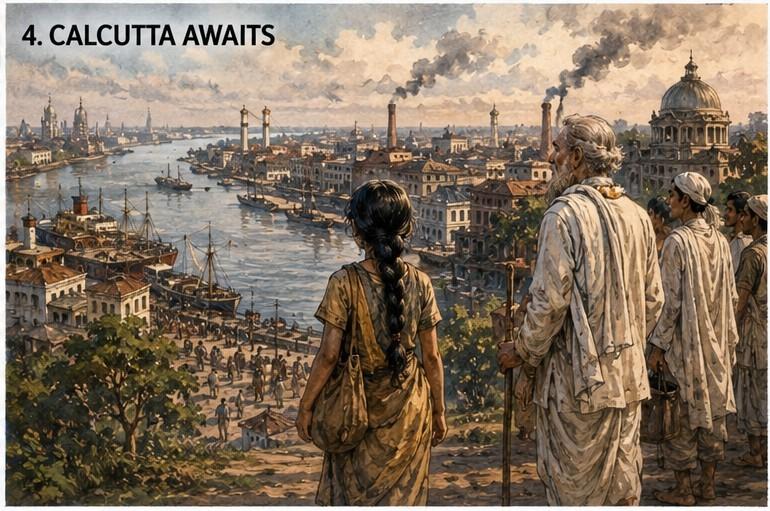
Finally, on the fortieth day, the pilgrims climbed a small rise near the outskirts of Calcutta.
From there they saw something astonishing.
Countless buildings stretched toward the horizon.
Smoke rose from factories.
Ships crowded the Hooghly River.
Railway lines crisscrossed the landscape.
Horse-drawn carriages moved through busy streets.
For Madhabi, the sight was overwhelming.
She had never imagined a city so vast.
The devotees paused to offer prayers.
Madhabi stood silently.
Before her lay the largest city she had ever seen.
Behind her lay the life she had escaped.
Ahead lay a future she could not yet imagine.
The city of Calcutta waited.
And destiny was preparing to open a new chapter in her life.
( to be continued)