

THE GIRL WHO CHOSE THE HORIZON
A Historical Novel
By Lokanath Mishra
Chapter Two
The Road Beyond Puri
The night was dark and silent.
Only the distant roar of the Bay of Bengal accompanied twelve-year-old Madhabi as she guided the mule along a sandy path leading away from Puri.
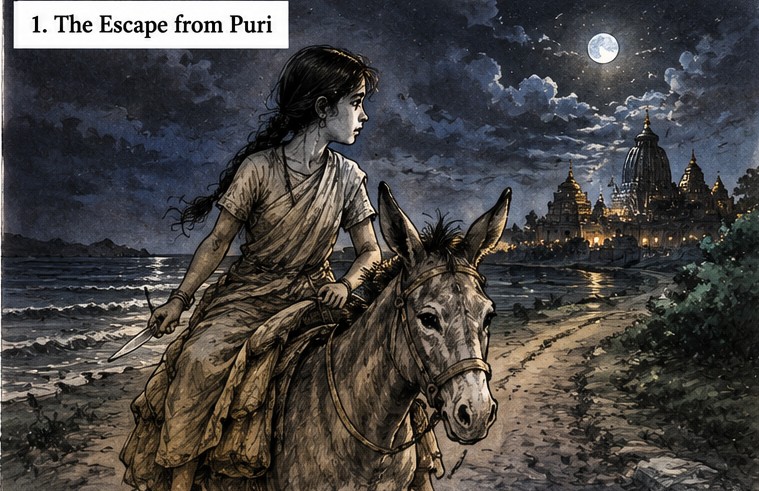
Her heart beat so loudly that she feared someone might hear it.
Every shadow seemed to hide a pursuer.
Every sound of rustling leaves made her glance behind.
Yet she continued forward.
For the first time in her life, she was making her own decision.
The temple town slowly disappeared into the darkness.
The towering spire of Lord Jagannath’s temple became smaller and smaller until it vanished entirely.
Madhabi felt a strange mixture of fear and relief.
She had escaped.
But where would she go now?
She had no relatives outside Puri.
No money.
No shelter.
No knowledge of the world beyond her village.
The mule carried her slowly along the coastal road.
Hours passed.
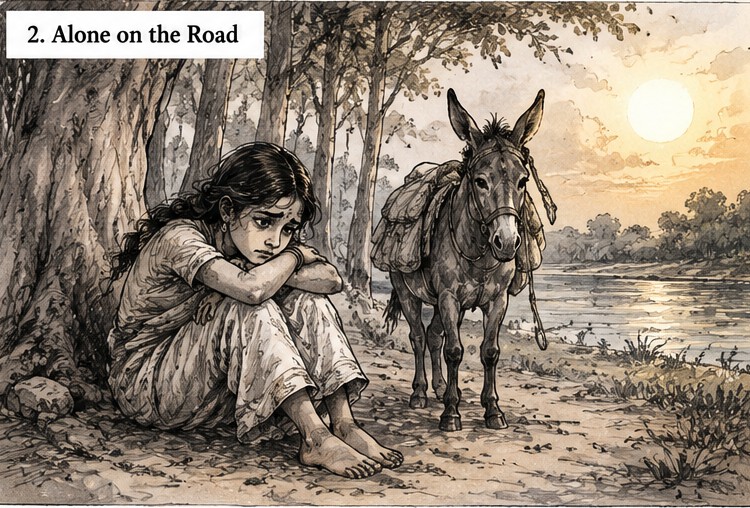
Near dawn she reached a grove of casuarina trees close to the sea.
Exhausted, she tied the mule to a tree and sat beneath its shade.
The cool morning breeze touched her face.
For the first time since leaving Puri, tears flowed freely.
She thought of her mother.
Kamala had never wished for the marriage.
Perhaps she was weeping now.
Perhaps she was being blamed for the disappearance.
The thought pained Madhabi deeply.
Yet she knew she could never return.
Returning meant surrender.
Returning meant becoming a prisoner for life.
As the first rays of sunlight appeared over the ocean, she wiped away her tears and stood up.
She would move forward.
Whatever fate awaited her.
By midday hunger began to trouble her.
She had brought only a small packet of flattened rice from the kitchen.
Soon it was finished.
The mule was thirsty.
She herself was thirsty.
For several hours she wandered along village paths searching for water.
Finally she reached a small settlement.
The villagers stared curiously at the young girl travelling alone.
Questions immediately followed.
“Where are your parents?”
“Where are you going?”
“Why are you alone?”
Madhabi had already learned her first lesson.
The truth was dangerous.
She quickly invented a story.
“My uncle lives near Cuttack,” she said.
“I am travelling to join him.”
The villagers accepted her explanation.
An old woman offered her water and boiled rice.
Madhabi thanked her with folded hands.
That evening she continued her journey.
For the next several days she travelled cautiously.
Sometimes she rode the mule.
Sometimes she walked beside it.
She avoided large villages and busy roads.
At night she slept beneath trees or in abandoned sheds.
Several times she narrowly escaped trouble.
One evening two drunken men attempted to stop her on a lonely road.
Madhabi immediately drew the small knife she carried.
Though frightened, she stared directly into their eyes.
The unexpected courage of the young girl surprised them.
Laughing mockingly, they eventually left.
Only after they disappeared did she realize how badly her hands were shaking.
The British Raj governed the land, but for a lone girl there was little protection.
Every day required vigilance.
Every night required courage.
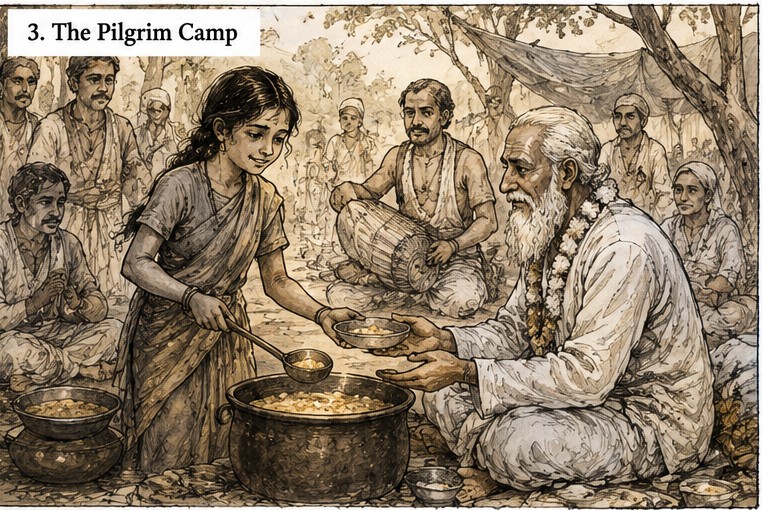
A week later she reached a large pilgrim camp near a river crossing.
Smoke rose from dozens of cooking fires.
Men and women sat in groups singing devotional songs.
The rhythmic chanting filled the evening air.
“Hare Krishna, Hare Krishna,
Krishna Krishna, Hare Hare.”
Madhabi stopped and listened.
The voices sounded peaceful.
Unlike the people she had encountered on the road, these pilgrims seemed kind and disciplined.
At the center of the gathering sat an elderly Vaishnava monk.
His name was Bhakti Charan Das.
His white beard flowed down to his chest.
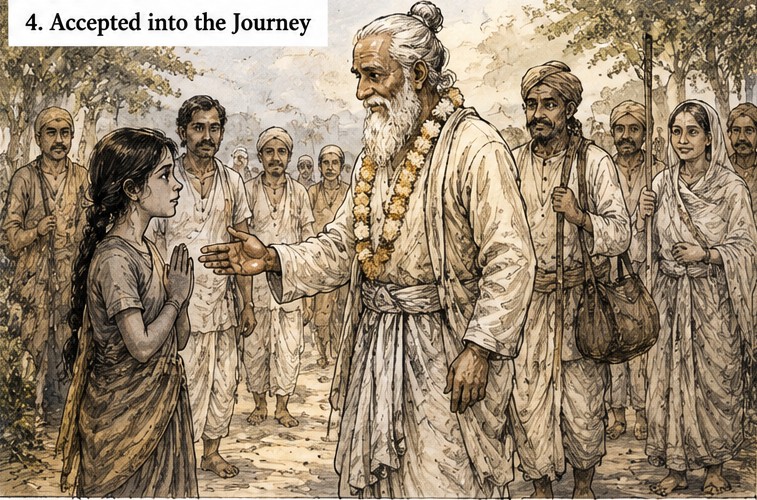
Tulsi beads hung around his neck.
His face radiated serenity.
Madhabi cautiously approached.
The monk looked at her with gentle eyes.
“Child, where are your family members?”
Again she hesitated.
Then she answered carefully.
“They are no longer with me.”
The monk sensed pain behind her words.
He did not question further.
Instead he offered her food.
For the first time in many days she ate until her hunger disappeared.
That night she slept peacefully among the pilgrims.
The following morning she learned that the group belonged to the Gaudiya Vaishnava tradition.
There were nearly forty devotees.
They travelled together from place to place, singing bhajans and visiting sacred sites.
Their next destination was Calcutta.
The city seemed unimaginably distant.
To Madhabi it sounded like another world.
She listened as devotees discussed their journey.
Some planned to walk.
Others carried supplies.
Several elderly women prepared meals.
Observing them carefully, Madhabi noticed that they needed help.
Gathering her courage, she approached Bhakti Charan Das.
“May I travel with your group?” she asked.
The monk studied her face.
“You are very young.”
“I can work.”
“What work can you do?”
“I can cook.”
The monk smiled gently.
“We shall see.”
That afternoon preparations began for the evening meal.
The women struggled to cook for such a large gathering.
Madhabi immediately joined them.
She cleaned vegetables.
Washed utensils.
Collected firewood.
Prepared rice.
Helped make dal.
Worked tirelessly without complaint.
The older women watched with surprise.
By sunset the meal was ready.
Everyone ate with satisfaction.
One elderly devotee laughed.
“This little girl works harder than three grown women.”
Others agreed.
The next morning Bhakti Charan Das called her.
“You may travel with us.”
Madhabi’s eyes filled with gratitude.
The monk continued.
“From today, you are under our protection.”
For the first time since fleeing Puri, she felt safe.
The long road to Calcutta awaited them.
It would take many weeks.
There would be rivers to cross, forests to pass, storms to endure, and countless miles to walk.
Madhabi did not know it then.
But among these wandering devotees she would learn the first lessons that would transform a frightened child into an extraordinary woman.
The journey had only begun.
( to be continued)