

THE GIRL WHO CHOSE THE HORIZON
A Historical Novel
By Lokanath Mishra
Chapter One
The Price of a Daughter
Puri, Odisha 1931
The sea roared endlessly beyond the ancient town of Puri. Every morning, waves from the Bay of Bengal crashed against the shore as if narrating stories of forgotten generations. Pilgrims arrived in thousands to seek blessings from Lord Jagannath. Priests chanted sacred hymns, conch shells echoed through the narrow streets, and the towering temple flag fluttered proudly in the wind.
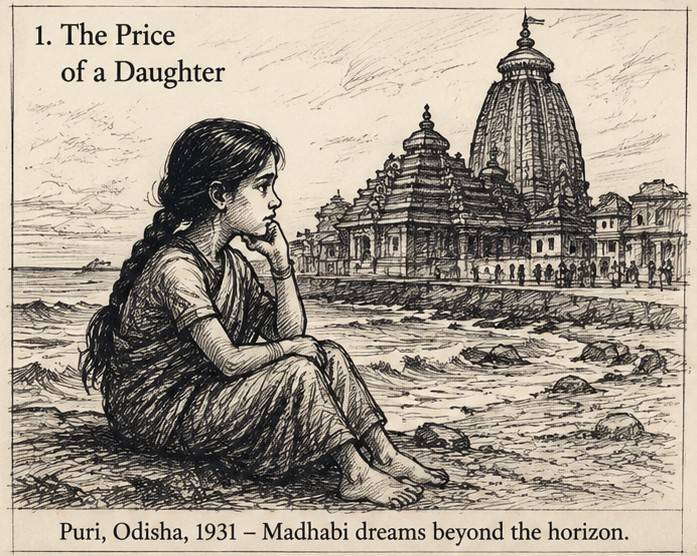
Yet behind the sacred atmosphere lay another reality—a society burdened by poverty, rigid customs, and unquestioned traditions.
In a small thatched house near the outskirts of Puri lived a twelve-year-old girl named Madhabi.
She was slender and dark-eyed, with an intelligence far beyond her years. While other girls spent their days playing games or helping their mothers, Madhabi often sat alone beside the sea, gazing at distant ships disappearing into the horizon.
She dreamed of seeing the world beyond Puri.
She dreamed of learning to read books and understand the mysteries hidden inside them.
But dreams were luxuries reserved for the fortunate.
Her father, Raghunath Das, was a poor man crushed by debts. Consecutive years of hardship had left him desperate. The British administration imposed taxes, local moneylenders demanded repayment, and survival itself had become a daily struggle.
One evening, Raghunath returned home with a strange look on his face.
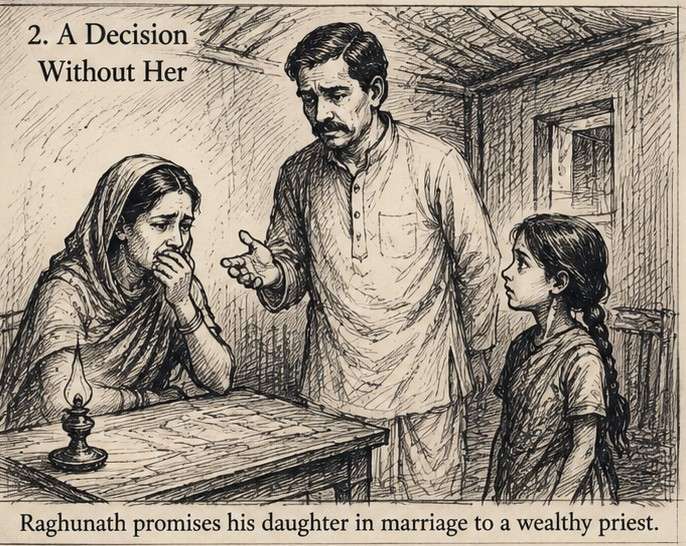
His wife, Kamala, sensed something was wrong.
“What has happened?” she asked softly.
Raghunath avoided her eyes.
“The debt is gone,” he replied.
Kamala’s face brightened for a moment.
“How?”
Raghunath remained silent.
Then he spoke words that struck her like thunder.
“I have promised Madhabi in marriage.”
Kamala froze.
“Marriage? She is only a child.”
“The arrangement is already made.”
“To whom?”
Raghunath lowered his head.
“Pandit Jagabandhu Mishra.”
Kamala gasped.
Everyone in the locality knew the man.
Pandit Jagabandhu was a wealthy temple priest nearly fifty years old. He had already lost two wives and sought another young bride to manage his household.
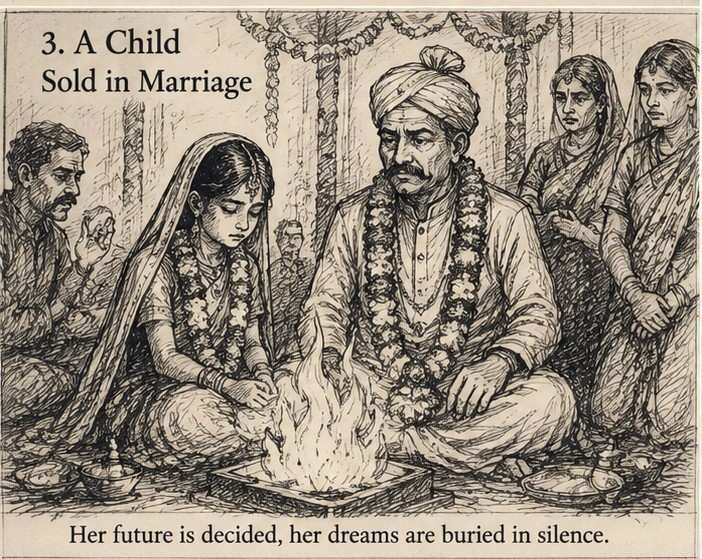
The agreement had been completed.
Money had changed hands.
For all practical purposes, Madhabi had been sold.
When Kamala informed her daughter, Madhabi could scarcely understand the meaning of the words.
At first she thought it was a misunderstanding.
Then she realized it was true.
Nobody had asked her opinion.
Nobody cared about her wishes.
Her future had been decided like the sale of cattle in a market.
That night she sat alone on the beach.
The moon reflected upon the waters.
Tears rolled down her cheeks.
“Why?” she whispered.
The sea offered no answer.
A few days later preparations for the wedding began.
Women sang traditional songs.
Relatives congratulated the family.
Neighbours praised Raghunath for securing such a “fortunate alliance.”
Only Madhabi remained silent.
Inside her heart, fear was growing.
The wedding took place according to custom.
The sacred fire burned.
Priests recited Sanskrit mantras.
Flowers covered the courtyard.
The child bride sat motionless beside a groom older than her father.
As the rituals ended, everyone celebrated.
Only one person mourned.
Madhabi.
That night she was taken to her husband’s house.
The old mansion stood in darkness.
Oil lamps flickered in the corridors.
Servants moved quietly through the building.
The atmosphere felt like a prison.
Madhabi sat alone in a room prepared for the newlyweds.
Outside, distant waves crashed against the shore.
Inside, silence filled the chamber.
She stared at the small window.
Beyond it lay freedom.
Beyond it lay uncertainty.
Beyond it lay danger.
But danger seemed preferable to captivity.
Hours passed.
When the household finally fell asleep, Madhabi acted.
She wrapped a shawl around herself.
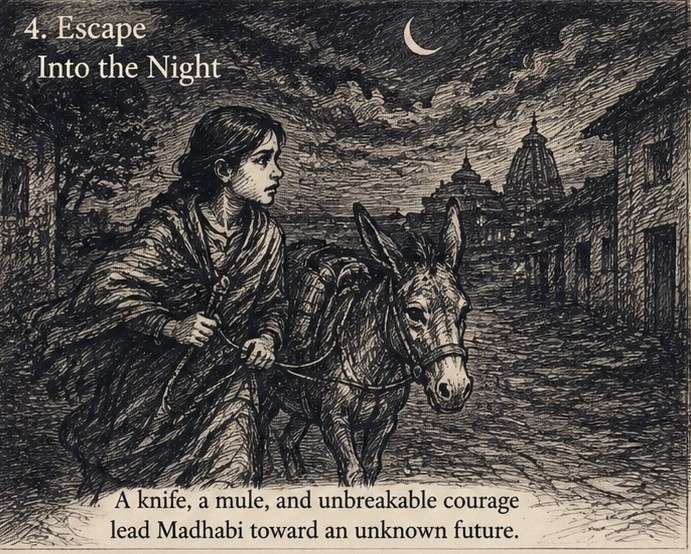
From the kitchen she quietly took a small knife.
In the stable she found a mule used for carrying supplies.
Her hands trembled.
Her heart pounded violently.
If she were caught, she would be dragged back.
Perhaps beaten.
Perhaps imprisoned.
But she no longer cared.
Without making a sound, she led the mule through the darkness.
The streets of Puri were deserted.
Clouds covered the moon.
The sea wind blew against her face.
At the edge of town she paused and looked back.
The temple spire stood in the distance.
The only home she had ever known was disappearing behind her.
A child of twelve years was riding toward an unknown future.
She did not know where she was going.
She possessed only a knife, a mule, and an unbreakable determination.
Yet that night, while the entire town slept, destiny began to change its course.
The frightened child bride vanished into the darkness.
And the woman who would one day become Dr. Madhabi Das was born.
( to be continued)
Pingback: THE GIRL WHO CHOSE THE HORIZON-6 - UniverseHeaven The Gates of Knowledge