

THE GIRL WHO CHOSE THE HORIZON
A Historical Novel By Lokanath Mishra
Chapter Four
The City of a Million Dreams
In 1931, Calcutta was the beating heart of eastern India.
To many, it was a city of opportunity.
To others, it was a city of struggle.
For twelve-year-old Madhabi, it was both.
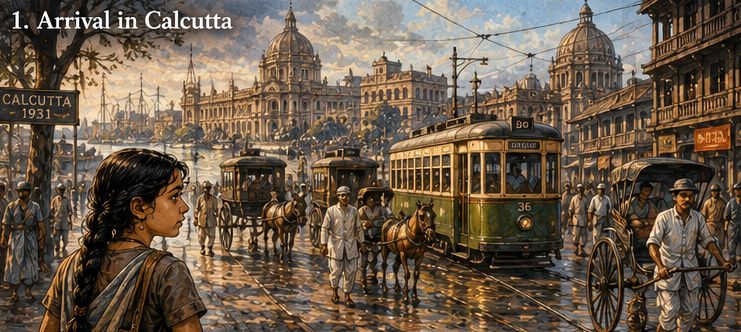
As the pilgrims entered the city, she was overwhelmed by the sights around her.
Huge buildings towered above crowded streets.
Trams rattled along iron tracks.
Motorcars shared the roads with horse carriages, hand-pulled rickshaws, and bullock carts.
Street vendors shouted in Bengali, Hindi, Odia, and English.
The air carried the smells of spices, coal smoke, and the nearby Hooghly River.
Madhabi had never imagined such a place.
Everything seemed enormous.
Everything seemed possible.
The Gaudiya devotees took shelter at a modest ashram in the northern part of the city.
For several weeks Madhabi remained there.
She continued cooking and assisting the elderly devotees.
But deep inside, she knew that the ashram could not be her permanent home.
One evening Bhakti Charan Das called her to his room.
The old monk sat beside an oil lamp reading a religious text.
He motioned for her to sit.
“You have travelled far, child.”
Madhabi nodded.
“You have courage.”
She remained silent.
The monk looked at her kindly.
“But courage alone is not enough. You must build a future.”
The words stirred something within her.
For years she had merely survived.
Now she began to think about living.
“What future can a girl like me have?” she asked.
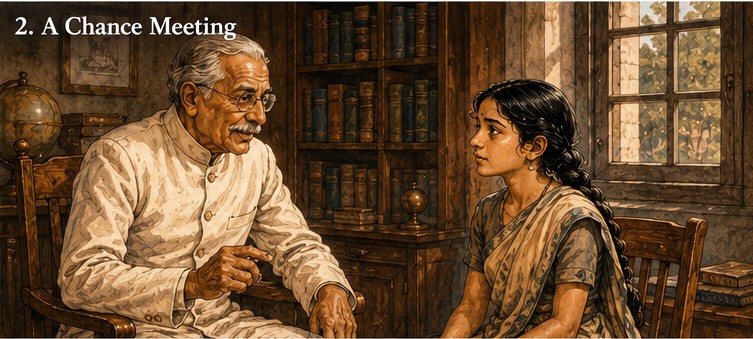
Bhakti Charan Das smiled.
“The future belongs to those who prepare for it.”
He pointed toward a stack of books.
“Education opens doors that courage alone cannot.”
That night Madhabi could not sleep.
Education.
The word echoed in her mind.
She had always longed to learn.
Yet fate had never given her the opportunity.
The next morning an unexpected visitor arrived at the ashram.
His name was Rai Bahadur Harish Chandra Sen.
He was one of Calcutta’s respected businessmen and philanthropists.
Although wealthy, he lived simply.
For many years he had supported orphanages, schools, and charitable institutions.
The sixty-year-old gentleman visited the ashram regularly and donated food and clothing.
As the devotees prepared lunch, Harish Chandra noticed a young girl efficiently organizing the kitchen.
She supervised cooking fires, distributed utensils, and ensured that everyone received food.
Her maturity surprised him.
Later he asked Bhakti Charan Das about her.
The monk briefly explained her circumstances without revealing details that might endanger her.
Harish Chandra listened thoughtfully.
“May I speak with her?” he asked.
A short while later Madhabi was invited to meet him.
She entered the room nervously.
The distinguished gentleman smiled warmly.
“What is your name?”
For a moment she hesitated.
Then she answered.
“Madhabi.”
It was one of the rare occasions she used her real name.
“Can you read?”
“A little.”
“Can you write?”
“Only a few words.”
Harish Chandra leaned forward.
“And if given the chance, would you like to study?”
Her eyes brightened instantly.
“More than anything.”
The sincerity in her voice impressed him.
Over the next several weeks he visited frequently.
Each time he spoke with Madhabi.
He discovered that she possessed an extraordinary memory.
She learned quickly.
Asked thoughtful questions.
Observed everything around her.
Most importantly, she had an intense hunger for knowledge.
Finally, one afternoon, he made a proposal.
“I would like to arrange your education.”
Madhabi stared at him in disbelief.
“You mean… school?”
“Yes.”
She felt tears forming in her eyes.
No one had ever offered her such a gift.
Not money.
Not jewelry.
Not comfort.
But something far more valuable.
A future.
With the blessings of Bhakti Charan Das, arrangements were made.
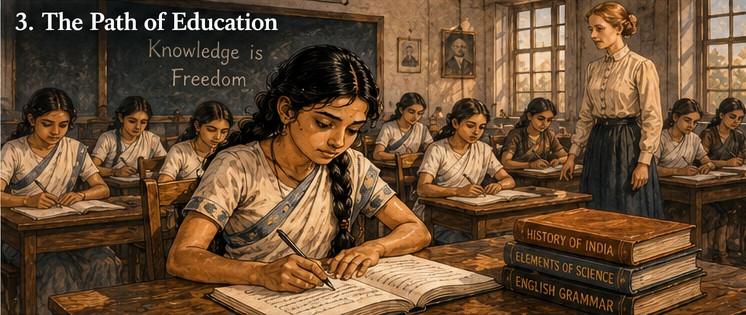
Madhabi moved into a girls’ boarding home supported by Harish Chandra’s charitable trust.
For the first time in her life she slept in a clean bed.
For the first time she possessed her own books.
For the first time she wore a school uniform.
The first day of school proved difficult.
Many students were younger than she was.
Most already knew far more than she did.
Some girls laughed at her imperfect Bengali.
Others mocked her rural background.
At night she cried quietly into her pillow.
The temptation to give up was strong.
Yet every time she thought of quitting, she remembered the wedding night in Puri.
She remembered the courage it had taken to escape.
Compared to that, studying was not difficult.
It simply required patience.
And so she worked.
She studied before sunrise.
She studied after sunset.
She copied lessons repeatedly until her fingers ached.
Within months her teachers noticed remarkable progress.
Within a year she had advanced beyond many classmates.
Books became her closest companions.
History fascinated her.
Science fascinated her even more.
The mysteries of the human body especially captured her imagination.
One day a teacher named Miss Eleanor Thompson, an Englishwoman employed at the school, conducted a science lesson.
She explained how diseases spread.
She described the work of physicians.
She spoke about hospitals where doctors saved lives.
The lecture left a profound impression on Madhabi.
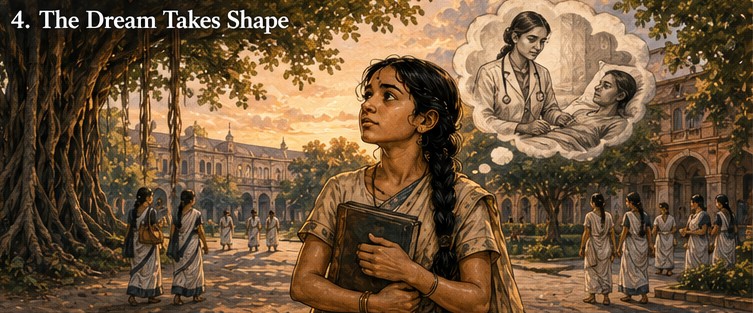
That evening she sat alone beneath a banyan tree in the school courtyard.
She remembered Sarojini Dasi’s fever during the pilgrimage.
She remembered villagers suffering from illness.
She remembered women dying during childbirth because medical help was unavailable.
A thought slowly emerged.
Perhaps her purpose was not merely to survive.
Perhaps her purpose was to heal.
For the first time, a dream took shape.
She wanted to become a doctor.
The dream seemed impossible.
A poor village girl.
A runaway child bride.
A girl with no family support.
How could such a person ever become a physician?
Yet the impossible no longer frightened her.
After all, she had already done something many believed impossible.
She had chosen freedom.
And now she was ready to choose her future.
Far away in Puri, the sea still roared against the shore.
But the frightened child who had fled into the darkness no longer existed.
In her place stood a determined young student whose eyes were fixed upon a distant goal.
The road ahead would be long.
There would be obstacles.
Failures.
Sacrifices.
Yet for the first time in her life, Madhabi knew exactly where she wanted to go.
She would become a doctor.
No matter how difficult the journey.