

THE GIRL WHO CHOSE THE HORIZON
A Historical Novel, By Lokanath Mishra
Chapter Eight
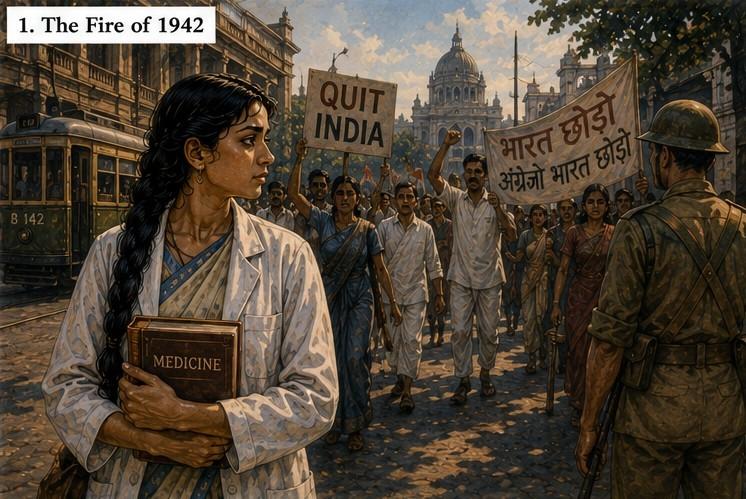
The Fire of 1942
By 1942, the world was at war.
Although the battlefields lay far beyond India, the effects of the conflict were felt everywhere.
Calcutta had become a city of tension and uncertainty.
Military vehicles moved through the streets.
British soldiers were visible at railway stations and ports.
Air-raid sirens were occasionally tested.
People spoke in hushed voices about the progress of the war.
At the same time, another struggle was unfolding within India.
The demand for independence had reached a critical stage.
When the Quit India Movement was launched in August 1942, protests spread across the country.
Students participated in demonstrations.
Workers organized strikes.
Thousands were arrested.
The atmosphere was charged with hope, anger, and determination.
Madhabi, now a senior medical student, observed these events from a unique position.
Her primary responsibility remained her studies and clinical training.
Yet she could not remain entirely untouched by the changing times.
Every day she witnessed the consequences of political unrest.
Injured protesters were brought to hospitals.
Police officers wounded during clashes also arrived for treatment.
Doctors cared for both without discrimination.
For Madhabi, this reinforced an important lesson.
The duty of a physician was to heal, regardless of a person’s beliefs or background.
The hospital itself had become a world of constant activity.
Patients filled every ward.
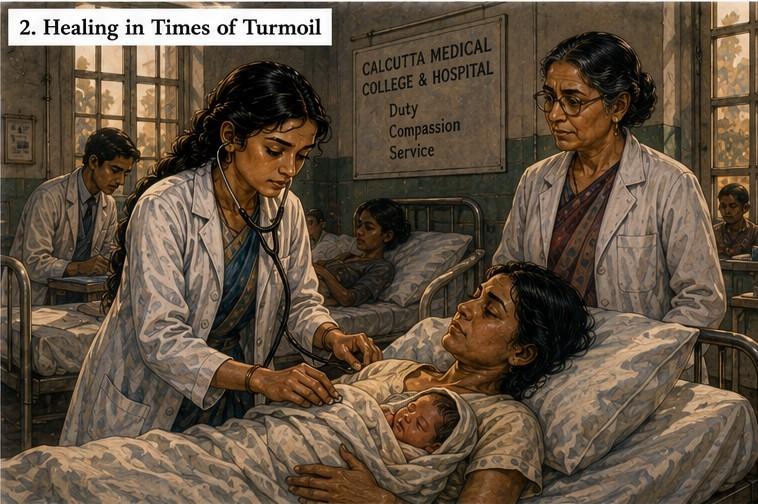
Doctors worked long hours.
Medical students assisted whenever needed.
The demands of wartime placed enormous pressure on healthcare institutions.
Madhabi often remained in the hospital until late at night.
Sometimes she slept only a few hours before returning to work.
Yet she rarely complained.
She understood that every patient represented a human life entrusted to their care.
One evening she and Dr. Sarala Mukherjee completed a difficult obstetric procedure.
The mother survived.
The newborn child survived.
As the exhausted family expressed their gratitude, Madhabi experienced a profound sense of fulfillment.
Moments like these reminded her why she had chosen medicine.
Saving a life brought a satisfaction unlike any other achievement.
Meanwhile, her final examinations approached.
The examinations would determine whether she could graduate and begin professional practice.
Failure would mean delay.
Success would open the door to her future.
The pressure was immense.
Students filled libraries from morning until midnight.
Lecture notes covered every desk.
Anxiety became a constant companion.
Yet Madhabi maintained her discipline.
Years of hardship had taught her perseverance.
When examination day arrived, she faced it with calm determination.
The written papers were difficult.
The practical examinations even more so.
External examiners questioned students rigorously.
Mistakes were not easily forgiven.
One examiner challenged her repeatedly on complex medical cases.
For nearly half an hour she answered questions.
When the session ended, she felt mentally exhausted.
Weeks later the results were announced.
Once again, Madhabi’s hard work was rewarded.
She passed with distinction.
Her professors congratulated her warmly.
Dr. Sarala Mukherjee smiled proudly.
“You have earned this success.”
But before receiving her full qualification, she had to complete internship training.
The internship proved to be one of the most demanding periods of her life.
For the first time she carried significant responsibility.
She examined patients.
Assisted surgeries.
Monitored recovery.
Responded to emergencies.
The transition from student to physician-in-training was both exciting and intimidating.
Every decision mattered.
Every mistake carried consequences.
Then came 1943.
And with it came tragedy.
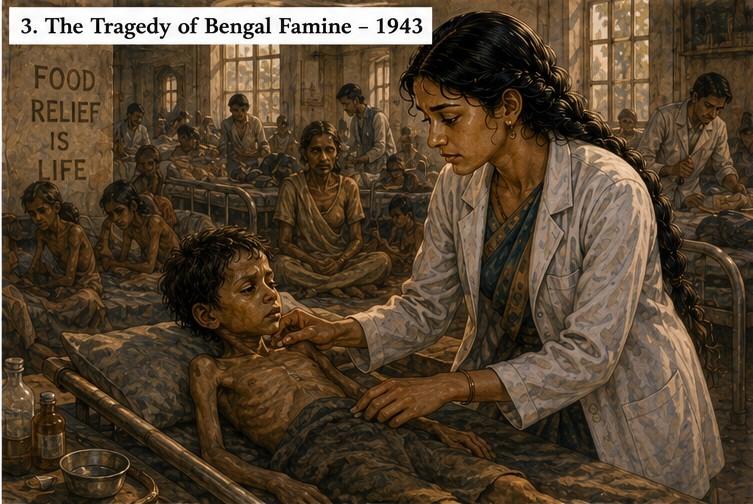
The Bengal Famine.
At first, reports of food shortages appeared in newspapers.
Then the shortages worsened.
Soon thousands of starving people began arriving in Calcutta.
Entire families migrated from villages in search of food.
Many never found it.
The city’s streets became scenes of unimaginable suffering.
Emaciated men, women, and children lay on sidewalks.
Some begged weakly for food.
Others lacked the strength even to speak.
Hospitals quickly became overwhelmed.
Doctors worked beyond their limits.
Medical supplies became scarce.
Beds were insufficient.
Patients filled corridors and verandas.
Madhabi could never forget those months.
Each day brought new scenes of heartbreak.
One morning she treated a young mother carrying a severely malnourished infant.
The child was little more than skin and bones.
Despite every effort, the infant died later that day.
The mother sat silently beside the small body.
No tears remained.
Even grief seemed exhausted.
That night Madhabi could not sleep.
She walked alone through the hospital grounds.
The suffering she had witnessed haunted her.
She questioned whether medicine alone could solve such immense human problems.
The next day she shared her concerns with Dr. Mukherjee.
The senior physician listened patiently.
Then she said,
“We cannot heal the entire world. But we can heal the person standing before us.”
The words remained with Madhabi for the rest of her life.
She realized that true service begins with individual acts of compassion.
No doctor could eliminate every injustice.
No physician could prevent every tragedy.
Yet every life saved mattered.
Every patient helped mattered.
Every act of kindness mattered.
As the famine gradually subsided, the scars remained visible everywhere.
Entire communities had been devastated.
Countless families had been shattered.
The experience transformed Madhabi profoundly.
She emerged from those years with a deeper understanding of suffering and resilience.
Medicine was no longer merely a profession.
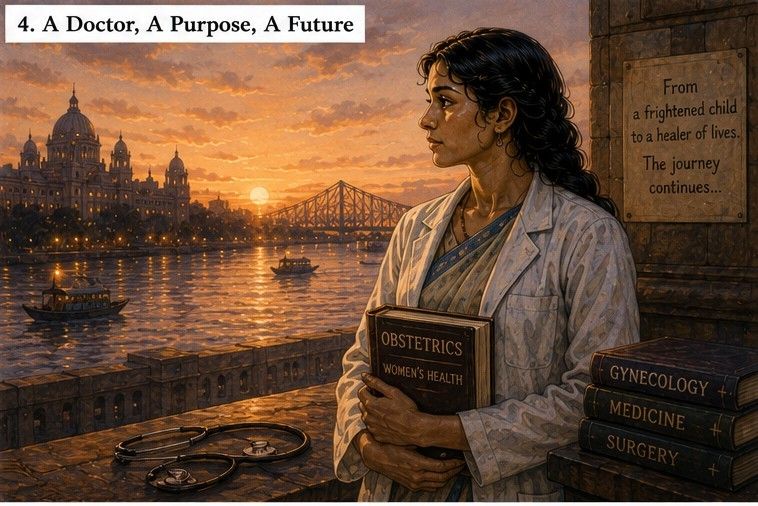
It had become a calling.
By the end of 1944, she completed her internship with distinction.
Her professors praised her clinical judgment.
Patients appreciated her compassion.
Colleagues respected her dedication.
One evening she stood on the banks of the Hooghly River, watching the sun set beyond the city.
The water shimmered in shades of gold and crimson.
She reflected upon the path she had travelled.
From a frightened child bride in Puri…
To a runaway pilgrim…
To a student…
To a doctor.
The transformation seemed almost miraculous.
Yet she knew that her journey was still unfinished.
Ahead lay specialization.
Advanced training.
New responsibilities.
And somewhere in the future awaited another person whose life would become intertwined with her own.
A fellow physician.
A man who would respect her not as a possession, but as an equal.
The next chapter of her life was about to begin.
And destiny was quietly preparing their meeting.