
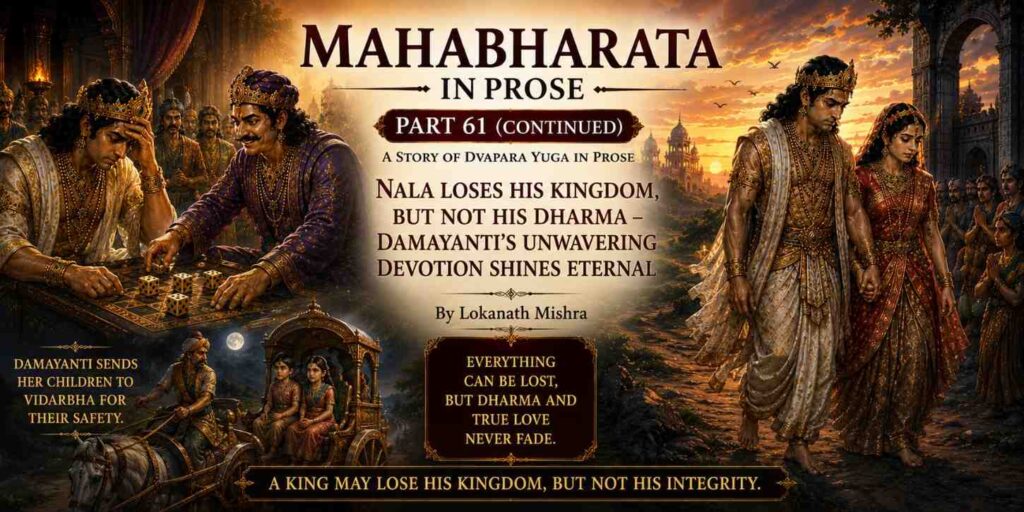
A Story of Dvapara Yuga in Prose
by Lokanath Mishra
Mahabharata in Prose – Part 61 (continued)
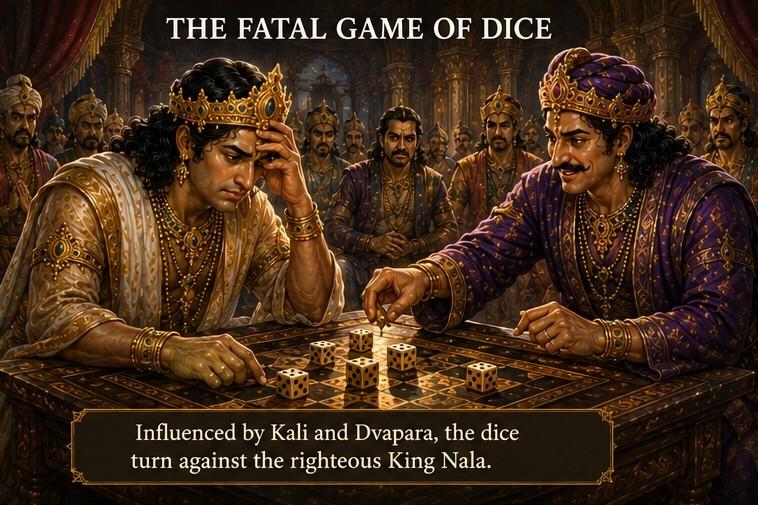
As the game of dice continued, an air of anxiety spread throughout the kingdom of Nishadha.
The royal court, once filled with discussions of justice and prosperity, had become the scene of endless gambling. Day after day, King Nala sat before the dice board, while Pushkara challenged him again and again.
Each throw of the dice seemed to favor Pushkara.
No one knew that Kali, having entered Nala’s mind, and his companion Dvapara, dwelling within the dice, had turned the game into a contest of deception.
The ministers watched helplessly.
The elders remained silent with grief.
And the people prayed that their beloved king would awaken from this terrible spell.
The Voice of Wisdom
Among Nala’s ministers was an aged counselor who had served both his father and grandfather.
Unable to bear the king’s downfall any longer, he approached the throne with folded hands.
“Your Majesty,” he said respectfully, “forgive your servant’s boldness. A king’s greatest treasure is not gold but wisdom. Wealth lost today may be regained tomorrow, but once judgment is clouded, an entire kingdom suffers.”
Nala looked at the old minister.
For a brief moment, his heart was moved.
The words echoed within him.
Yet Kali’s influence quickly stirred restlessness in his mind.
“The game is not yet over,” Nala replied. “Fortune changes with every throw of the dice.”
The minister sighed deeply.
“My lord, fortune indeed changes—but wisdom should not.”
Seeing that the king would not listen, he stepped back with tears in his eyes.
⸻
Damayanti’s Courage
Queen Damayanti refused to remain a silent spectator.
She entered the royal assembly once more.
The courtiers respectfully made way for her.
Standing beside Nala, she spoke with gentle firmness.
“My lord, throughout our lives we have honored dharma above all else. Do not allow this game to rob you of the peace you have built through years of righteous rule.”
Nala lowered his eyes.
He loved Damayanti deeply.
Every word she spoke arose from affection, not criticism.
Yet his mind remained trapped between reason and irresistible compulsion.
“Only a little longer,” he answered softly.
“I cannot withdraw now.”
Damayanti understood that something beyond ordinary desire had overtaken him.
She silently prayed for divine intervention.
The Kingdom Begins to Crumble
The gambling continued for many more days.
First went the royal treasury.
Then the elephants.
Then the horses.
Next, fertile lands and prosperous villages.
The wealth accumulated over generations disappeared with the fall of the dice.
The citizens of Nishadha gathered outside the palace.
They whispered among themselves.
“Our king has never wronged anyone.”
“Why has such misfortune befallen him?”
“Can no one stop this madness?”
Yet none dared interfere with the king’s decision.
They could only watch with sorrow.
⸻
Damayanti’s Wise Decision
Realizing that the danger was growing greater each day, Damayanti made a difficult decision.
She summoned her trusted charioteer, Varshneya.
When he arrived, she spoke quietly.
“Faithful friend, I have an important duty for you.”
Varshneya bowed.
“My Queen, command me.”
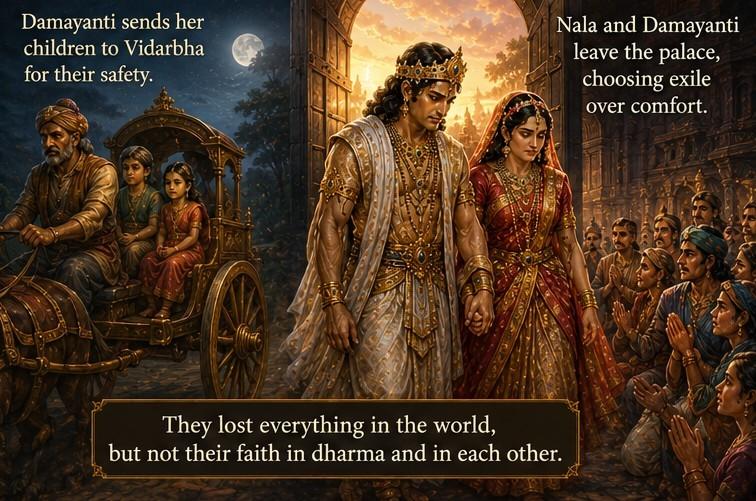
Damayanti looked toward her two young children—Prince Indrasena and Princess Indrasena.
Her voice trembled slightly.
“Take the children at once to my father’s kingdom in Vidarbha. Tell King Bhima nothing that would dishonor my husband. Simply say that difficult times have come.”
Varshneya was shocked.
“My Queen… are matters truly so serious?”
She nodded.
“A mother must think first of her children’s safety.”
With tears in his eyes, the loyal charioteer accepted the command.
That very night, before the kingdom realized what was happening, he departed with the prince and princess toward Vidarbha.
Damayanti watched the chariot disappear into the darkness.
Though her heart ached with separation, she found comfort in knowing that her children would be safe.
The Final Wager
The next morning, Pushkara entered the assembly with confidence.
Looking at Nala, he smiled coldly.
“My cousin, you have lost your wealth, your armies, your elephants, your horses, and your treasures.”
He paused deliberately.
“What remains?”
The hall fell silent.
Nala answered with quiet dignity.
“I still possess my kingdom.”
Pushkara’s eyes gleamed.
“Then let the kingdom be our next wager.”
The ministers gasped.
Some fell at the king’s feet.
“Your Majesty!”
“Do not do this!”
“The kingdom belongs not only to the king but also to the people!”
But Nala’s judgment remained clouded.
Slowly, he nodded.
“So be it.”
The dice were cast.
The assembly watched in breathless silence.
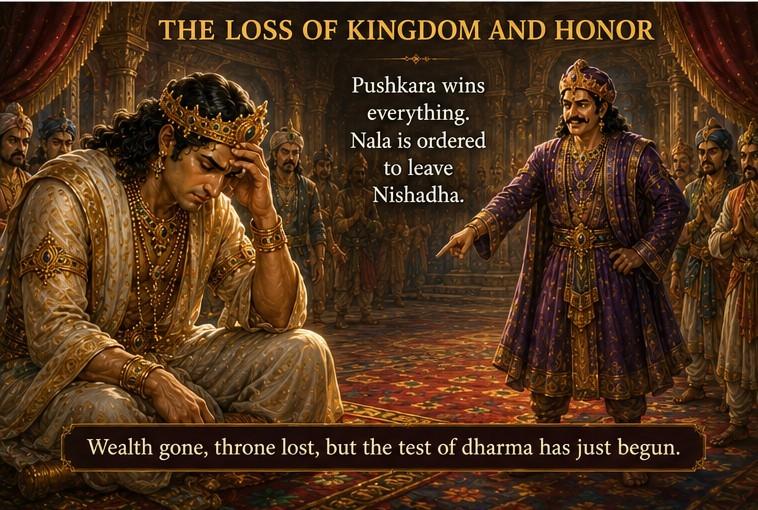
Pushkara won.
⸻
The Fall of a King
For several moments, no one spoke.
The impossible had happened.
King Nala, once the most prosperous ruler of Nishadha, had lost everything.
Pushkara rose from his seat.
“From this day onward,” he declared, “I am the King of Nishadha.”
His words echoed through the hall.
Then, turning toward Nala, he spoke harshly.
“You possess nothing now.”
“Leave this kingdom at once.”
“If anyone offers shelter, food, or assistance to the fallen king, that person shall be punished.”
The proclamation spread quickly throughout the city.
The citizens wept openly.
Many wished to help their beloved king.
But fear of Pushkara’s punishment restrained them.
⸻
The Departure
Nala removed his royal ornaments.
One by one, he laid aside his crown, his jewels, and his weapons.
At last, he stood dressed in simple garments.
Damayanti quietly stepped beside him.
“I shall go wherever my husband goes.”
Nala looked at her with deep sorrow.
“You are the daughter of a mighty king.”
“You need not share my suffering.”
Damayanti replied without hesitation,
“When I accepted you as my husband before gods and kings, I vowed to remain beside you in joy and sorrow alike.”
“No hardship can separate us.”
Nala’s eyes filled with tears.
Together, hand in hand, they walked out of the palace they had once ruled.
No royal procession accompanied them.
No soldiers marched before them.
Only silence followed their footsteps.
From behind closed doors, the people watched with tearful eyes.
Many bowed secretly as their beloved king and queen passed by.
They dared not speak.
But their hearts were filled with gratitude and sorrow.
Thus, the rulers of Nishadha entered the forest with nothing except their faith in each other.
The Sage’s Lesson
Sage Brihadashva looked compassionately at Yudhishthira.
“You see now, O son of Dharma, that even the noblest king may lose his kingdom through the power of fate and a single weakness.”
Yudhishthira nodded slowly.
“But unlike many men,” the sage continued, “Nala did not abandon righteousness after losing everything. His greatest trials had only begun.”
The Pandavas sat silently around the sacred fire.
Bhima clenched his fists in anger at Pushkara’s cruelty.
Draupadi wiped away a tear, deeply moved by Damayanti’s unwavering devotion.
Arjuna reflected upon the mysterious workings of destiny.
The night grew deeper.
Yet in the hearts of the Pandavas, the story of Nala had already begun to kindle a new hope—that suffering, however severe, need not be the end of one’s journey.
⸻
Thus, King Nala lost his kingdom, his wealth, and his throne, but he did not lose the one treasure that fate could never steal—his adherence to dharma. And beside him stood Queen Damayanti, proving that true love remains steadfast even when fortune fades.
(Continued in Part 62…)