
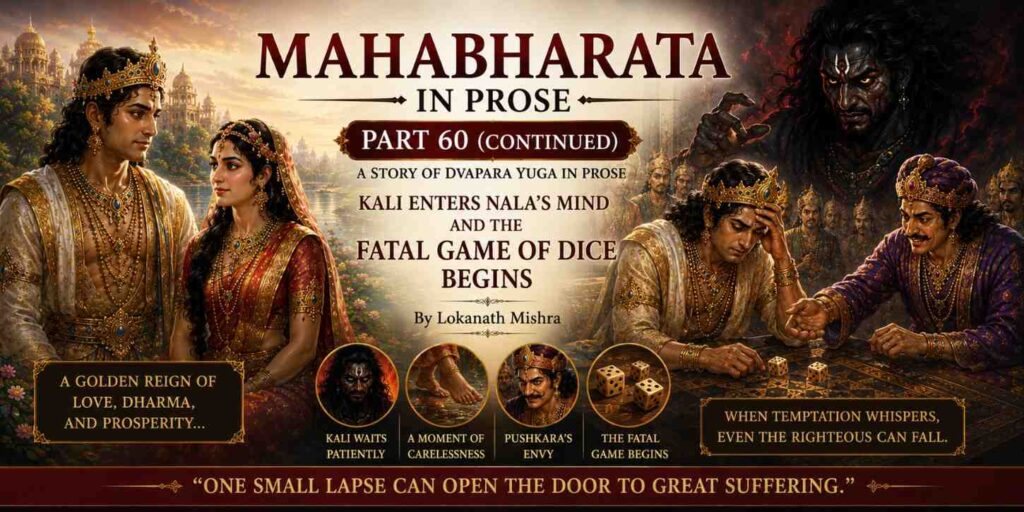
A Story of Dvapara Yuga in Prose
by Lokanath Mishra
Mahabharata in Prose – Part 60 (continued)
Years passed peacefully in the kingdom of Nishadha.
King Nala and Queen Damayanti ruled with wisdom, compassion, and unwavering devotion to dharma. Their reign became a model for other kingdoms, and their fame spread throughout Aryavarta.
The people lived without fear.
The fields yielded abundant harvests.
The rivers flowed full, and trade flourished along every road.
Justice was administered fairly, and no one left the royal court unheard.
Every morning, King Nala would rise before sunrise, offer prayers to the Supreme Lord, and then attend to the affairs of his kingdom. Damayanti stood beside him in every duty, advising him with wisdom and kindness. The people often said that Nishadha prospered because its king and queen ruled not with pride, but with love.
In time, they were blessed with two children—a son named Indrasena and a daughter named Indrasena. Their palace was filled with happiness, and it seemed that fortune would remain with them forever.
But destiny rarely allows worldly happiness to remain undisturbed.
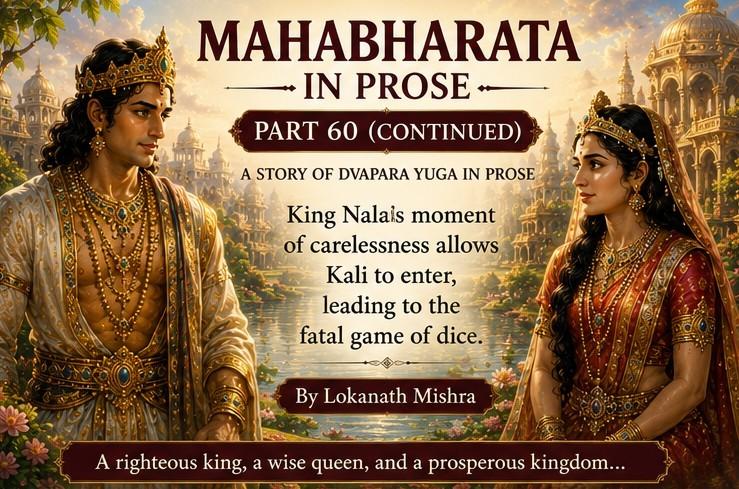
Kali Waits Patiently
Far away, hidden from mortal sight, Kali had not forgotten his humiliation.
Ever since Damayanti had chosen Nala over the gods and over him, he had nourished a deep resentment.
Yet Kali knew that he could not enter the heart of a righteous man without cause.
“Dharma protects Nala,” he said to Dvapara.
“As long as he remains vigilant in his conduct, I have no power over him.”
Dvapara asked,
“Then what will you do?”
Kali answered calmly,
“I shall wait.”
Years passed.
Kali watched every action of King Nala.
He observed his prayers, his judgments, his generosity, and his discipline.
Again and again he found no fault.
But patience is one of the greatest weapons of evil.
Kali was willing to wait for years if necessary.
⸻
A Moment of Carelessness
One evening, after returning from the royal gardens, Nala prepared to perform his evening prayers.
As was his daily custom, he washed his hands and feet before offering worship.
But on that day, his mind was occupied with matters of the kingdom.
Distracted by urgent concerns, he unknowingly failed to cleanse one of his feet completely before beginning his sacred rites.
It was a small lapse.
So small that no human observer would have noticed it.
But for Kali, it was enough.
“The opportunity has come,” he declared.
In that very instant, Kali entered Nala’s mind.
Not to destroy his goodness entirely.
Not to erase his wisdom.
But to cloud his judgment ever so slightly.
The change was invisible.
Even Nala himself remained unaware.
Yet from that day onward, subtle restlessness began to arise within him.
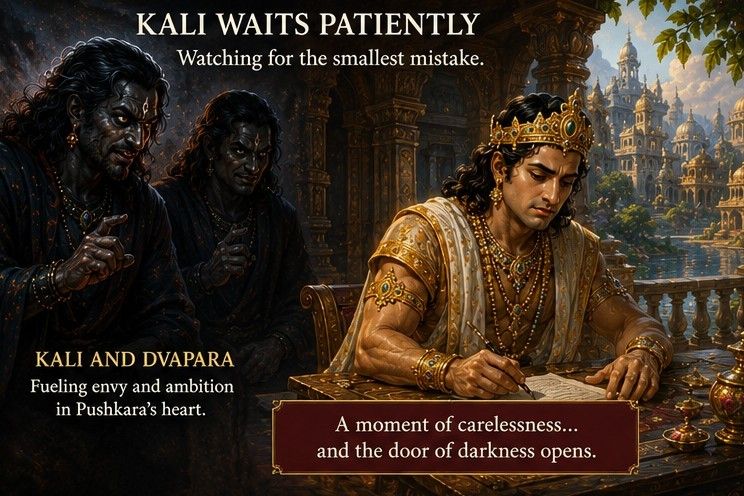
Pushkara’s Envy
Nala had a cousin named Pushkara.
Though treated kindly by the king, Pushkara secretly envied Nala’s prosperity.
He often compared his own life with that of the beloved ruler of Nishadha.
“Everything belongs to Nala,” he thought bitterly.
“The kingdom… the wealth… the love of the people… and even Damayanti.”
Kali perceived the jealousy growing in Pushkara’s heart.
He approached him unseen and whispered thoughts of greed and ambition.
“Why should Nala possess everything?”
“You are equally worthy.”
“Challenge him.”
Slowly, envy grew into desire.
And desire ripened into ambition.
⸻
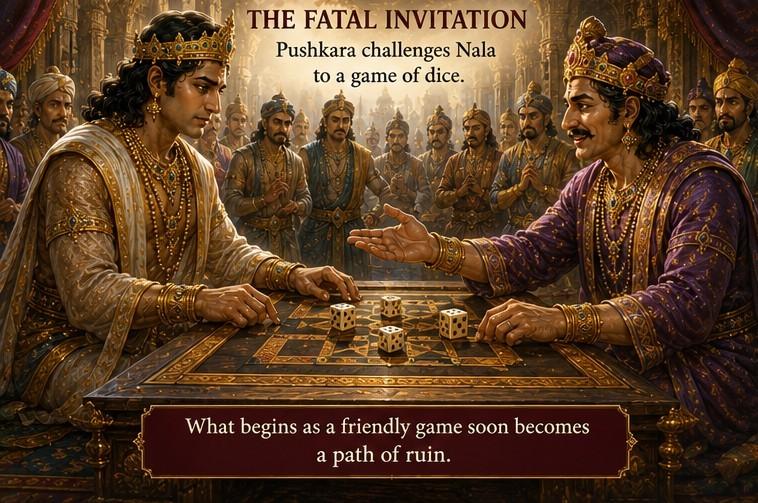
The Fatal Invitation
One afternoon, Pushkara arrived at the royal palace.
Nala welcomed him warmly.
“My brother,” he said, embracing him, “it has been long since your last visit.”
Pushkara smiled politely, concealing his true intentions.
After spending some time in conversation, he casually suggested,
“It has been many years since we played a friendly game of dice.”
Nala hesitated.
He knew that excessive attachment to gambling often led to ruin.
Many kings had lost both wealth and honor through such games.
Smiling gently, he replied,
“Let us spend our time in better pursuits.”
But Kali had already begun clouding his judgment.
Pushkara persisted.
“Surely a great king fears no friendly game.”
The words were simple.
Yet they struck Nala’s pride.
After a brief silence, he answered,
“Very well.”
Thus began a game that would alter the course of many lives.
The Dice Begin to Roll
The royal assembly gathered to witness the contest.
Ministers, nobles, and learned elders took their seats.
At first, the stakes were small.
A few ornaments.
Some fine horses.
Golden vessels.
Nala lost.
He smiled.
“It is only chance.”
They played again.
This time the wager was larger.
Again Nala lost.
Pushkara appeared surprised, but inwardly he rejoiced.
The dice, influenced by Kali and Dvapara, never seemed to favor the righteous king.
Hour after hour the game continued.
Nala’s ministers exchanged worried glances.
One elderly counselor approached respectfully.
“Your Majesty,” he said softly, “fortune is turning against you. It would be wise to stop now.”
But Nala, his judgment gradually clouded, replied,
“A king does not abandon a game halfway.”
The ministers withdrew with heavy hearts.
⸻
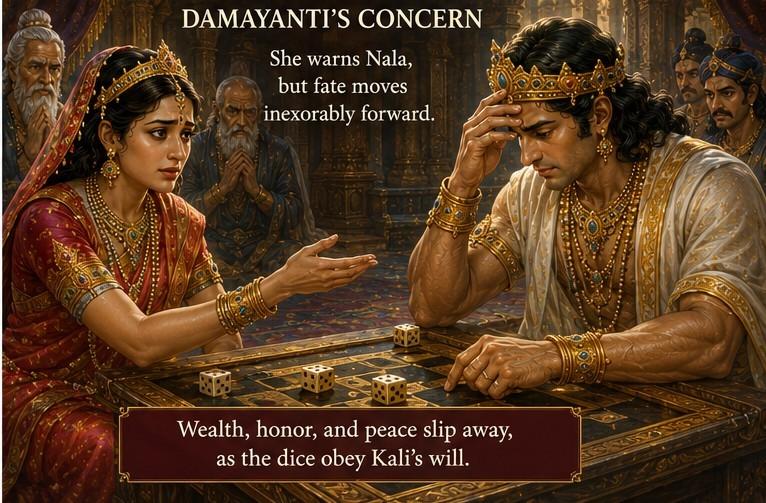
Damayanti’s Concern
News of the gambling soon reached Queen Damayanti.
She hurried to the assembly hall.
Standing beside her husband, she spoke quietly,
“My lord, this game no longer brings honor. Please end it.”
Nala looked at her.
For a brief moment, his old clarity seemed to return.
But Kali’s influence again disturbed his mind.
“Only one more game,” he said.
Damayanti’s heart sank.
She had never before seen such determination in her husband over something so dangerous.
Day after day the gambling continued.
The treasury diminished.
The royal stables became empty.
Jewels, elephants, chariots, and fertile lands—all passed into Pushkara’s possession.
The citizens of Nishadha grew anxious.
Never had they imagined that their wise and righteous king could become so deeply entangled in a game of dice.
⸻
The Lesson for Yudhishthira
At this point, Sage Brihadashva paused.
Looking directly at Yudhishthira, he asked gently,
“O King, do you now understand why I have chosen to tell you this story?”
Yudhishthira lowered his head.
“I do, revered sage.”
“King Nala was righteous, noble, and beloved by his people.”
“Yet even he fell into the snare of dice.”
The sage nodded.
“Exactly.”
“No man should imagine that virtue alone protects him from every weakness.”
“The truly wise remain vigilant throughout life.”
Yudhishthira reflected deeply.
The sorrow he had long carried over his own game of dice began to lighten.
He realized that he was not alone.
Even another great king, equally devoted to dharma, had suffered a similar fate.
Yet Brihadashva had not told this story to reopen old wounds.
He told it to inspire hope.
For if Nala could recover from ruin, perhaps the sons of Pandu could as well.
The sacred fire burned steadily as night descended upon the forest.
The Pandavas sat in thoughtful silence.
They knew that the darkest chapters of King Nala’s life were still ahead.
But they also sensed that somewhere beyond those trials lay redemption.
⸻
Thus, a single moment of carelessness allowed Kali to enter the life of the righteous King Nala. What began as a friendly game of dice slowly became the doorway through which fate, temptation, and suffering entered the kingdom of Nishadha.
(Continued in Part 61…)