

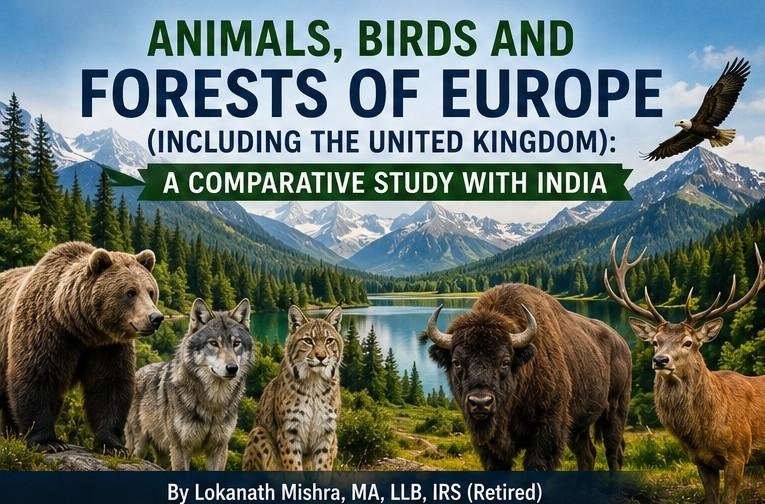
Animals, Birds and Forests of Europe (Including the United Kingdom): A Comparative Study with India:
By Lokanath Mishra, MA, LLB, IRS (Retired)
Introduction
Europe is a continent blessed with remarkable natural beauty. Although it is one of the most densely populated and industrialized regions of the world, it has successfully preserved many of its forests, mountains, rivers, wetlands, and wildlife habitats. During my journey through the United Kingdom, France, Belgium, the Netherlands, Germany, Switzerland, Liechtenstein, Austria, and Italy, I observed that Europeans have achieved a remarkable balance between urban development and environmental conservation.
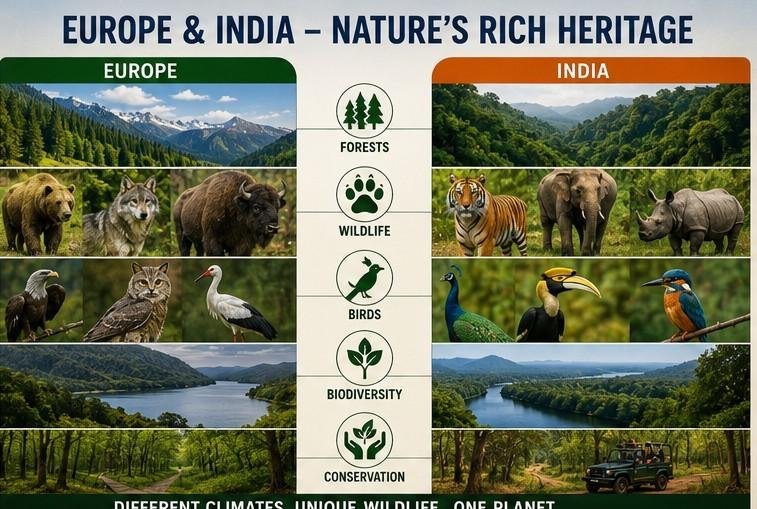
India and Europe differ greatly in climate, vegetation, and biodiversity. India, with its tropical and subtropical climate, supports a far greater variety of wildlife, while Europe, with its temperate and boreal climates, is home to animals specially adapted to cold winters and mountainous terrain. Nevertheless, both regions possess rich natural heritage that deserves admiration and protection.
The Dense Forests of Europe
Although Europe has been inhabited and cultivated for thousands of years, several magnificent forests still survive.
Among the most important are:
- The Black Forest in southwestern Germany, famous for its dense conifer forests, waterfalls, wildlife, and picturesque villages.
- Białowieża Forest, one of Europe’s last remaining primeval forests and a UNESCO World Heritage Site. It shelters the famous European bison.
- Taiga stretching across Norway, Sweden and Finland, consisting mainly of pine, spruce and fir trees.
- Bavarian Forest, one of Central Europe’s oldest national parks.
- Cairngorms National Park, containing ancient Caledonian pine forests.
- New Forest, famous for its free-roaming ponies, deer and woodland birds.
These forests not only preserve biodiversity but also regulate climate, conserve water resources, and attract millions of tourists every year.
Major Wild Animals of Europe
Europe’s forests are home to many fascinating mammals.
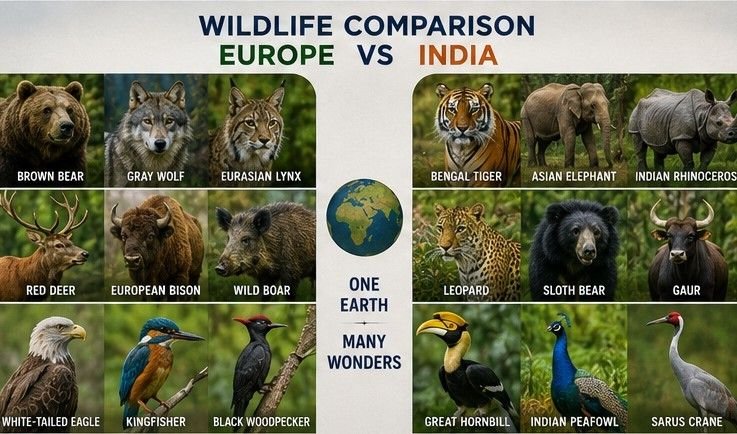
Brown Bear
The brown bear is Europe’s largest land carnivore. It is commonly found in Scandinavia, the Carpathian Mountains, the Balkans and parts of Eastern Europe. Although powerful, it generally avoids human contact unless threatened.
Gray Wolf
After decades of decline, wolves are gradually returning to many European forests due to improved conservation measures. They play a vital role in maintaining ecological balance by controlling herbivore populations.
Eurasian Lynx
The Eurasian lynx is Europe’s largest wild cat. It inhabits mountain forests and hunts deer, hares and other small mammals. Because of its secretive nature, it is rarely seen.
Red Deer
The red deer is one of Europe’s most widespread large mammals. During autumn the males produce loud calls during the breeding season, a spectacular natural event.
Wild Boar
Wild boars occur throughout Europe. Highly intelligent and adaptable, they inhabit forests, agricultural land and even areas close to towns.
European Bison
The European bison is Europe’s largest surviving land mammal. Once nearly extinct, successful conservation programmes have restored populations in protected forests such as Białowieża.
Other Mammals
Europe also supports foxes, badgers, martens, otters, beavers, roe deer, chamois, ibex, hares, hedgehogs and numerous bat species.
Remarkable Birds of Europe
Europe is a paradise for bird lovers.
Among the notable species are:
- Golden Eagle
- White-tailed Eagle
- Eurasian Eagle Owl
- Black Woodpecker
- Western Capercaillie
- White Stork
- Common Crane
- Kingfisher
- European Robin
- Barn Owl
- Great Spotted Woodpecker
- Various swans, ducks and geese
Every spring and autumn, millions of migratory birds travel between Europe, Africa and Asia using ancient flyways. Wetlands, lakes and forests provide vital resting and breeding grounds.
The Parrots of London
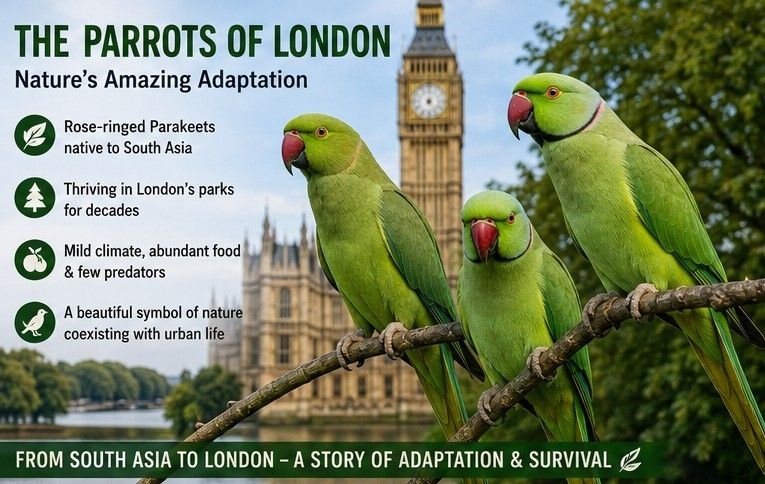
One of the most surprising sights for visitors to London is the presence of bright green parrots flying freely in parks and residential areas.
These birds are mainly the Rose-ringed Parakeet. Native to South Asia and parts of Africa, they are believed to have escaped from captivity several decades ago. Over time they adapted remarkably well to Britain’s climate.
Today thousands of these parrots can be seen in places such as Hyde Park, Richmond Park, Kensington Gardens and many suburban neighbourhoods.
Their success can be attributed to:
- Mild winters in southern England.
- Abundant food supplied by fruit trees, gardens and bird feeders.
- Few natural predators.
- Excellent adaptability and intelligence.
Their loud calls and brilliant green plumage have become a familiar feature of London’s parks, delighting residents and tourists alike.
Why Europe Has Few Dangerous Snakes
A common belief is that Europe has no poisonous snakes. This is not entirely correct.
Europe does have venomous snakes, but they are comparatively few in number and generally less dangerous than many species found in tropical countries.
Examples include:
- Common European Adder
- Asp Viper
- Nose-horned Viper
Several factors explain why Europe has relatively few dangerous snakes:
- The continent experiences long, cold winters, limiting reptile diversity.
- Much of northern Europe is too cold for tropical snake species.
- Human settlements and agriculture have reduced snake habitats.
- Efficient wildlife management keeps snake populations stable.
- There are no native cobras, kraits, mambas or large vipers comparable to those in tropical Asia or Africa.
Snakebite deaths in Europe are uncommon because medical facilities are readily available and antivenom treatment is effective.
Forest Wildlife of India
India possesses one of the richest wildlife heritages in the world.
Important mammals include:
- Bengal Tiger
- Asian Elephant
- Indian Leopard
- Sloth Bear
- Gaur
- Indian Rhinoceros
- Dhole (Indian Wild Dog)
- Nilgai
- Sambar Deer
- Barasingha
- Blackbuck
- Wild Buffalo
India’s forests are also home to thousands of bird species, including:
- Indian Peafowl
- Great Hornbill
- Crested Serpent Eagle
- Asian Koel
- Indian Roller
- Himalayan Monal
- Sarus Crane
- Painted Stork
- Kingfishers
- Parakeets
- Sunbirds
The tropical forests of India support reptiles, amphibians and insects in far greater diversity than Europe.
Comparing Europe and India
Europe’s wildlife is characterised by species adapted to temperate and cold climates. Forests are dominated by pine, spruce, fir, beech and oak trees, while large mammals include bears, wolves and deer.
India’s forests range from Himalayan alpine forests to tropical rainforests and mangrove ecosystems. This diversity supports apex predators such as the Bengal tiger, Asiatic lion and leopard, along with elephants, rhinoceroses and numerous colourful birds.
Europe generally has fewer animal species but has succeeded in restoring many through strict conservation laws. India possesses greater biodiversity but faces stronger pressures from population growth, habitat loss and human-wildlife conflict.
Conservation Efforts
European nations have invested heavily in wildlife conservation. National parks, protected forests, ecological corridors and strict hunting regulations have allowed populations of wolves, bears, lynx and bison to recover.
The United Kingdom has restored wetlands, expanded woodland cover and protected numerous bird species. London itself demonstrates that wildlife can coexist with modern urban life, where foxes, hedgehogs, swans, ducks, squirrels and rose-ringed parakeets thrive alongside millions of people.
India has also achieved significant conservation successes through Project Tiger, Project Elephant, crocodile breeding programmes and the establishment of biosphere reserves and national parks. Continued efforts are essential to safeguard its extraordinary biodiversity.
Conclusion
The forests and wildlife of Europe and India reveal nature’s remarkable adaptability to different climates and landscapes. Europe offers majestic forests, brown bears, wolves, lynx, red deer and spectacular migratory birds, while India dazzles with tigers, elephants, rhinoceroses, hornbills and countless tropical species.
The flourishing parrots of London remind us that wildlife can adapt to changing environments when given suitable conditions. Likewise, Europe’s successful conservation of forests and large mammals demonstrates that economic development and environmental protection can progress together.
The future of both Europe and India depends upon preserving forests, protecting wildlife, reducing pollution and educating future generations to respect nature. Only through international cooperation and responsible stewardship can humanity ensure that these magnificent animals and birds continue to enrich our planet for centuries to come.