
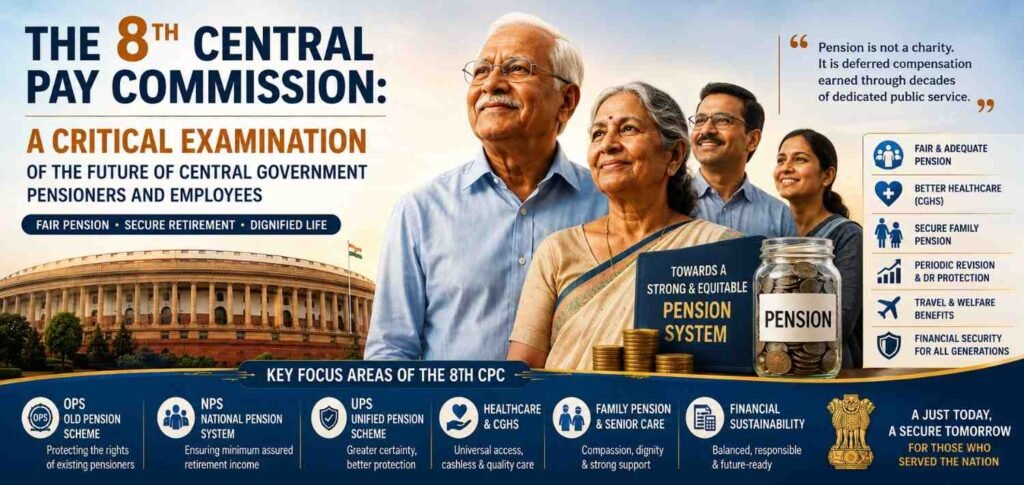
The Eighth Central Pay Commission: A Critical Examination of the Future of Central Government Pensioners and Employees:
By Lokanath Mishra, The Chief Adviser, The All India Pensioners Association of CBIC:
Introduction
The constitution of the Eighth Central Pay Commission (8th CPC) marks another significant milestone in the evolution of the service conditions of Central Government employees and pensioners in India. Since Independence, every Pay Commission has attempted to balance two equally important objectives—ensuring a fair standard of living for employees and pensioners while maintaining the fiscal sustainability of the Government.
The Government of India has invited representations from employees’ unions, pensioners’ associations, defence personnel, and individual stakeholders. Numerous organizations, including the All India Pensioners Association of CBIC, Bharat Pensioners Samaj, and the Staff Side of the National Council (JCM), have submitted memoranda seeking comprehensive reforms in pensions, allowances, healthcare, and retirement benefits. (8cpc.gov.in)
Why Pensioners Deserve Special Consideration
A serving employee has opportunities for promotions, annual increments, incentives, training, and career progression. A pensioner has none of these.
After retirement, pension is the only assured source of income. However, expenditure on food, medicines, housing, and healthcare increases substantially with age.
Therefore, pension revision should not merely compensate inflation through Dearness Relief (DR); it must also maintain the dignity and standard of living promised during government service.
Old Pension Scheme (OPS) Pensioners
Those covered under the Old Pension Scheme have rendered long years of public service under conditions prevailing before the introduction of contributory pension systems.
The following benefits deserve serious consideration:
- A substantial upward revision of basic pension through a realistic fitment formula.
- Full parity between past and future pensioners wherever feasible.
- Periodical pension revision every five years instead of waiting for the next Pay Commission.
- Restoration of pension anomalies created over successive Pay Commissions.
- Additional pension linked with advancing age should continue and be strengthened.
- Simplification of family pension rules.
- Liberalisation of medical facilities under the Central Government Health Scheme.
Such measures would provide social security without altering the fundamental structure of the OPS.
National Pension System (NPS)
Employees covered under the National Pension System face a different challenge.
Their retirement income depends largely upon:
- accumulated contributions,
- market performance,
- annuity rates,
- life expectancy.
Unlike OPS, there is no guaranteed pension linked to the last pay drawn.
Accordingly, the Commission may consider:
- increasing Government contribution wherever financially feasible;
- guaranteeing a reasonable minimum pension after retirement;
- improving annuity products;
- reducing administrative charges;
- providing better protection against inflation.
These measures would strengthen retirement security while retaining the contributory character of NPS.
Unified Pension Scheme (UPS)
The Unified Pension Scheme seeks to provide greater certainty than the traditional NPS while remaining fiscally more predictable than OPS.
If implemented effectively, UPS should ensure:
- minimum assured pension,
- family pension protection,
- inflation-indexed increases,
- transparent eligibility conditions,
- portability across departments,
- simple retirement procedures.
Its success will ultimately depend upon the adequacy of the guaranteed pension and the confidence it inspires among employees.
Should Existing Pensioners Benefit?
The answer should be yes.
Historically, every Central Pay Commission has recommended revision of pensions along with pay revisions, although the precise methodology has differed. Recent clarifications by the Government also indicate that pension revision falls within the Commission’s scope. (The Economic Times)
If only serving employees receive substantial increases while pensioners receive comparatively limited benefits, disparities between employees and retirees of the same rank would widen.
Therefore, pension revision should remain an integral component of the 8th CPC.
Dearness Relief (DR)
Dearness Relief protects pensioners from inflation.
However, DR alone cannot compensate for:
- rising healthcare costs,
- increasing cost of assisted living,
- age-related expenditure,
- technological changes affecting daily life.
The Commission should continue DR while simultaneously revising the basic pension substantially.
Annual Increment
Retired employees naturally do not receive annual increments.
However, this creates a widening gap between serving employees and pensioners over time.
One possible reform could be:
- a modest annual pension enhancement;
- or automatic pension revision after every five years;
- or a fixed percentage increase linked with longevity.
Such measures would recognise the increasing financial burden of ageing.
House Rent Allowance (HRA)
HRA is intended for serving employees and therefore is generally not payable to pensioners.
Nevertheless, housing costs continue even after retirement.
Instead of extending HRA directly, the Government may consider:
- higher pension for metropolitan pensioners,
- special housing assistance for economically weaker retirees,
- enhanced accommodation support for very senior pensioners.
Leave Travel Concession (LTC)
Presently, pensioners generally do not enjoy LTC.
Many retired employees spend decades serving the nation without any travel assistance after retirement.
The Commission may examine:
- concessional railway travel,
- concessional air travel for senior pensioners,
- periodic LTC after retirement,
- pilgrimage or heritage travel assistance,
- travel concessions for family pensioners.
These facilities would promote healthy ageing and national integration.
Medical Facilities
Medical expenditure is the greatest concern for elderly pensioners.
The Commission should recommend:
- universal CGHS coverage,
- cashless treatment in private hospitals,
- simplified reimbursement,
- wider availability of wellness centres,
- annual preventive health check-ups.
Medical security is perhaps more important than any increase in pension.
Family Pension
Widows and dependent family members deserve stronger protection.
The Commission should examine:
- enhancement of minimum family pension,
- faster sanction,
- simplified documentation,
- digital processing,
- compassionate treatment of elderly widows.
Periodical Pension Revision
Waiting ten years for pension revision no longer reflects modern economic realities.
A better system would include:
- automatic revision every five years,
- inflation-linked correction,
- periodic review of healthcare support,
- simplified pension updation.
Such a mechanism would reduce hardship without waiting for another Pay Commission.
Fiscal Responsibility
Every recommendation must remain financially sustainable.
A balanced approach requires:
- protecting the dignity of pensioners;
- ensuring fairness between different generations of employees;
- maintaining fiscal discipline;
- preserving long-term sustainability of public finances.
Financial prudence and social justice should complement, not contradict, each other.
Conclusion
The Eighth Central Pay Commission has an historic opportunity to modernise India’s pension architecture.
For OPS pensioners, the priority should be equitable pension revision, improved medical care, periodic pension enhancement, and removal of longstanding anomalies.
For NPS and UPS employees, the focus should be on adequate retirement security, minimum assured pension, inflation protection, and transparency.
Ultimately, retirement should never mean financial insecurity. Pension is not a charity bestowed by the Government; it is deferred compensation earned through decades of dedicated public service. A compassionate and equitable pension policy is therefore not merely an administrative necessity but a constitutional obligation towards those who have devoted the best years of their lives to serving the nation.