
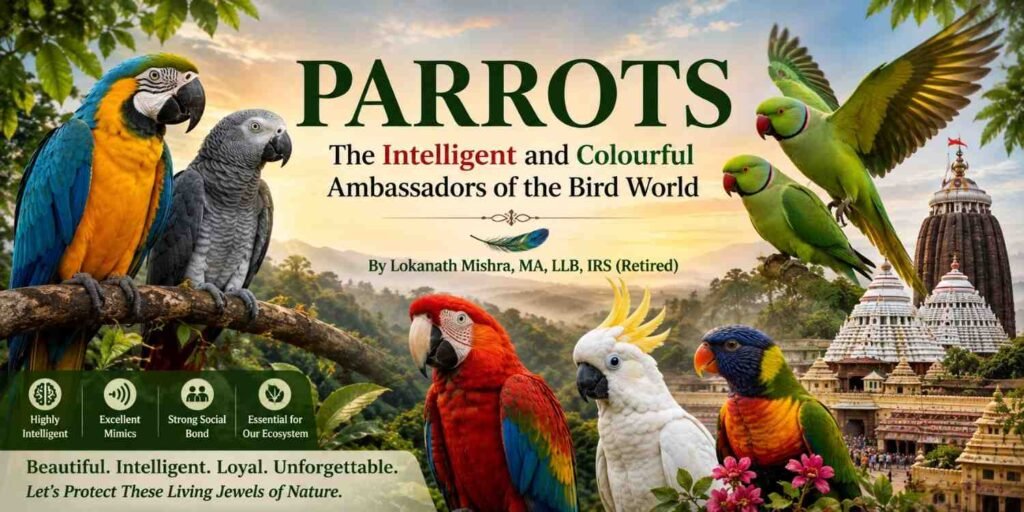
Parrots: The Intelligent and Colourful Ambassadors of the Bird World:
By Lokanath Mishra, MA, LLB, IRS (Retired)
Introduction
Parrots are among the most beautiful, intelligent and fascinating birds on Earth. Their brilliant colours, curved beaks, remarkable ability to imitate sounds, playful behaviour and strong social bonds have captivated human beings for thousands of years. They are admired not only for their beauty but also for their extraordinary intelligence, which places them among the most cognitively advanced birds in the world.
Today parrots are found naturally on every inhabited continent except Europe and Antarctica. However, through the pet trade and accidental or deliberate releases, some species have established wild populations in many European cities, including London.
Evolution and Origin
Scientists believe that the ancestors of modern parrots evolved approximately 50–60 million years ago, shortly after the extinction of the dinosaurs. Fossil evidence suggests that ancient parrots lived in warm forests where flowering plants and fruit-bearing trees were abundant.
Over millions of years they diversified into hundreds of species occupying tropical rainforests, dry woodlands, savannas, mangrove forests and mountain valleys.
Worldwide Distribution
Parrots are naturally distributed mainly in tropical and subtropical regions.
The greatest diversity occurs in:
- South America
- Central America
- Australia
- New Guinea
- Indonesia
- India
- Sri Lanka
- Southeast Asia
- Africa
Australia and South America possess the largest number of parrot species.
How Many Species Exist?
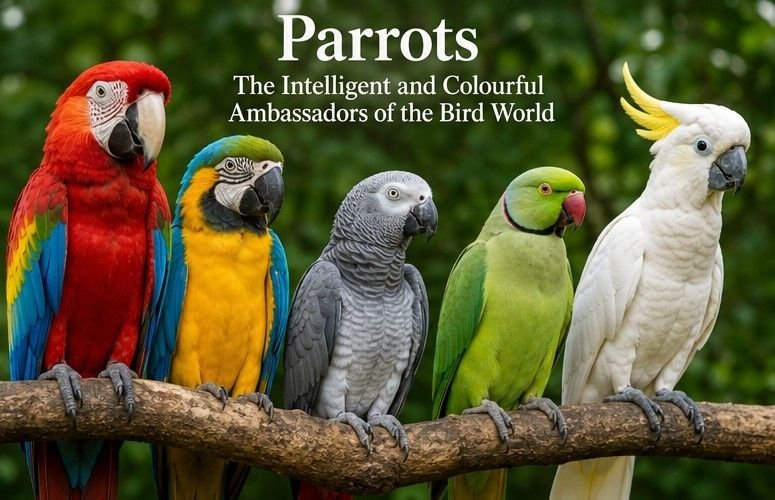
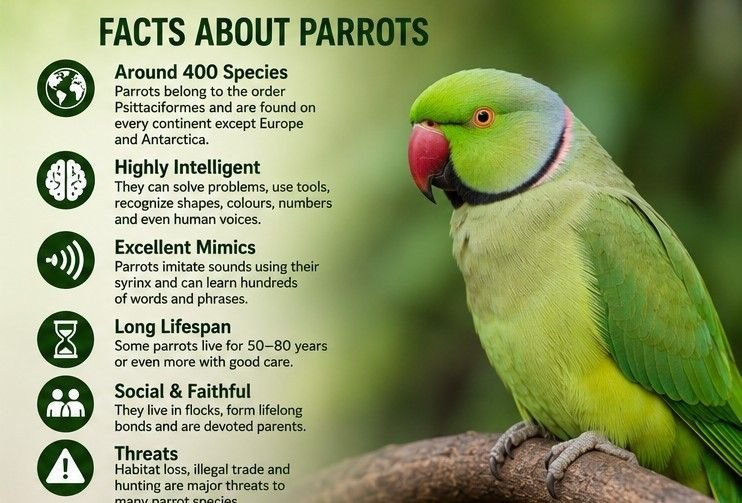
According to modern ornithological classifications, there are about 400 species of parrots belonging to the order Psittaciformes. These species are divided into three major families:
- Psittaculidae
This family includes the parakeets of Asia, Australia and Africa, such as the Rose-ringed Parakeet commonly seen in India and London.
- Psittacidae
This family includes Amazons, African Grey Parrots and the magnificent Macaws of South America.
- Cacatuidae
These are the cockatoos of Australia and nearby islands, recognised by their spectacular feather crests.
Global Population
It is impossible to determine the exact number of parrots living worldwide because many species inhabit remote tropical forests. Scientists estimate that hundreds of millions of individual parrots exist globally, although many species have declined sharply because of habitat destruction and illegal capture.
Some common species number in the millions, whereas several rare species survive with only a few hundred individuals.
Sadly, nearly one-third of all parrot species are considered threatened or endangered, making parrots one of the world’s most threatened groups of birds.
Physical Characteristics
Parrots vary greatly in size.
- The smallest species, the Buff-faced Pygmy Parrot, measures only about 8 centimetres.
- The magnificent Hyacinth Macaw may reach one metre from head to tail.
Most parrots possess:
- Bright green, red, blue or yellow feathers
- A powerful curved beak
- Strong neck muscles
- Zygodactyl feet (two toes pointing forward and two backward), allowing them to climb and grasp objects with remarkable precision.
Unlike most birds, parrots often hold food in one foot while eating.
Extraordinary Intelligence
Parrots rank among the world’s most intelligent birds.
Scientific studies show that many species can:
- Solve complex problems
- Recognise shapes and colours
- Understand numbers
- Remember people for many years
- Learn by observation
- Use simple tools
- Distinguish between different human voices
The African Grey Parrot is widely regarded as one of the most intelligent birds known.
Can Parrots Speak?
This is the question that fascinates almost everyone.
Parrots do not speak in the same way that humans do. Instead, they imitate sounds with remarkable accuracy using a specialised vocal organ called the syrinx.
Many parrots can imitate:
- Human speech
- Laughter
- Doorbells
- Telephone rings
- Music
- Dogs barking
- Cats meowing
- Car alarms
Some exceptionally intelligent parrots have learned hundreds of words and can use certain words or short phrases appropriately in familiar situations. Research suggests they are capable of associating some words with meanings, although they do not possess human language in the full sense.
Why Can They Mimic Speech?
In the wild, parrots constantly communicate with members of their flock.
Young parrots learn calls from their parents and companions. When kept with humans, they often treat people as members of their social group and imitate human sounds as part of their communication.
This explains why parrots living alone with people usually become better mimics than those living in large aviaries.
Lifespan
One of the most remarkable features of parrots is their longevity.
Approximate lifespans are:
- Budgerigar: 8–15 years
- Cockatiel: 15–25 years
- Rose-ringed Parakeet: 20–30 years in captivity, often somewhat shorter in the wild
- African Grey Parrot: 40–60 years
- Amazon Parrot: 40–70 years
- Macaw: 50–80 years
- Some Cockatoos: more than 80 years
With excellent care, a few individual parrots have reportedly lived for over 90 years.
Daily Lifestyle
Parrots are highly active during daylight hours.
Their typical daily routine includes:
Early Morning
They leave communal roosts in search of food.
Morning
They feed on fruits, nuts, seeds, flowers, buds and grains.
Afternoon
They rest during the hottest hours, preen their feathers and interact socially.
Evening
They return to communal roosts where hundreds or thousands spend the night together for safety.
Food Habits
Parrots eat a wide variety of plant foods.
Their diet includes:
- Fruits
- Seeds
- Nuts
- Flowers
- Nectar
- Leaf buds
- Tender shoots
- Grains
Some species occasionally eat insects or larvae, particularly while feeding their chicks.
Their strong beaks allow them to crack extremely hard nuts that few other birds can open.
Family Life
Parrots are among the most devoted bird parents.
Most species form long-term breeding pairs. Both parents share responsibility for:
- Incubating eggs
- Feeding chicks
- Protecting the nest
- Teaching young birds how to survive
Many species remain with the same mate for many years, sometimes for life.
Enemies
Natural predators include:
- Hawks
- Eagles
- Falcons
- Snakes
- Monkeys
- Wildcats
Today, however, the greatest threat is human activity.
Threats
Major threats include:
- Destruction of forests
- Illegal wildlife trade
- Hunting
- Climate change
- Agricultural expansion
- Invasive species
Millions of parrots have been removed from the wild over the past century.
Conservation
Many countries now protect parrots through strict wildlife laws.
International agreements regulate or prohibit commercial trade in many species. Conservation programmes focus on:
- Protecting forests
- Restoring habitats
- Breeding endangered species
- Educating local communities
- Preventing illegal wildlife trafficking
Parrots in Human Culture
Parrots have appeared in mythology, literature, paintings and religious traditions for thousands of years.
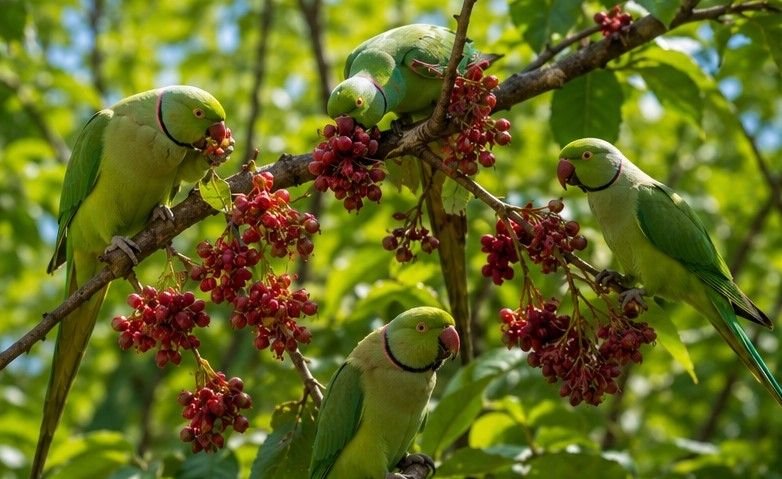
In India they are associated with Kamadeva, the god of love, whose traditional mount is a parrot. Green parrots are also familiar around many temples, orchards and villages, and they feature in folklore, poetry and art.
In Odisha, Rose-ringed Parakeets are commonly seen around the sacred city of Puri and other temple towns, where people often regard them with affection as part of the natural environment.
Conclusion
Parrots are far more than colourful birds. They are highly intelligent, socially complex creatures with remarkable memories, strong family bonds and extraordinary vocal abilities. Their success in adapting to environments as different as the tropical forests of India and the parks of London illustrates the resilience of nature.
Yet many parrot species face an uncertain future because of habitat loss and illegal trade. Their survival depends upon protecting forests, conserving biodiversity and respecting wildlife in its natural habitat.
The cheerful calls of parrots, whether heard in the forests of India, the temples of Puri or the parks of London, remind us of the richness of the natural world and of humanity’s responsibility to preserve it for future generations.