
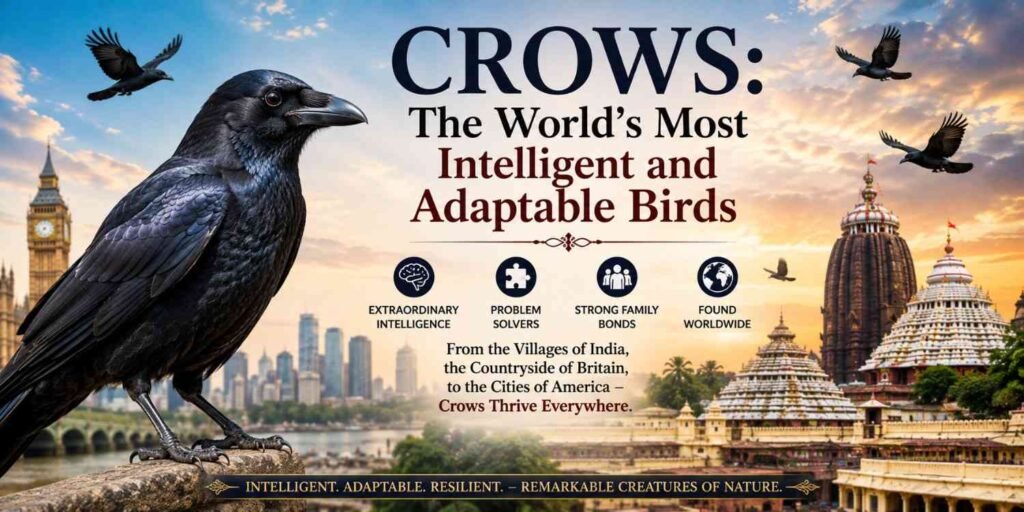
Crows: The World’s Most Intelligent and Adaptable Birds
By Lokanath Mishra, MA, LLB, IRS (Retired)
Introduction
The crow is one of the most intelligent, adaptable and widespread birds in the world. Although it is often overlooked because of its plain black appearance, the crow possesses extraordinary intelligence, remarkable memory and exceptional problem-solving abilities. It has lived alongside human civilization for thousands of years and appears in the mythology, literature, folklore and religious traditions of many cultures.
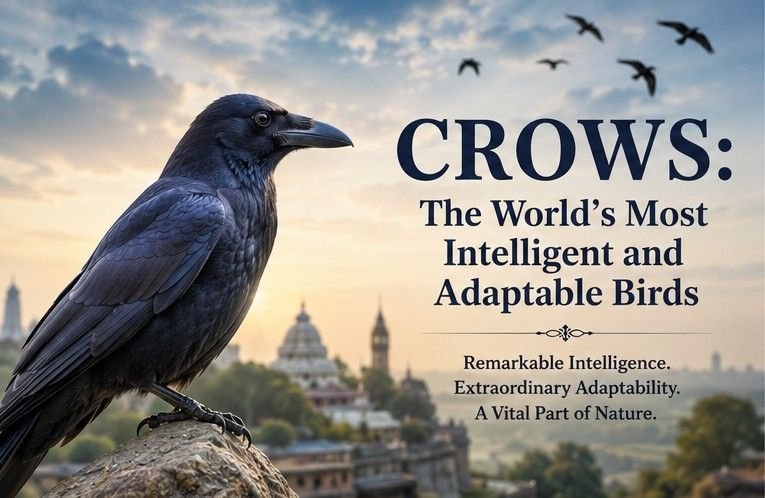
Scientists consider crows to be among the most intelligent birds, with mental abilities comparable in some respects to those of great apes. They can recognise human faces, remember people for many years, use tools, solve puzzles and even teach their young by observation.
Origin and Evolution
Crows belong to the family Corvidae, which includes crows, ravens, rooks, jackdaws, magpies, jays and nutcrackers. This bird family evolved approximately 17–20 million years ago.
The scientific genus Corvus contains the true crows and ravens. Over millions of years, they adapted to forests, mountains, grasslands, deserts and cities, making them one of the most successful bird groups on Earth.
How Many Species of Crows Are There?
There are about 50 species of true crows and ravens (genus Corvus) in the world. If the entire Corvidae family is included, there are more than 130 species.
Some well-known members are:
- House Crow
- Carrion Crow
- Hooded Crow
- American Crow
- Fish Crow
- Jungle Crow
- Large-billed Crow
- Common Raven
- Rook
- Jackdaw
How Many Crows Are There in the World?
No exact census exists because crows live across vast areas and are constantly moving. Ornithologists estimate that hundreds of millions of crows and ravens live worldwide.
Some species, such as the American Crow and House Crow, each number in the tens of millions, while other species have much smaller populations.
Physical Characteristics
Most crows are black, though some species have grey or white markings.
General features include:
- Length: 40–70 cm (depending on species)
- Wingspan: 80–140 cm
- Strong pointed beak
- Powerful legs
- Excellent eyesight
- Highly developed brain
The raven is generally the largest member of the crow family.
Intelligence
Crows are famous for their intelligence.
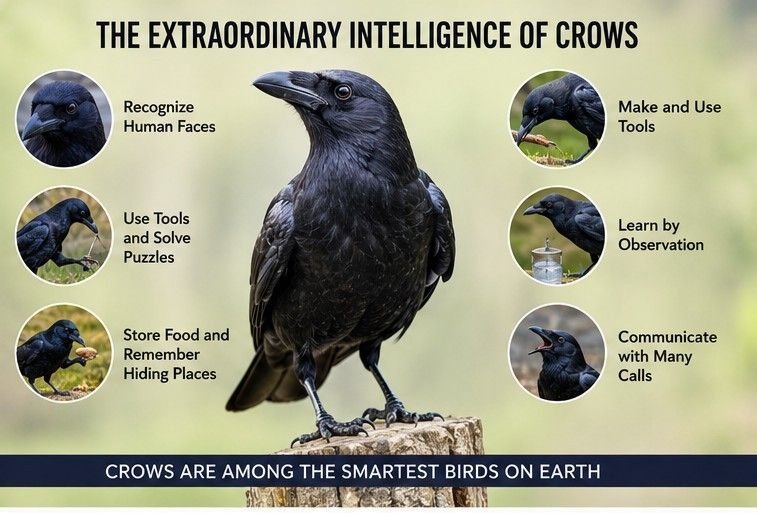
Scientific studies have shown that they can:
- Recognise individual human faces.
- Remember people for many years.
- Make and use tools.
- Bend wires into hooks to obtain food.
- Drop nuts onto roads so passing vehicles crack them open.
- Store food and remember hundreds of hiding places.
- Solve complex puzzles.
- Learn by watching other birds.
- Warn other crows about dangerous people or animals.
Researchers often compare their problem-solving abilities with those of chimpanzees in certain tasks.
Communication
Crows communicate through a wide range of sounds and body language.
Their calls can indicate:
- Danger
- Food discovery
- Territory
- Family contact
- Alarm
- Courtship
Scientists have identified dozens of different calls used in different situations.
Food Habits
Crows are omnivorous and eat almost anything.
Their diet includes:
- Insects
- Earthworms
- Fruits
- Seeds
- Grains
- Eggs
- Small reptiles
- Fish
- Frogs
- Carrion (dead animals)
- Human food waste
Their flexible diet explains why they thrive in cities as well as in forests.
Family Life
Most crows form long-term breeding pairs.
Both parents:
- Build the nest.
- Incubate the eggs.
- Feed the chicks.
- Protect the family.
Young crows often remain with their parents for many months and may even help raise the next brood.
Lifespan
Wild crows usually live 7–15 years, though many die younger because of predators, disease or accidents.
Under favourable conditions, some individuals have lived 20–30 years, and a few captive birds have exceeded that age.
Crows in India
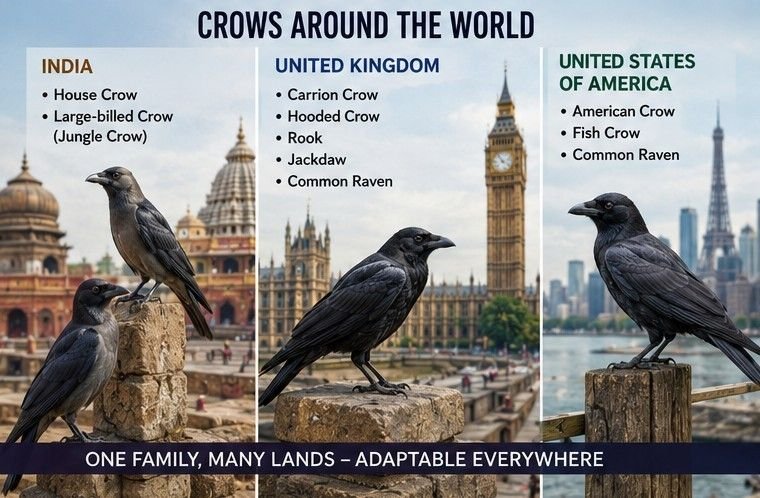
India has several crow species.
- House Crow (Corvus splendens)
This is the common crow seen in almost every Indian town and village. It has a black body with a grey neck and breast and lives close to humans.
- Large-billed Crow (Corvus macrorhynchos)
Also called the Jungle Crow, it is larger, entirely black and found in forests, hills and many cities.
These crows are deeply woven into Indian culture. In Hindu tradition, food is often offered to crows during Śrāddha ceremonies as a mark of respect for departed ancestors.
Crows in the United Kingdom
The United Kingdom is home to several members of the crow family.
The most common are:
- Carrion Crow – the familiar all-black crow found throughout much of England and Wales.
- Hooded Crow – grey-bodied with black head, wings and tail, common in Scotland and parts of Ireland.
- Rook – recognised by its pale bare skin around the base of the beak and its habit of nesting in large colonies called rookeries.
- Jackdaw – the smallest common crow, with grey eyes and a grey nape.
- Common Raven – the largest crow family member in Britain, found mainly in upland and coastal regions.
Crows are a familiar sight in parks, farmland, woodlands and towns across the UK.
Crows in the United States of America
Several species occur in North America.
The most common include:
American Crow (Corvus brachyrhynchos)
Found across most of the United States and southern Canada, this adaptable species inhabits forests, farms and cities.
Fish Crow (Corvus ossifragus)
Common along the Atlantic and Gulf coasts, feeding on fish, shellfish and other aquatic food.
Northwestern Crow
Occurs in parts of the Pacific Northwest.
Common Raven
Widely distributed across western and northern North America.
American crows are highly social and often gather in enormous winter roosts containing thousands or even hundreds of thousands of birds.
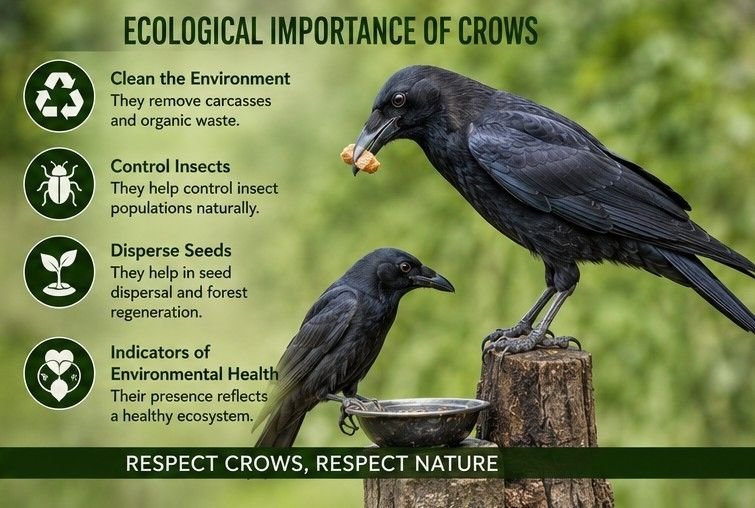
Ecological Importance
Crows play an important role in maintaining healthy ecosystems.
They:
- Remove animal carcasses.
- Help control insect populations.
- Disperse seeds.
- Clean organic waste.
- Serve as indicators of environmental health.
Although they sometimes damage crops, their overall contribution to ecological balance is significant.
Threats
While many crow species remain common, some face challenges from:
- Habitat destruction
- Pesticides
- Pollution
- Road accidents
- Disease, including avian influenza in some regions
- Climate change
Conservation of natural habitats benefits crows and countless other bird species.
Crows in Culture and Religion
Crows appear in myths and traditions throughout the world.
In India, they are respected in Hindu customs and are associated with remembrance of ancestors.
In Britain, ravens have long been linked with the Tower of London, where legend says that if the ravens ever leave, the Kingdom will fall. Although ravens are distinct from crows, they belong to the same family (Corvidae) and share many characteristics.
Native American traditions often portray the crow or raven as a symbol of intelligence, transformation and wisdom.
Conclusion
The crow is far more than an ordinary black bird. It is one of nature’s greatest examples of intelligence, adaptability and social cooperation. Whether seen in the villages of India, the countryside of Britain or the cities of America, crows demonstrate remarkable learning ability, strong family bonds and an exceptional capacity to live alongside humans.
By protecting forests, reducing pollution and respecting wildlife, we help ensure that future generations will continue to witness the fascinating lives of these extraordinary birds.