
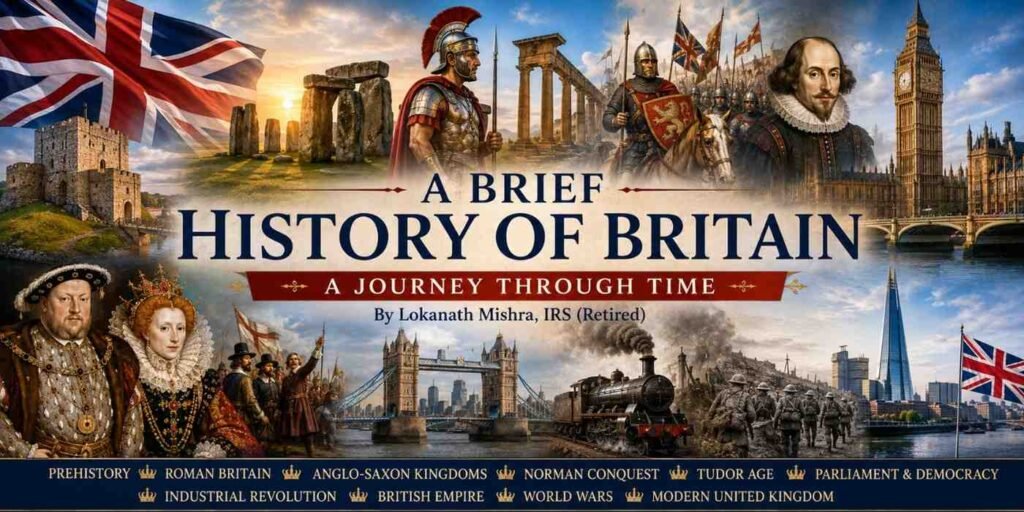
A Brief History of Britain:
By Lokanath Mishra, IRS ( retired)
Introduction:
The history of Britain is a long and complex story of peoples, kingdoms, political struggles, religious changes, industrial transformation and the gradual development of parliamentary democracy. From prehistoric settlements and Roman Britain to the medieval kingdoms and the modern United Kingdom, the British Isles have experienced profound changes that have influenced the wider world.
Prehistoric Britain and the Romans:
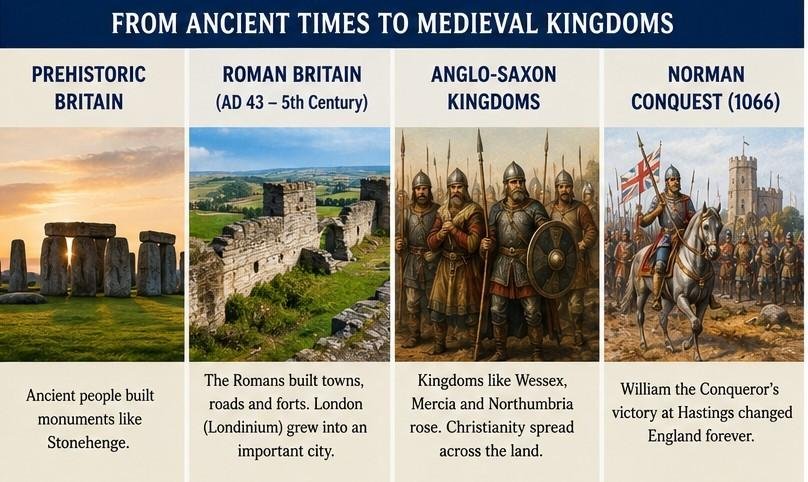
Human settlement in Britain goes back thousands of years. Ancient communities constructed remarkable monuments such as Stonehenge, demonstrating the organisation and religious practices of prehistoric societies.
In AD 43, the Roman invasion under Emperor Claudius brought much of Britain under Roman rule. The Romans established towns, roads, forts and administrative centres. London, originally Londinium, developed into an important commercial and administrative settlement. Roman rule lasted for several centuries before the Roman army withdrew in the early fifth century.
The Anglo-Saxon Kingdoms:
Following the end of Roman rule, various Germanic peoples, particularly the Angles, Saxons and Jutes, settled in Britain. Several kingdoms emerged, including Wessex, Mercia, Northumbria and East Anglia.
Christianity was reintroduced and gradually spread through the kingdoms. Over time, Wessex became particularly powerful. Alfred the Great, King of Wessex, played an important role in resisting Viking expansion and promoting learning and administration.
The Norman Conquest:
A decisive turning point came in 1066, when William, Duke of Normandy, invaded England and defeated King Harold II at the Battle of Hastings.
William became William I, or William the Conqueror. The Norman Conquest transformed English political institutions, land ownership, architecture, language and administration. Norman castles and churches were constructed throughout the country, while a powerful central monarchy developed.
Magna Carta and the Growth of Parliament:
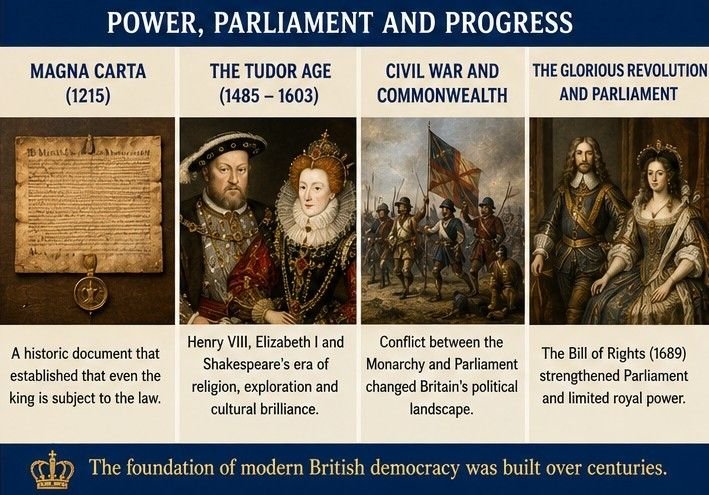
The reign of King John witnessed serious conflict between the Crown and powerful nobles. In 1215, King John was compelled to accept the Magna Carta, an important document in the development of constitutional government and the principle that the ruler was subject to the law.
Parliament gradually developed during the medieval period. Representatives of counties and towns increasingly participated alongside nobles and clergy. Over centuries, Parliament acquired greater authority over taxation and legislation.
The Tudor Age:
The Tudor dynasty ruled England from 1485 to 1603. It was an important period of religious, political and cultural transformation.
Henry VIII broke with the authority of the Pope and established the Church of England under royal supremacy. The reign of Elizabeth I brought political stability and cultural flourishing. The defeat of the Spanish Armada in 1588 became one of the most famous events of Elizabeth’s reign.
The Tudor period also witnessed the English Renaissance and the works of William Shakespeare, whose plays became an enduring part of world literature.
The Civil War and Constitutional Conflict:
During the seventeenth century, relations between the monarchy and Parliament deteriorated. The conflict eventually resulted in the English Civil War between supporters of King Charles I and Parliament.
Parliament’s forces ultimately prevailed. Charles I was tried and executed in 1649, and England became a republic, commonly known as the Commonwealth, with Oliver Cromwell as its dominant political figure.
The monarchy was restored in 1660 under Charles II. However, the fundamental constitutional conflict between royal authority and parliamentary power had changed the political landscape permanently.
The Glorious Revolution and Constitutional Monarchy:
In 1688, James II was removed from the throne during the Glorious Revolution. William III and Mary II became joint monarchs.
The Bill of Rights of 1689 strengthened Parliament and established important limitations on royal authority. These developments contributed significantly to the emergence of Britain’s constitutional monarchy, in which the monarch’s powers became increasingly constrained by law and parliamentary government.
The Union and the United Kingdom:
The political union between England and Scotland was established by the Acts of Union 1707, creating the Kingdom of Great Britain.
In 1801, Great Britain and Ireland were united to form the United Kingdom of Great Britain and Ireland. Following the creation of the Irish Free State in 1922, the present United Kingdom of Great Britain and Northern Ireland emerged.
The history of the Union remains complex, involving changing relationships among England, Scotland, Wales and Ireland and, in modern times, the development of devolved governments in Scotland, Wales and Northern Ireland.
The Industrial Revolution:
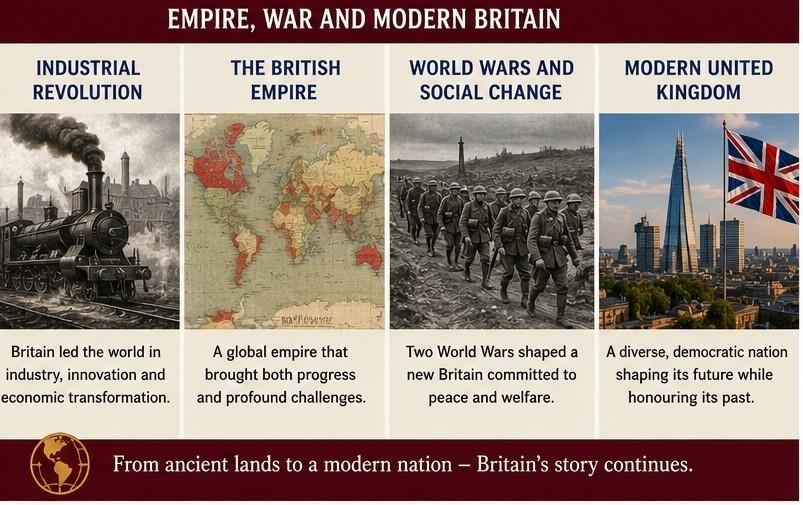
Britain became the birthplace of the Industrial Revolution during the eighteenth and nineteenth centuries.
New inventions and technologies transformed agriculture, manufacturing, transportation and trade. Steam power, coal, iron production, factories, canals and railways changed the British economy and society.
Cities expanded rapidly, while Britain became a leading industrial and commercial power.
The Industrial Revolution also produced serious social problems, including overcrowded cities, poor working conditions and child labour. These problems eventually encouraged important social, economic and political reforms.
The British Empire:
During the eighteenth, nineteenth and early twentieth centuries, Britain developed an enormous overseas empire.
At its height, the British Empire controlled territories across every inhabited continent. British influence spread through trade, administration, migration, military power, education and the English language.
The imperial period had a profound and complicated legacy. It contributed to the development of global trade and institutions but was also associated with conquest, exploitation, racial inequality and the loss of political independence of many peoples.
The Expansion of Democracy:
British democracy developed gradually rather than through a single revolution.
The Reform Acts of the nineteenth century progressively expanded the electorate and redistributed parliamentary representation. Political participation continued to grow during the nineteenth and twentieth centuries.
Women also fought a long campaign for the right to vote. The Representation of the People Act 1918 gave voting rights to many women and men, while equal voting rights for women and men over 21 were established in 1928.
The development of universal suffrage transformed Parliament into a much broader representation of the British population.
The Two World Wars:
Britain played a major role in both World Wars.
During the First World War (1914–1918), Britain and its allies fought the Central Powers. The war caused enormous loss of life and brought significant social and economic changes.
In 1939, Britain entered the Second World War against Nazi Germany. Under Prime Minister Winston Churchill, Britain continued the war despite severe military and economic difficulties. The Battle of Britain, the Blitz and Britain’s eventual participation in the Allied victory became defining episodes of twentieth-century British history.
The Welfare State and Modern Britain:
After the Second World War, Britain underwent major social and economic transformation. The National Health Service was established in 1948, providing publicly funded healthcare.
The post-war period also witnessed the expansion of social security, education and public services. At the same time, Britain faced economic difficulties and the gradual decline of its imperial power.
The process of decolonisation accelerated after 1945, and many former British colonies became independent states.
Britain in the Modern Era:
The United Kingdom today is a constitutional monarchy and parliamentary democracy. The monarch serves as Head of State, while the Prime Minister leads the Government.
The House of Commons consists of elected Members of Parliament, while the House of Lords provides a second chamber for legislative scrutiny and revision.
The United Kingdom has also undergone important constitutional changes through the creation of devolved governments in Scotland, Wales and Northern Ireland.
Britain’s relationship with Europe changed significantly when the United Kingdom joined the European Economic Community in 1973 and subsequently left the European Union in 2020 following the Brexit process.
Britain Today:
Modern Britain is a diverse, multicultural and globally connected country. London remains one of the world’s major financial, cultural and political centres.
The United Kingdom continues to exercise international influence through diplomacy, trade, science, education, culture and institutions such as the Commonwealth.
At the same time, contemporary Britain faces questions concerning economic inequality, regional development, constitutional reform, the future of the Union and its role in a rapidly changing world.
Conclusion:
The history of Britain is ultimately a story of continuous change.
Roman Britain gave way to Anglo-Saxon kingdoms; the Norman Conquest transformed medieval England; Magna Carta and the growth of Parliament contributed to constitutional government; the Civil War and Glorious Revolution changed the relationship between Crown and Parliament; the Industrial Revolution transformed society and the economy; the British Empire shaped global history; and the expansion of democracy gradually gave political rights to a much larger proportion of the population.
The Palace of Westminster, therefore, is an appropriate place from which to reflect upon British history. Its ancient Westminster Hall connects the present with medieval Britain, while the Houses of Commons and Lords represent the continuing evolution of parliamentary government.
To understand Westminster is, in many respects, to understand the long constitutional journey of Britain itself.