Waterloo: The Day Napoleon Lost an Empire:
A Historical Novel of the Battle of Waterloo, 18 June 1815:
By Lokanath Mishra, IRS (Retd.)
Waterloo: The Day Napoleon Lost an Empire:
A Journey to the Battlefield:
Years after the guns of Waterloo had fallen silent, I stood upon the historic battlefield in Belgium.
The fields were green and peaceful.
There was no sound of cannon.
No cavalry thundered across the plain.
No infantry stood in long lines with muskets in their hands.
Yet, as I looked across the landscape, I felt that the earth itself remembered.
Here, on 18 June 1815, one of the greatest military commanders in history had fought the battle that would become his last.
His name was Napoleon Bonaparte.
The opposing commander was Arthur Wellesley, Duke of Wellington, supported by the determined Prussian Field Marshal Gebhard Leberecht von Blücher.
The battle would last for hours.
By evening, Napoleon’s dream of restoring his European empire would lie broken upon these fields.
Europe Before the Storm:
To understand Waterloo, we must first understand Napoleon.
Born in Corsica in 1769, Napoleon rose rapidly during the turmoil of the French Revolution. He became a brilliant military commander and eventually seized political power in France.
In 1804, he crowned himself Emperor of the French.
His armies subsequently fought across much of Europe.
Napoleon won spectacular victories at places such as Austerlitz, Jena and Friedland. Kingdoms fell before him, alliances were broken and new political arrangements were imposed across Europe.
But his ambition created an equally powerful fear among other European nations.
Britain, Austria, Russia, Prussia and other states repeatedly formed coalitions against France.
The struggle became more than a conflict between two armies.
It became a struggle over the future political order of Europe.
Napoleon’s Fall and Exile:
Napoleon’s great ambition eventually brought disaster.
His invasion of Russia in 1812 ended catastrophically. His armies suffered enormous losses, and European powers took advantage of his weakness.
By 1814, the Allied armies had invaded France.
Napoleon abdicated and was sent into exile on the Mediterranean island of Elba.
The European powers believed that the Napoleonic era had ended.
They were mistaken.
The Emperor Returns:
In early 1815, Napoleon escaped from Elba.
He landed in France with a small number of followers.
Something extraordinary happened.
Instead of arresting him, soldiers sent to oppose him began joining him.
Napoleon marched towards Paris.
Louis XVIII fled.
Napoleon entered Paris and once again became Emperor.
This extraordinary period became known as the Hundred Days.
But Europe would not permit Napoleon to rebuild his empire.
The major powers formed another coalition.
Their armies began assembling.
Napoleon understood that he could not allow all the Allied armies to unite.
His plan was therefore bold.
He would move rapidly into Belgium and defeat the Allied armies separately before they could combine their strength.
The Opposing Armies:
Two major Allied armies were positioned in the region.
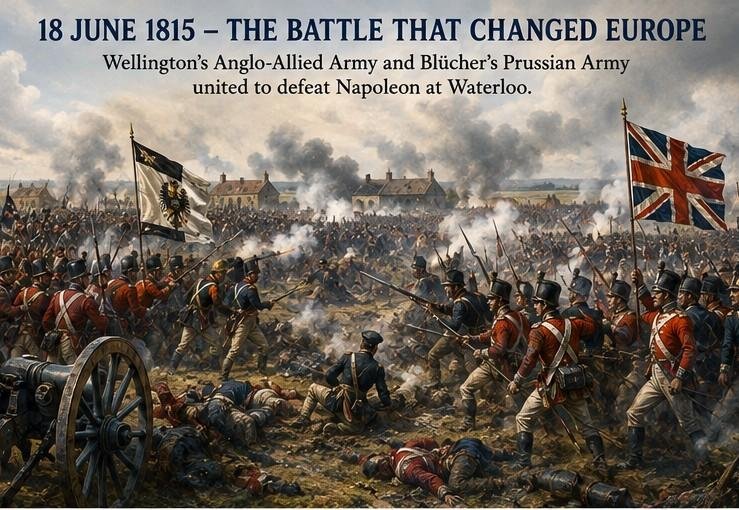
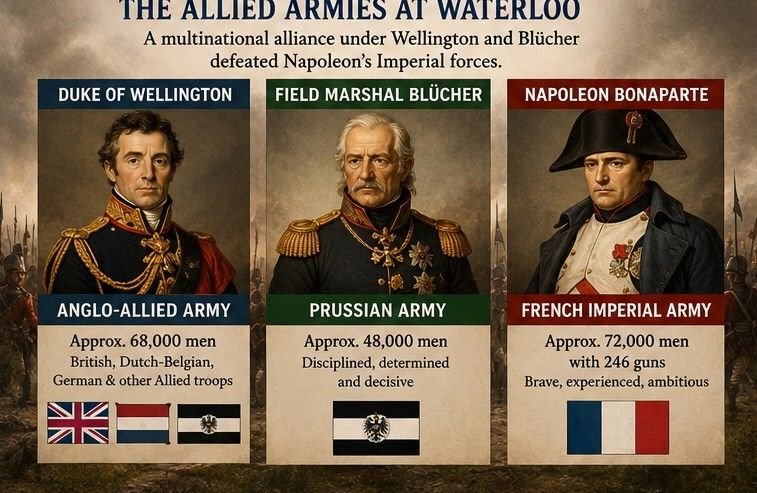
One was an Anglo-Allied army commanded by the Duke of Wellington.
The other was a Prussian army commanded by Field Marshal Blücher.
This point is important.
The army commanded by Wellington was not composed entirely of English or British soldiers.
It was a multinational army.
The National Army Museum describes Wellington’s force at Waterloo as approximately 68,000 men, consisting of British troops together with Dutch-Belgian and German contingents. The Prussian army numbered about 48,000 men. Napoleon had approximately 72,000 men and 246 guns at Waterloo. (National Army Museum)
Thus, when we use the expression “Anglo-Allied army”, it refers to the army commanded by Wellington in which British troops formed a major component alongside troops from allied states.
The term “Anglo” refers principally to the British element and the British-led character of the force; it does not mean that every soldier under Wellington was English.
The Prussians were separate allies under Blücher.
Who Were the Soldiers Called “Anglo” or British Soldiers:
The British contingent included soldiers from different parts of the British Army, including English, Scottish, Welsh and Irish soldiers.
The army also contained famous British regiments such as the Scots Greys and the Guards.
Alongside them fought soldiers from the Netherlands, Belgium, Hanover, Brunswick, Nassau and other German states.
Therefore, Waterloo should properly be remembered as a victory of an Allied coalition, rather than simply a British victory.
The British and allied soldiers stood under Wellington.
The Prussians stood under Blücher.
Their cooperation would prove decisive.
The Battle Before Waterloo:
Napoleon entered Belgium in June 1815.
His first major objective was to separate Wellington’s army from Blücher’s Prussians.
On 16 June, the French fought the Prussians at Ligny.
Napoleon defeated Blücher there.
But the Prussian army was not destroyed.
It withdrew, reorganised and remained capable of returning to the battlefield.
On the same day, Wellington’s forces fought the French at Quatre Bras.
The French failed to achieve the decisive breakthrough they needed.
The following day, Wellington withdrew towards the ridge near Mont-Saint-Jean.
The stage was now set for Waterloo.
The Night Before Waterloo:
On 17 June, heavy rain fell.
The soldiers were exhausted.
The fields became wet and muddy.
Napoleon’s army had been marching and fighting for days.
Across the battlefield, Wellington positioned his army along the ridge of Mont-Saint-Jean.
He knew that Blücher had promised to come to his assistance.
The crucial question was whether the Prussians could arrive before Napoleon destroyed Wellington’s army.
That night, thousands of soldiers slept in the rain.
Some prayed.
Some wrote letters.
Some thought of their wives and children.
Some probably wondered whether they would see another sunrise.
Napoleon was confident.
Wellington was calm.
Blücher was determined.
The morning would decide their fate.
The Morning of 18 June:
The sun rose over Waterloo.
Napoleon waited for the ground to dry before beginning the main attack.
The French army stood opposite Wellington’s defensive position.
Nearly 150,000 men would eventually be involved in the wider battle and surrounding operations.
The peaceful Belgian countryside was about to become a battlefield.
At approximately 11.30 in the morning, the first major French attack began.
Hougoumont: The First Great Struggle:
Napoleon launched an attack against Hougoumont, a fortified farm on Wellington’s right.
At first, it appeared to be a diversion.
But the fighting became fierce.
British Guards and German troops defended the position.
The French repeatedly attacked.
The defenders refused to surrender.
The buildings, gardens and surrounding walls became scenes of terrible hand-to-hand fighting.
The French could not break through.
Hougoumont remained in Allied hands throughout the battle.
The Great French Attack:
Napoleon then launched a major assault against Wellington’s centre-left.
French infantry advanced in enormous formations.
They crossed the fields under fire.
For a moment, it appeared that Wellington’s line might break.
But Wellington had deliberately placed much of his infantry behind the crest of the ridge.
The soldiers were partly protected from French artillery.
As the French advanced over the ridge, Allied infantry rose and opened fire.
The attack faltered.
Then Allied cavalry charged.
For a brief moment, the French formations were thrown into confusion.
But the cavalry advanced too far and suffered heavily when French cavalry counter-attacked.
The battlefield became a chaos of horses, smoke, gunfire and wounded men.
The French Cavalry Charges:
Napoleon’s cavalry was among the finest in Europe.
French horsemen repeatedly charged Wellington’s infantry.
But Wellington’s infantry adopted a defensive formation known as the square.
The soldiers stood in compact formations with bayonets facing outward.
French cavalry galloped towards them.
Horses could not easily break the wall of bayonets.
Again and again the cavalry charged.
Again and again the squares held.
The ground was wet, and the French cavalry could not achieve the decisive breakthrough Napoleon needed.
La Haye Sainte:
At the centre of the battlefield stood another important position—La Haye Sainte.
German and British troops defended the farmhouse.
The fighting here was extraordinarily intense.
The defenders held out for much of the day.
Eventually, however, the French captured La Haye Sainte.
The victory gave Napoleon a dangerous opportunity.
Wellington’s centre was under tremendous pressure.
The battle seemed to be moving towards a crisis.
Then Came the Prussians:
Napoleon had been waiting for news of the Prussian army.
He knew that Blücher was somewhere to the east.
But he did not know precisely when the Prussians would arrive.
Then, gradually, the sound of battle appeared on Napoleon’s right.
The Prussians had arrived.
Blücher had kept his promise.
The defeated army of Ligny had not disappeared.
It had marched towards Waterloo.
Fresh Prussian troops began attacking the French flank and rear.
Napoleon now faced two enemies.
Wellington in front.
Blücher on his right.
The French army was being squeezed.
Napoleon’s Last Hope:
Napoleon was not yet defeated.
He was still Napoleon.
He still possessed his elite Imperial Guard, soldiers who had fought in many of his greatest campaigns.
If the Imperial Guard could break Wellington’s centre, Napoleon might still win.
The Emperor made his final gamble.
The Imperial Guard advanced.
The soldiers marched towards Wellington’s position.
The battlefield had become a landscape of dead and wounded men.
Smoke filled the air.
The future of Napoleon’s empire was now being decided in a few hundred yards of Belgian countryside.
“The Guard Retreats”:
The Imperial Guard attacked.
But Wellington’s troops held.
French columns were met by concentrated Allied fire.
The Imperial Guard faltered.
Then came the terrible moment.
The Imperial Guard began to retreat.
The cry spread through the French army:
“The Guard retreats!”
For Napoleon’s soldiers, this was almost unimaginable.
The Imperial Guard had been regarded as the ultimate symbol of French military power.
If the Guard could retreat, perhaps the battle was lost.
The French line began to collapse.
Wellington Gives the Final Order:
Wellington observed the collapse of Napoleon’s army.
He raised his telescope.
The French were retreating.
The moment had come.
Wellington ordered his army to advance.
The Allied troops moved forward.
At the same time, Blücher’s Prussians continued their attacks.
The French army began a general retreat.
Waterloo was over.
Napoleon’s Final Defeat:
Napoleon had lost.
His attempt to destroy the Allied coalition had failed.
His army was routed.
The dream of rebuilding his European empire disappeared in a single afternoon.
The battle was one of the decisive military events of modern European history.
The National Army Museum describes Waterloo as Napoleon’s last gamble and as the battle that ended France’s attempt to dominate Europe. (National Army Museum)
Why Did They Fight:
The question naturally arises:
Why did these men fight?
The soldiers themselves had different reasons.
Napoleon fought because he had returned to power and wanted to preserve his empire and political authority.
The Allied powers fought because they feared another period of Napoleonic domination and wanted to restore a stable European order.
Wellington fought to defeat Napoleon and protect the Allied position in Belgium.
Blücher fought because Prussia was determined to defeat Napoleon after years of war and occupation.
But the ordinary soldier had another reason.
He fought because he was ordered to fight.
Many had never met Napoleon.
Many had never seen Paris.
Many had no personal quarrel with the man standing opposite them.
Yet they stood in line, loaded their muskets, fixed their bayonets and marched towards death.
That is one of the saddest truths of war.
The Human Cost:
Waterloo was not merely a contest between famous commanders.
Thousands of ordinary human beings died or were wounded.
The battlefield was filled with suffering.
Horses lay among fallen soldiers.
The wounded cried for help.
Families across Europe would receive letters informing them that a son, husband or brother would never return.
Victory for one side meant grief for thousands of families.
The green fields that I saw during my visit therefore conceal a terrible human story.
Napoleon Abdicates:
After Waterloo, Napoleon returned to Paris.
His political position had become impossible.
On 22 June 1815, he abdicated for the second time.
He hoped to escape to America.
Instead, he surrendered to the British.
The British government sent him into exile on the remote island of Saint Helena in the South Atlantic.
There he spent the remainder of his life.
Napoleon died on Saint Helena in 1821.
The man who had once dominated much of continental Europe was gone.
The End of an Era:
Waterloo ended the Napoleonic Wars.
For more than two decades, Europe had experienced almost continuous major conflict associated with the French Revolutionary and Napoleonic wars.
Waterloo finally ended Napoleon’s attempt to return to power.
The Allied victory created the conditions for a new European political order.
The Congress of Vienna had already begun reshaping Europe, and after Napoleon’s final defeat the major powers sought to preserve peace and maintain a balance of power.
The National Army Museum notes that Waterloo ended the wars that had convulsed Europe since the French Revolution and helped inaugurate a long period of European peace. (National Army Museum)
Wellington and Blücher:
History remembers two men standing on opposite sides of the battlefield but united by one purpose.
Arthur Wellesley, Duke of Wellington, was the commander of the Anglo-Allied army.
He had already gained fame during the Peninsular War against Napoleon’s forces in Spain and Portugal.
At Waterloo, he demonstrated extraordinary defensive skill and patience.
Gebhard Leberecht von Blücher, the Prussian commander, was an older soldier with enormous determination.
His army’s arrival at Waterloo transformed the battle.
Wellington could hold Napoleon in front.
Blücher could attack Napoleon’s flank.
Together they defeated the French Emperor.
Was Waterloo a British Victory or an Allied Victory:
It is tempting, particularly in Britain, to call Waterloo a British victory.
British soldiers certainly played a major role.
Wellington was British.
But historically the more accurate description is an Allied victory.
Wellington’s army was multinational.
It contained British, Dutch-Belgian and German troops, among others.
Blücher’s Prussian army was another major component of the coalition.
Therefore, Waterloo was a victory achieved through cooperation among several European armies.
The battle demonstrated that Napoleon could be defeated when his enemies coordinated their military strength.
The Meaning of Waterloo Today:
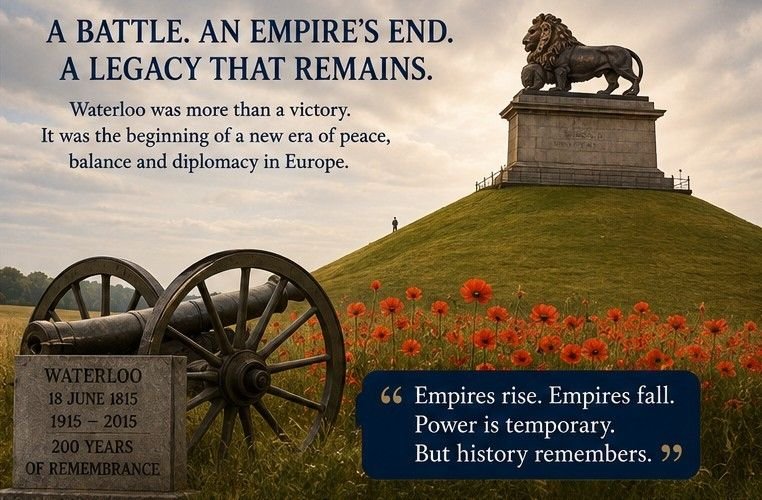
Two centuries later, the guns are silent.
The soldiers have disappeared.
The uniforms have become museum pieces.
The commanders belong to history.
But Waterloo remains alive in the imagination of Europe.
The battlefield is now a place of remembrance.
Visitors come from Britain, France, Belgium, Germany and many other countries.
They come not only to celebrate victory but also to remember the enormous cost of war.
Standing on the Battlefield:
As I stood at Waterloo, I looked across the fields and tried to imagine the scene of 1815.
Where I saw green grass, soldiers once saw enemy formations.
Where I saw peaceful roads, cavalry once thundered.
Where I saw visitors taking photographs, artillery once fired.
Where I stood in silence, thousands of men once shouted orders and battle cries.
History suddenly seemed alive.
I realised that a battlefield is not merely a geographical location.
It is a memory.
It is a place where the decisions of a single day changed the lives of millions.
The Emperor Who Lost Everything:
Napoleon had conquered kingdoms.
He had commanded enormous armies.
He had crowned himself Emperor.
He had placed members of his family on European thrones.
Yet at Waterloo, all his achievements were placed at risk.
In a few hours, his final attempt to recover his empire collapsed.
Waterloo therefore became more than a military defeat.
It became a symbol of the limits of power.
The greatest military genius can still be defeated by circumstances, strategy, resistance and the combined determination of opponents.
The Final Lesson:
Waterloo teaches us that history is rarely made by one person alone.
Napoleon was undoubtedly a remarkable military commander.
But he faced Wellington’s defensive skill, Blücher’s determination, the courage of thousands of Allied soldiers and the enormous resources of the coalition.
The final outcome was decided not only by the brilliance of commanders but also by the courage, endurance and sacrifice of ordinary soldiers.
And perhaps that is the deepest lesson of the battlefield.
Behind every great name in history stand thousands of unnamed men and women whose lives were changed by the decisions of powerful leaders.
Conclusion: The Silence After the Guns:
When I left the Waterloo battlefield, I looked back once more.
The landscape was peaceful.
Birds flew across the sky.
The fields were green.
There was no indication that this peaceful place had once witnessed one of the bloodiest and most decisive battles of nineteenth-century Europe.
But history remained there.
Napoleon had come to Waterloo seeking victory and the restoration of his empire.
Wellington came determined to stop him.
Blücher came to keep his promise.
Thousands of soldiers came because duty demanded it.
By nightfall, Napoleon’s army was defeated.
Three days later, the Emperor abdicated.
Soon afterwards, he was on his way to Saint Helena.
The Napoleonic age had ended.
And Waterloo entered history.
As I stood upon that battlefield during my visit to Belgium, I felt that the silence of Waterloo spoke more powerfully than the guns ever could.
It seemed to say:
Empires rise. Empires fall. Power is temporary. But history remembers.
Lokanath Mishra, IRS (Retd.)