
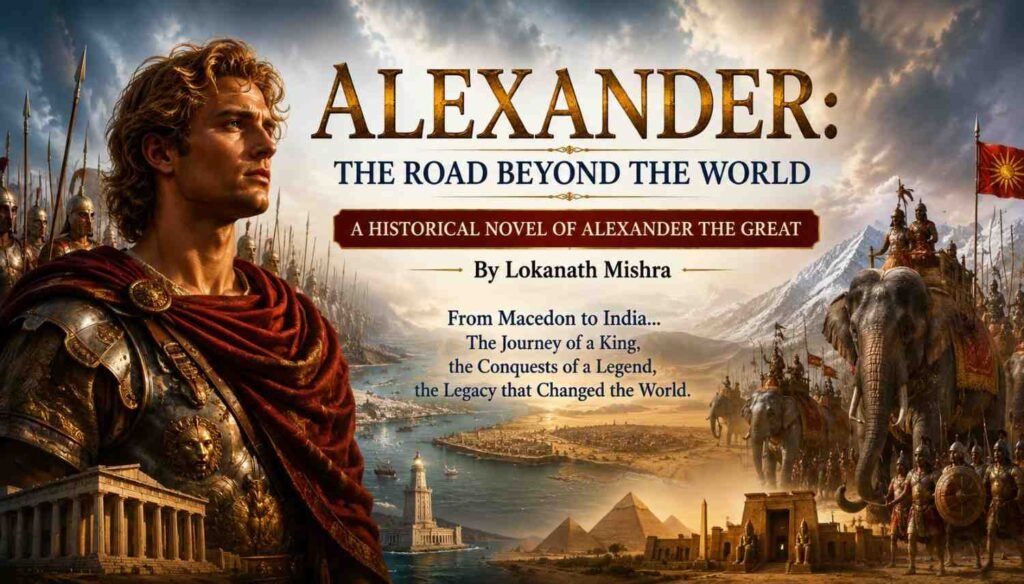
Alexander: The Road Beyond the World:
A Historical Novel of Alexander the Great:
By Lokanath Mishra:
The morning sun had barely risen over Pella when the young king stood upon the palace balcony and looked towards the distant mountains.
Macedon was quiet.
But Alexander was not.
He was only twenty years old, yet the weight of a kingdom already rested upon his shoulders.
His father, Philip II of Macedon, was dead.
The throne was his.
But Alexander did not intend merely to sit upon it.
He wanted to do what no Macedonian king had ever done.
He wanted to cross the mountains, defeat the great Persian Empire and carry his armies towards the edge of the known world.
Some believed he was ambitious.
Some called him reckless.
Others whispered that the young king was touched by destiny.
Alexander himself believed only one thing:
The world was too small for a man who had been born to conquer it.
⸻
Chapter I — The Young King
Alexander had grown up in an extraordinary world.
His father, Philip II, had transformed Macedon from a relatively divided kingdom into a powerful military state. He had created a disciplined army and developed the famous Macedonian phalanx, whose soldiers fought with long spears called sarissas.
But Alexander was more than a soldier.
His father had arranged for the philosopher Aristotle to educate him.
From Aristotle he learned about philosophy, politics, medicine, geography, literature and the stories of the ancient heroes.
Among those heroes, Alexander admired Achilles above all.
He read the Iliad and imagined himself following the path of Achilles.
He wanted glory.
But he wanted something even greater.
He wanted his name to survive after his body had returned to dust.
Then came the terrible year of 336 BC.
Philip II was assassinated.
Alexander immediately became king.
He was twenty.
His enemies thought Macedon would collapse.
Several Greek states rebelled.
Alexander moved with astonishing speed.
He marched south and forced the rebellious Greek states to submit.
When the city of Thebes rose against him, Alexander destroyed the city in 335 BC, except for its temples and the house traditionally associated with the poet Pindar.
The message was unmistakable.
The young king would not tolerate rebellion.
But Alexander’s eyes were already turned eastward.
Beyond the Aegean Sea stood the vast Achaemenid Persian Empire.
It was rich.
It was powerful.
And Alexander intended to conquer it.
⸻
Chapter II — Across the Hellespont
In 334 BC, Alexander crossed into Asia.
His army was not enormous by the standards of later empires, but it was highly trained and extraordinarily confident.
Macedonian infantry marched with their long sarissas.
Cavalry moved rapidly across the plains.
Among them rode Alexander himself.
He was not a distant commander who watched battles from a safe hill.
He repeatedly placed himself where the fighting was fiercest.
At the Battle of the Granicus, Alexander attacked Persian forces near the river.
The battle was dangerous.
For a moment, the young king was almost killed.
A Persian soldier raised his weapon behind him.
Alexander’s companion Cleitus intervened and saved his life.
The Macedonians won.
The road into Asia Minor opened before them.
Alexander continued south.
Cities surrendered.
Others resisted.
His army moved from one victory to another.
Yet the Persian king was still waiting.
His name was Darius III.
He was ruler of an empire that stretched across enormous territories.
Darius believed that Alexander was merely an ambitious young Macedonian.
He would soon discover his mistake.
⸻
Chapter III — The King of Kings
At Issus, in 333 BC, the two armies finally met.
Darius possessed a larger army.
He had the authority of the Persian throne behind him.
Alexander had something different.
He had confidence.
The battlefield was narrow, limiting the advantage of Persian numbers.
Alexander personally led the cavalry charge.
The fighting was fierce.
Darius watched as Alexander’s troops advanced towards him.
The Persian king eventually fled.
The Persian army collapsed.
Alexander had defeated the King of Kings.
But he did not immediately pursue Darius into the heart of Persia.
Instead, he turned south.
There was another land he wanted.
Egypt.
⸻
Chapter IV — Egypt
Egypt welcomed Alexander.
The ancient land of the Nile had been under Persian rule, and many Egyptians regarded Alexander as a liberator.
He entered the country in 332 BC.
At the ancient city of Memphis, he participated in Egyptian religious ceremonies and was recognised as pharaoh.
But Alexander did not merely want to rule Egypt.
He wanted to leave his own mark upon it.
Near the Mediterranean coast, he selected a site for a new city.
Its name would become famous throughout history:
Alexandria.
The city was intended to become a centre of commerce, learning and culture.
Alexander would not live to see what Alexandria would eventually become.
But his decision changed history.
The city later became one of the greatest intellectual centres of the ancient world.
Yet Alexander had little time to admire his creation.
The Persian Empire still stood before him.
And Darius was waiting.
⸻
Chapter V — The Road to Gaugamela
Alexander left Egypt and marched east.
His army crossed lands that would correspond to parts of modern-day Syria, Iraq and Iran.
Darius gathered an enormous army.
He wanted one final battle.
The two armies met near Gaugamela in 331 BC.
It was one of the decisive battles of the ancient world.
Darius had prepared the battlefield carefully.
The Persian army was vastly larger.
Alexander’s soldiers knew that they were facing an enemy capable of crushing them through sheer numbers.
But Alexander had a plan.
He moved his forces in a way that drew the Persian army apart.
Then, at the decisive moment, he led a cavalry charge towards Darius.
The Persian king once again fled.
The Persian army broke.
The great empire of the Achaemenids was effectively defeated.
Alexander entered Babylon.
Then came Susa.
Then Persepolis.
The treasures of Persia fell into Macedonian hands.
Alexander was no longer merely the king of Macedon.
He had become ruler of an enormous empire.
But victory did not satisfy him.
Every victory seemed to create another horizon.
⸻
Chapter VI — The Burning of Persepolis
One night, Alexander sat among the magnificent buildings of Persepolis.
The palace complex was filled with the wealth of generations of Persian kings.
Alexander’s officers celebrated.
Wine flowed.
The atmosphere became increasingly wild.
According to ancient accounts, the Greek woman Thais suggested that the Persian palace should be burned as revenge for the destruction of Greek temples during earlier Persian invasions.
Alexander agreed.
Fire spread through the palace.
Flames rose into the night sky.
For a moment, the conqueror watched silently.
Perhaps he remembered the destruction suffered by Greece.
Perhaps he regretted the decision.
Perhaps he did not.
History has never provided a completely certain answer.
But the flames of Persepolis became one of the most enduring images of Alexander’s conquest.
⸻
Chapter VII — Beyond Persia
Alexander now possessed lands stretching far beyond Macedon.
Yet he continued eastward.
He crossed difficult mountains.
He entered territories corresponding to modern Afghanistan and Central Asia.
The campaign became harder.
The landscape was unfamiliar.
The people resisted.
The distances seemed endless.
Alexander founded settlements and cities as he moved.
He married Roxana, a Bactrian noblewoman.
His soldiers were increasingly exhausted.
But Alexander was fascinated by the unknown.
He had defeated the greatest empire of the western world.
What remained?
India.
⸻
Chapter VIII — The Indus
Alexander’s army crossed the Hindu Kush and eventually reached the region of the Indus River.
The soldiers had marched thousands of miles.
They had fought Persians, Central Asian peoples and numerous local rulers.
Yet Alexander continued.
In 326 BC, he faced one of the most formidable opponents of his eastern campaign:
King Porus.
Porus ruled a kingdom in the Punjab.
His army included war elephants.
To the Macedonians, the elephants were terrifying.
They were enormous creatures carrying armed soldiers, moving like living towers across the battlefield.
The battle was fought near the Hydaspes River, known today as the Jhelum.
The fighting was fierce.
Alexander’s army eventually defeated Porus.
But something about the Indian king impressed him.
Alexander reportedly asked him how he wished to be treated.
Porus answered, according to the famous tradition:
“Like a king.”
Alexander admired the response.
Rather than humiliating his defeated opponent, he restored Porus to his position and allowed him to govern additional territory.
It was one of the unusual moments in Alexander’s career when conquest gave way to respect.
⸻
Chapter IX — The Soldiers Say No
Alexander wanted to continue.
Beyond the Punjab lay more kingdoms.
More rivers.
More mountains.
Perhaps, beyond them, another ocean.
Alexander called upon his soldiers to march farther.
But the army had reached its limit.
They had been away from home for years.
They had crossed deserts and mountains.
They had fought countless battles.
They had watched friends die.
They wanted to return.
At the Hyphasis River, the soldiers finally refused to go farther.
Alexander was furious.
He argued.
He appealed to their courage.
He reminded them of their victories.
But the army would not move.
For perhaps the first time in his career, Alexander had met an enemy he could not defeat by force.
It was not another king.
It was exhaustion.
It was distance.
It was the human desire to return home.
Alexander eventually accepted their decision.
The march eastward stopped.
The greatest conqueror of his age had reached the boundary created not by an enemy army, but by his own men.
⸻
Chapter X — The Return
The return journey was terrible.
Alexander divided his forces.
Part of the army travelled by sea.
Another part marched through difficult southern regions.
The journey cost many lives.
The conqueror who had once appeared almost invincible now saw the price of his ambitions.
His empire stretched across an enormous area—roughly two million square miles by some modern estimates—covering parts of three continents and extending from Greece and Egypt through the Persian heartlands into Central Asia and northwestern India.
But an empire so vast was difficult to govern.
Alexander had created something extraordinary.
He had not yet created a stable system to preserve it.
⸻
Chapter XI — Babylon
In 323 BC, Alexander returned to Babylon.
He was only thirty-two years old.
He had conquered more territory than almost any ruler before him.
He had crossed deserts.
He had defeated armies.
He had founded cities.
He had brought Greek language and culture into contact with the peoples of Egypt, Persia, Central Asia and India.
But now something unexpected happened.
Alexander became seriously ill.
For days he lay upon his bed.
His generals gathered around him.
The soldiers waited anxiously outside.
The king who had once ridden at the front of his army could no longer stand.
His body was failing.
His generals asked who would inherit the empire.
Alexander had no clear adult heir capable of immediately ruling the vast territory he had conquered.
Ancient sources preserve different traditions about his final words and the exact course of his illness.
But one thing is certain.
Alexander died in Babylon in 323 BC, at the age of thirty-two.
The man who had spent thirteen years creating an empire was gone.
⸻
Chapter XII — The Empire Without an Heir
Silence followed Alexander’s death.
Then came the question that would determine the future:
Who would rule?
Alexander had conquered an empire.
But he had not created a simple succession.
His generals were powerful men.
They had commanded armies.
They had their own ambitions.
The empire began to fracture.
The struggle became known as the Wars of the Diadochi, the wars of the successors.
Alexander’s generals fought one another.
Territories changed hands.
Kings rose and fell.
The empire was divided into several major Hellenistic kingdoms.
The dream of a single empire did not survive its creator.
But something else did.
⸻
Chapter XIII — The Empire That Survived Him
Alexander’s greatest legacy was not merely the land he conquered.
It was the movement of people, ideas and cultures across enormous distances.
Greek became an important language of administration and culture across much of the eastern Mediterranean and Near East.
Greek artistic traditions mixed with Persian, Egyptian, Central Asian and Indian influences.
Cities founded or reorganised during the Hellenistic period became centres of trade and learning.
Merchants travelled farther.
Scholars exchanged ideas.
Different peoples encountered one another in ways that would have been difficult to imagine before Alexander’s campaigns.
The world had changed.
Alexander had not created a permanent political empire.
But he had helped create a new cultural world.
It would become known as the Hellenistic world.
⸻
Epilogue — The Man Who Wanted the World
Centuries later, historians would still argue about Alexander.
Was he a brilliant military genius?
A ruthless conqueror?
A visionary?
A destroyer?
A cultural bridge between East and West?
Perhaps he was all of these.
He was a young man who inherited a kingdom and transformed it into an empire.
He defeated Darius.
He conquered Egypt.
He entered Persia.
He crossed Central Asia.
He reached India.
He founded cities.
He inspired loyalty among his soldiers and fear among his enemies.
Yet the greatest irony of his life was that he conquered enormous territories but could not conquer time.
At thirty-two, his life ended.
His empire did not remain united.
His generals divided it.
His cities survived.
His language travelled.
His legends multiplied.
And his name became larger than the empire itself.
On a quiet night in Babylon, the greatest conqueror of his age lay dying.
Perhaps he remembered Macedon.
Perhaps he remembered the mountains.
Perhaps he remembered the first time he had crossed into Asia.
Perhaps he imagined the lands beyond India—lands he had never reached.
The world was still there.
Vast.
Unconquered.
Waiting.
But Alexander was no longer able to ride towards it.
The young king who had once believed that the world was too small for his ambition had finally discovered the one boundary that no army could cross.
The boundary of human life.
And that is why, more than two thousand years later, the story of Alexander the Great still refuses to die.
The End.