

The Dawn Beyond Mount Kalathi : A Phenomenological Study of the Messinian Sunrise
By Lokanath Mishra
At precisely 07:15 EEST on August 30, 2026, a distinctive astronomical and topographical convergence unfolds along the coastal fringe of Kalamata, Greece. While classical maritime literature often celebrates the Mediterranean sunrise as an unencumbered horizon event—the sun ascending directly from an empty expanse of water—the littoral environment of the Messinian Gulf offers a fundamentally different dynamic. Here, the sunrise operates as a dramatic interplay between landform, light refraction, and open sea, structured by the sheer verticality of Mount Kalathi and the broader Taygetos range.
The Geomorphological Canvas
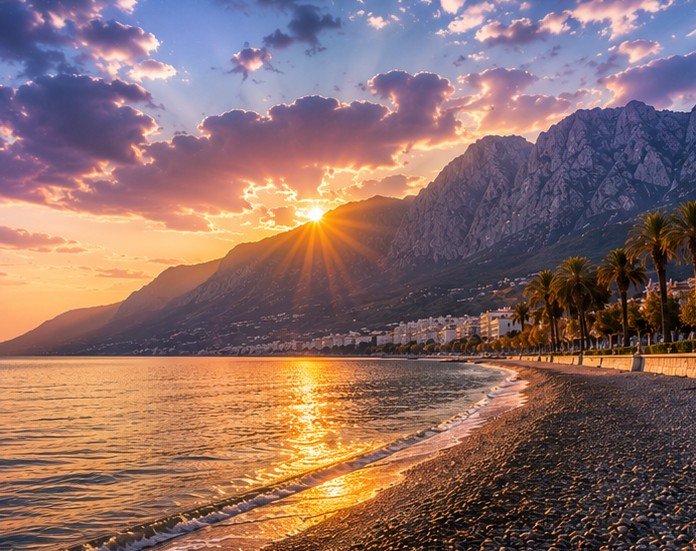
The beach at Kalamata presents an open coastal geometry facing south toward the Mediterranean, while bounded immediately to the east and northeast by high-relief topography. Rising sharply from the water’s edge to an elevation of 1,316 meters, Mount Kalathi acts as a monumental eastern wall. Positioned on the pebble-strewn shore at an azimuth of approximately 78° (East-North-East), an observer does not watch the sun breach a flat oceanic line. Instead, the morning sequence is defined by a prolonged pre-dawn illumination, as the sun ascends behind the mass of the mountain prior to visual cresting.
The Chronology of Illumination
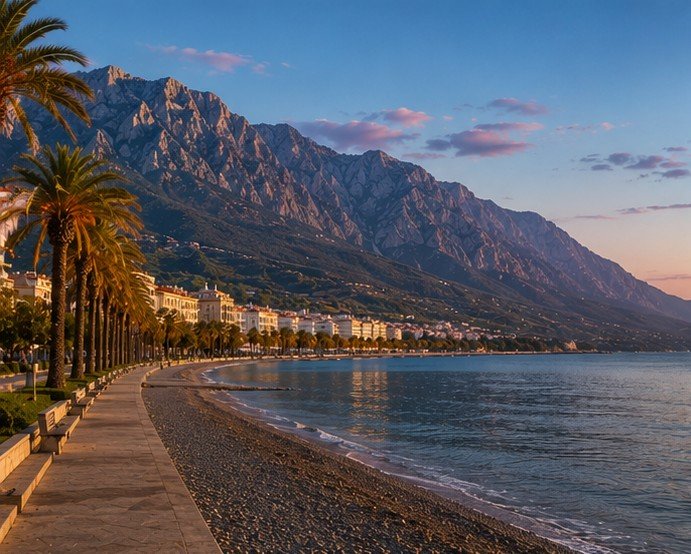
The atmospheric transformation begins well before the sun clears the mountain crest. As early solar rays strike the upper atmosphere, light diffracts over the sharp ridgeline of Kalathi, scattering shorter blue wavelengths and casting deep violet and gold hues across the sky.
When the solar disk breaches the peak at 07:15 AM, the effect is immediate and profound:
The Cresting Phase: Light breaks directly over the jagged edge of the mountain, instantly shifting the scene from soft diffuse radiance to direct, high-contrast illumination.
Shadow Projection: The massive shadow of Mount Kalathi recedes down the slopes, exposing the sharp ravines, pine coverage, and limestone surfaces of the Taygetos range to the morning warmth.
Vector Reflection: Direct light hits the surface of the Messinian Gulf, creating a concentrated, linear reflection beam that travels across the calm water directly to the pebble shore.
Synthesis of Mountain and Sea
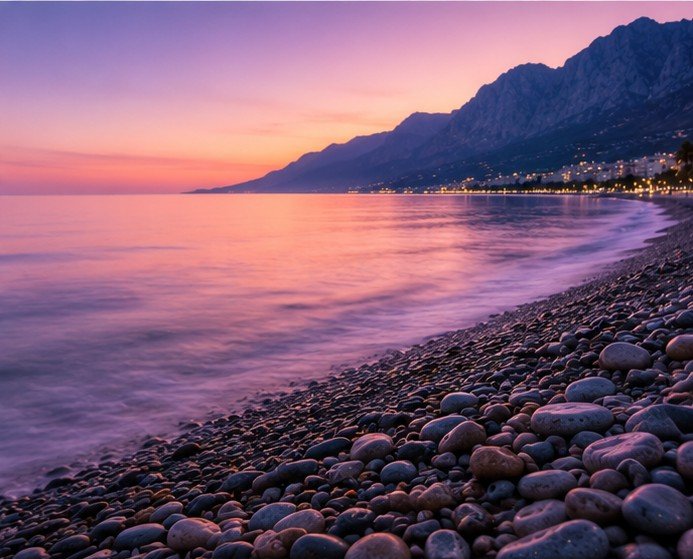
The morning landscape of Kalamata derives its power from this dual identity. The wide, open pedestrian promenade and expansive beach offer a feeling of vast marine space, yet the overwhelming proximity of Mount Taygetos creates an intimate terrestrial framing. Observing the sun rise from the sea shore—not out of the water, but out of the mountain—redefines the traditional coastal morning, uniting the static grandeur of tectonic relief with the fluid, kinetic light of the Mediterranean.