
Unveiling the Secrets of Rumasala Mountain in Sri Lanka
( by Lokanath Mishra)
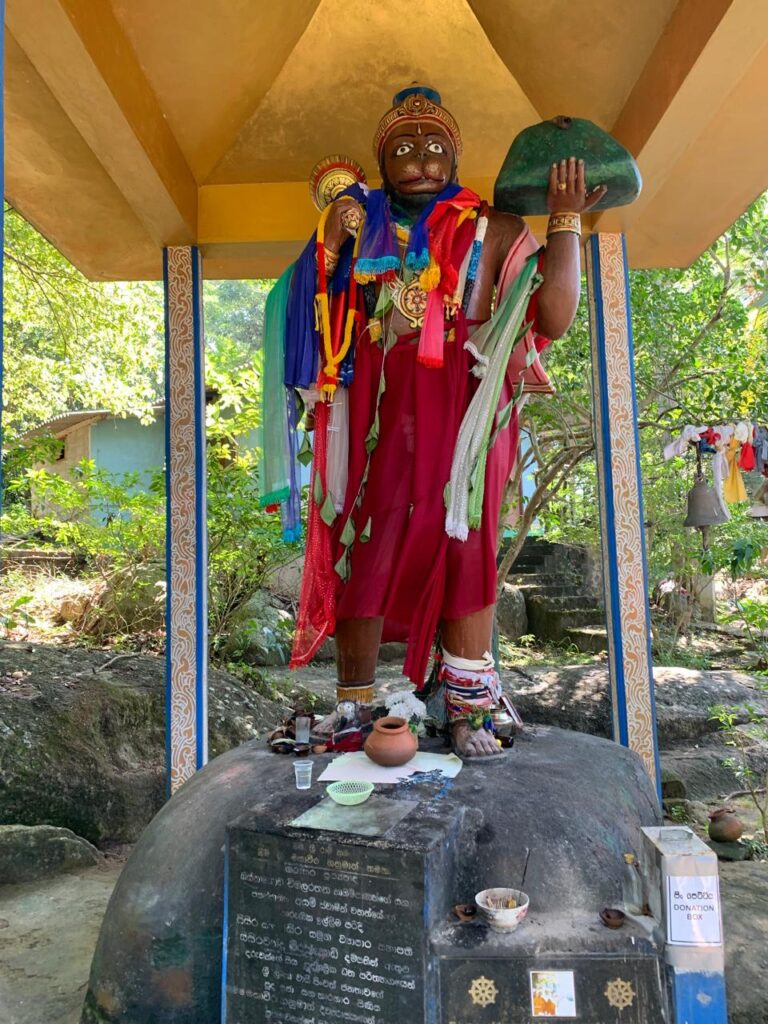
On December 24, 2024, I embarked on a journey to Rumasala Mountain, a site steeped in legend and history. This mountain holds great significance, as it is believed to be the place where Hanuman, the loyal devotee of Lord Rama, is moving in the forest and sea beach in live.
Rumasala Mountain serves as a tangible link to the Ramayana, providing evidence that the epic is rooted in fact.
As I explored the mountain, I felt a deep sense of spirituality and connection to the Ramayana. Locals believe that Hanuman’s spirit still resides in these hills, watching over devotees and offering guidance. The experience was truly humbling, and I felt grateful to have visited this sacred site.
My visit to Rumasala Mountain reinforced my conviction that the Ramayana is, in fact, a real story rooted in history. The mountain’s unique energy, combined with its historical significance, makes it a compelling testament to the epic’s authenticity.
As I departed Rumasala Mountain, I felt inspired and enlightened, carrying with me the memories of a truly unforgettable experience.
What we know from Ramayana,
Mata Sita , a kidnapped princess, a heroic battle to save her, a fallen warrior, a flying god carrying a holy mountain of herbs to save him. The legend of Rumassala is closely linked with the epic tale of Rama and Sita; a story intertwined with much of the history of Sri Lanka.
According to the epic Sanskrit tale, the Ramayana, the re-incarnated god Lord Rama’s wife was kidnapped and whisked far away by King Ravana. After months of searching, a distraught Rama and his younger brother Lakshmana traced Sita to Sri Lanka, thanks to the help of the immortal monkey god Hanuman. Rama, Lakshmana, Hanuman and an entire army of men and monkeys waged war on Ravana’s kingdom to rescue the kidnapped princess.
During the battle, Lakshmana was severely wounded by the son of Ravan, prompting a concerned Rama to dispatch Hanuman to the Himalaya to bring Sanjeevi from the mountain, which contained every miraculous herb on earth. Having arrived at the Himalaya mountain and being uncertain which herbs to take back, Hanuman decided to use his power to transport the part of mountain having Sanjibani back to Sri Lanka. The monkey-god made it back in time to save Lakshamana, the battle was won by Lord Rama, and Sita was rescued.
However, while Hanuman was flying with the mighty mountain, he is believed to have dropped fragments of it along the way – one of which fell on the southern end of Sri Lanka. This fragment is what is now fabled to be the lush Rumassala Hill, a wondrous place, rich in biodiversity, situated in close proximity to the southern coastal hotspot of Unawatuna.
Renowned Sri Lankan historian and physician, C. G. Uragoda believes that the name Rumassala is a corruption of the Sanskrit word ‘Ramasala’, which translates to ‘Rama’s Hall’. Uragoda believes that the name Unawatuna too draws from the tale of Rama and Sita. He argues that the name is a derivative of the Sinhala phrase, ‘onna wetuna’, which translates to ‘there, it fell’ – possibly from when the fragment of mountain fell.
The legend of Rumassala is further strengthened by the unexplained mysteries surrounding it. Logic has failed to explain a number of intriguing features of the Rumassala Hill. The place is considered to be a haven for herbs, with researchers having found and recorded 150 different species on the hill. The herb locals refer to as ‘Kalu Nika’ is even believed to have magic like properties. The identified herb species are unique to the hill, and don’t grown anywhere else in the vicinity. One possible explanation is that the soil properties of the hill are inherently different to the surrounding landscape – supporting the Ramayana legend that it was transplanted from a completely different geographical location. Interestingly, the herbs found on the Rumassala Hill are an exact match for herbs found on Ritigala Mountain, also fabled to have been formed by a fragment of the Sanjeevi mountain dropped by Hanuman. While myth and legend may capture our imagination and help romanticize the past, science gives us concrete proof that Rumassala is indeed a special location. Sri Lanka’s famous resident science visionary, Sir Arthur C. Clarke, discovered that the area has a magnetic anomaly, consistent with being struck by a meteorite. The scientific explanation for the special landscape of Rumassala could thus be that it is actually a meteorite that fell from the sky. If so, the exotic plant life on the hill could be other-worldly! According to Clarke, Rumassala has one of the lowest gravitational fields on earth, resulting in satellites being lost in orbit when they pass overhead.
Rumassala was also recognized for its beauty during the country’s colonial past, with the hill being named ‘Buono Vista’, which likely stems from ‘Buena Vista’ – Spanish for ‘good view’. A very apt name, considering the beautiful and exhilarating coastal views the hill offers. The Port of Galle was a key location in the maritime routes of the Indian Ocean during the colonial era. During this period, many ships are believed to have used the southern end of Rumassala to stock up on fresh water before embarking on long and arduous voyages. The remnants of an old jetty used for this purpose in the past is now used as a diving platform by the youth of the area.
In addition to a large number of rare medicinal plants, Rumassala is home to a variety of birds, reptiles and mammals, some of which are endemic species. The turquoise waters at the base of the cliff too are rich in vibrant sea life, truly making Rumassala a must visit mini-paradise within the paradise isle of Lanka. Finally we can say at the cost of repetition that in the epic Ramayana, the Sanjeevani Mountain is a magical herb that can revive the dying. According to the story, Hanuman carried the Sanjeevani herb from the Himalayas to Sri Lanka to save Lakshman, the wounded brother of Lord Rama. It is believed that parts of the mountain fell in five places in Sri Lanka, which are now known as the “Sanjeevani drops”:
Dolukanda: A mountain range near the ancient monastery hospital of Arankale
Rumassala: Located in Unawatuna, near Galle
Ritigala: Located between Anuradhapura and Polonnaruwa
Thalladi: Located near Mannar
Kachchativu: An island in the Jaffna district of the northern province
The Dronagiri Mountains in the Himalayas are believed to be the origin of the Sanjeevani herb. In Hindu mythology, the mountain is also mentioned in the Ramayana.