
Mahabharata : (A Story of the Dvapara Yuga in Prose) Part – 34
By Lokanath Mishra
On the quiet banks of the River Ramabeni, the five Pandava brothers were seated with their mother, Kunti, engaged in earnest conversation. The forest breeze moved gently, carrying with it the scent of leaves and water, when suddenly Bhima burst into loud, uncontrollable laughter. His booming voice echoed along the riverbank.
The Pandavas looked in the direction of his gaze and saw an astonishing sight. From a distance, an extremely aged ascetic was approaching them. His matted locks were so long that they dragged along the ground. Tears streamed constantly from his eyes, and his frail body was bent at three places. He moved forward in tiny, hurried steps, his face contorting painfully with every stride. Watching the old man’s strange, rapid movements, Bhima clapped his hands and laughed even louder.
Yudhishthira, however, was displeased. Turning sharply toward Bhima, he said,
“Maruti, when will you abandon such foolishness? Why are you laughing? This, too, is a wondrous creation of the Divine. To mock him is unworthy of you.”
The old ascetic continued approaching them. Suspicion stirred in Yudhishthira’s mind. He quietly asked Sahadeva,
“Who might this great soul be?”
Sahadeva replied calmly,
“Maharshi Vyasa himself has come, unable to bear our suffering any longer.”
As the old man reached them, he stood like a humble beggar, his hands outstretched. Instantly, Kunti and the five brothers fell flat at his feet in reverence. Vyasa laughed heartily and said,
“I wished to keep you in doubt for a while and amuse myself. But Sahadeva did not allow me to play this little game.”
With that, he assumed his divine form. Kunti brought a seat made of deer skin and placed it before him. Vyasa accepted the seat and sat down.
Kunti, her voice heavy with restrained pride and pain, spoke bitterly,
“While you live and watch, my sons—royal princes—wander in the forests, living on alms. Meanwhile, the sons of Gandhari enjoy royal pleasures. What sin have my children committed?
I am the daughter of Kuntibhoja, a bride of the Soma dynasty, yet my life has become wretched.
Born as Kshatriyas, my sons suffer as though they were fatherless.”
As she spoke, her sorrow overflowed. In the presence of her own people, her composure broke, and tears streamed down her face. With a trembling voice she asked,
“Father, for which sin are we being punished so cruelly?”
Vyasa consoled her gently.
“Do not grieve, my child. All this is part of a divine design. The terror caused by demons like Kumbhira, Kinnara, Hidimba, and Bakasura had shaken both heaven and earth. To destroy them, your exile was necessary. Now the days of sorrow are coming to an end.
King Drupada is arranging a swayamvara for his daughter, Krishnaa (Draupadi). Have you heard?”
Kunti replied,
“We heard of it from the sage Sumantra.”
Vyasa continued,
“Kings from many lands have already begun to arrive. Do not delay any longer—go at once to the land of Panchala. In Hastinapura, discussions have already taken place with Shri Krishna. A formidable archery challenge has been prepared, and Krishna himself has declared that only Partha (Arjuna) is capable of piercing the target.”
Vyasa then looked at Bhima and prophesied,
“For this maiden, there will be many battles. O Bhima, it is you who will crush the pride and strength of the Kauravas.”
With affection, Vyasa placed his hand on Bhima’s head. Overwhelmed with joy, Bhima lifted Vyasa onto his shoulders and began dancing. Vyasa laughed, while Yudhishthira scolded Bhima in mock anger. Finally, Vyasa descended, blessed Kunti and the Pandavas, and departed.
The mere news that the Kauravas would be present in Panchala was enough to ignite Bhima’s impatience. He sprang to his feet, urging everyone to leave at once. The journey began. Bhima moved at such tremendous speed that the others struggled to keep up. Yudhishthira deliberately walked slowly, knowing well the storm of anger brewing within Bhima—a rage born of years of exile, humiliation, and hardship.
At last, Bhima complained,
“If you all walk like this, the swayamvara will be over by the time we arrive!”
Finding no other solution, he lifted Kunti onto his head, placed Yudhishthira and Arjuna on his shoulders, and tucked Nakula and Sahadeva under his arms. He did not merely walk—he ran, or rather, he seemed to fly.
Thus, the Pandavas reached the capital of Panchala, where kings from nearly every kingdom had already assembled. The city wore a festive air, with grand arrangements for royal guests. Following Yudhishthira’s command, Bhima searched for lodging. He found an unused camp and suggested they stay there, but Yudhishthira laughed and said,
“No one knows we are alive. Why would royal quarters be reserved for us? Find a humble place where we will not be noticed.”
Outside the city stood a potter’s hut, warm from the constant fire within—perfect for the cold month of Magha. The potter and his wife welcomed Kunti and her sons warmly, as if they had been waiting for them. There the Pandavas stayed, disguised as Brahmins, and wandered the city unnoticed.
The next day was the swayamvara. Leaving Kunti behind, the five brothers, still in Brahmin attire, entered the grand assembly. Kings, sages, and celestial beings filled the hall. Krishna and Balarama were present. Seeing them, the Pandavas bowed respectfully. When Balarama questioned Krishna about the unfamiliar Brahmins, Krishna merely smiled, offering no direct answer.
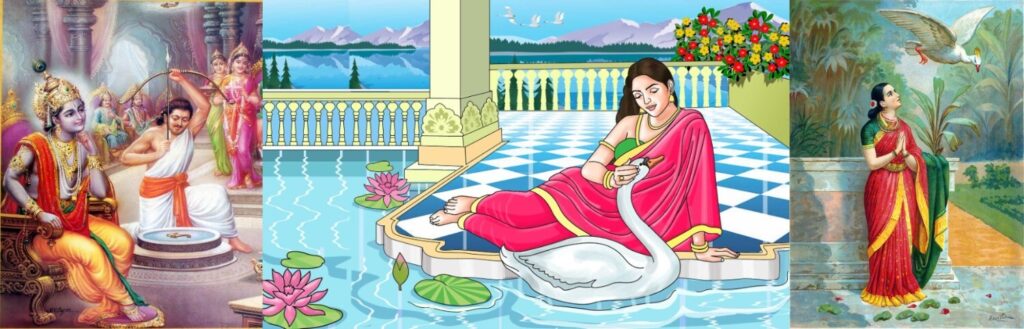
King Drupada soon entered the hall and announced the rules of the contest. A revolving wheel with sharp blades stood aloft, above which was placed a golden fish. Below it lay a vessel of water. The archer had to look at the fish’s reflection in the water and pierce its left eye without looking up.
Only the one who accomplished this feat would win Draupadi’s hand.
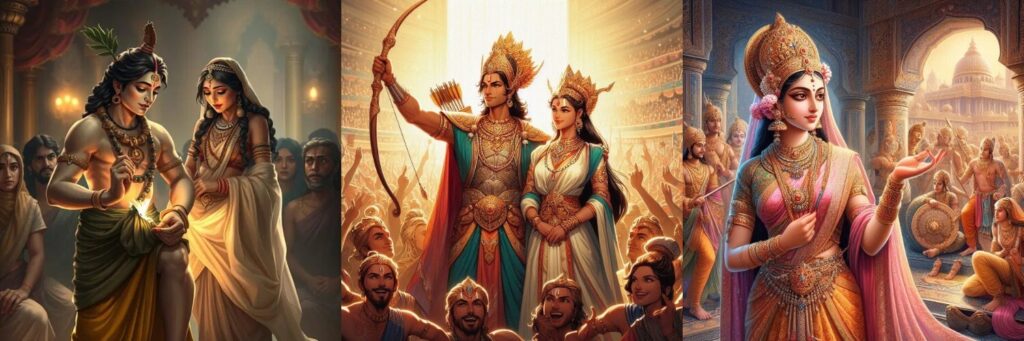
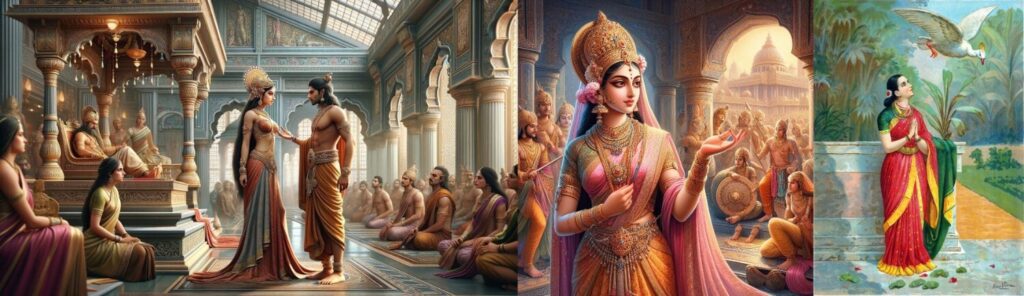
After the announcement, Draupadi was prepared by her companions—bathed, adorned, and dressed in fine garments and jewels. When she entered the assembly, radiant like the moon among stars, the hearts of kings trembled with desire and anticipation.
She circumambulated the hall, offering respectful glances, and finally took her seat. Her eyes briefly met those of Krishna and Balarama, and she bowed with devotion.
As gods gathered invisibly above the hall, Krishna softly asked Balarama,
“Brother, who do you think will pierce the target?”
Balarama replied confidently,
“Karna is a master archer. He will succeed—and Draupadi will be given to Duryodhana.”
Unseen by most, destiny smiled quietly, for the wheel of fate had already begun to turn.
Based on a reading of Sarala Mahabharata
ତୀର୍ଥଯାତ୍ରାର ପୂର୍ଣ୍ଣତା
Sri Jagannatha Darsana as the Culmination of Char Dhama and Dvadasa Jyotirlinga Pilgrimage
Mahabharata ( A Story of Dvapar Yuga in Prose) Part 33B
Pingback: Mahabharata - UniverseHeaven