
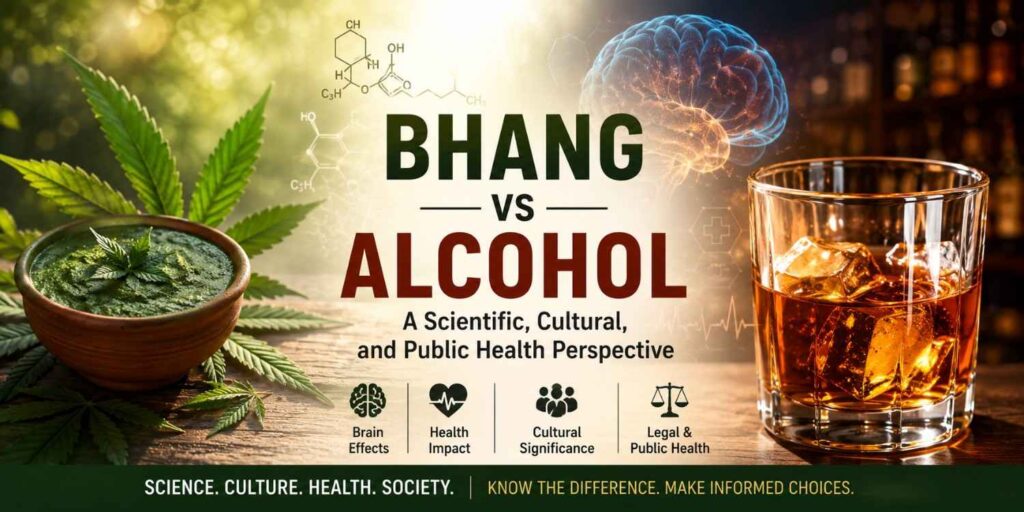
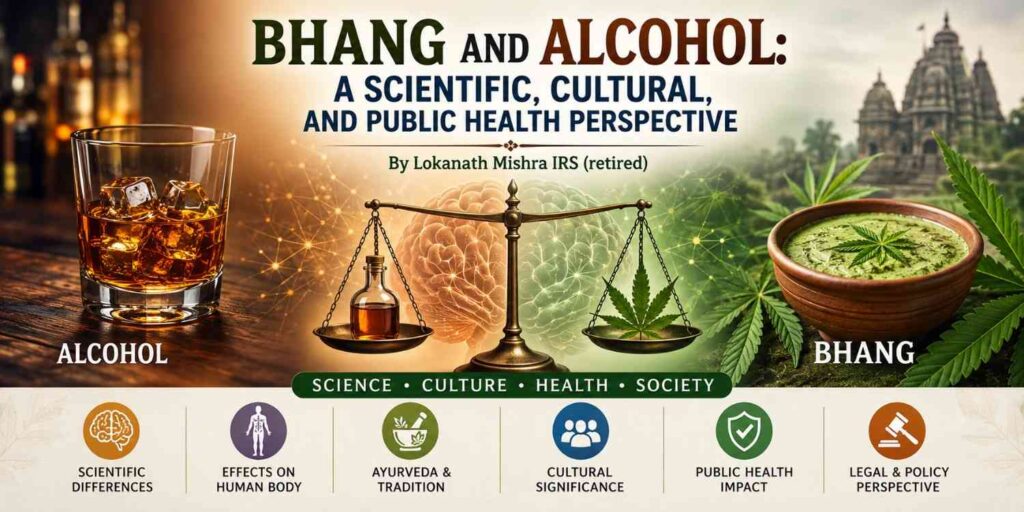
Bhang and Alcohol: A Scientific, Cultural, and Public Health Perspective
By Lokanath Mishra IRS ( retired)
Abstract
Alcohol and bhang are two psychoactive substances that have been used by human societies for centuries, yet they differ fundamentally in their chemistry, pharmacology, physiological effects, cultural significance, and public health consequences. Alcohol is one of the leading causes of preventable disease, injury, and death worldwide. Bhang, a traditional preparation made primarily from the leaves and flowering tops of Cannabis sativa, has occupied a unique place in Indian culture, Ayurveda, and Hindu religious traditions for thousands of years. This article examines the scientific differences between alcohol and bhang, explains their mechanisms of action on the human brain, discusses their health effects, explores the cultural importance of bhang in India, and considers the public health issues surrounding their regulation. The discussion is based on current scientific knowledge and historical evidence.
Introduction
Psychoactive substances have influenced human civilization for millennia. Among the most widely known are alcohol and cannabis. Although both alter brain function and human behaviour, they differ remarkably in their biological mechanisms, medical effects, and social consequences.
Alcohol is legally available throughout most parts of the world despite overwhelming scientific evidence linking its excessive use to liver disease, cardiovascular disorders, cancers, accidents, domestic violence, and millions of deaths annually. In contrast, bhang, a traditional edible preparation of cannabis, has been consumed in India for centuries during religious ceremonies and festivals and has also been used in Ayurvedic medicine. Because of its long cultural history and its distinct pharmacological profile, bhang continues to be the subject of scientific and public policy discussions.
Understanding the differences between these two substances requires examining not only their effects on the human body but also their historical, cultural, and legal contexts.
Alcohol and Its Effects on the Human Body
Alcohol, chemically known as ethanol, is rapidly absorbed after consumption. Approximately twenty percent is absorbed through the stomach, while nearly eighty percent enters the bloodstream through the small intestine. Once absorbed, alcohol circulates throughout the body and easily crosses the blood-brain barrier, affecting almost every region of the brain.
The liver metabolizes alcohol primarily through the enzyme alcohol dehydrogenase, producing acetaldehyde, a highly toxic compound that is subsequently converted into acetate. When alcohol is consumed faster than the liver can metabolize it, blood alcohol concentration rises, resulting in intoxication.
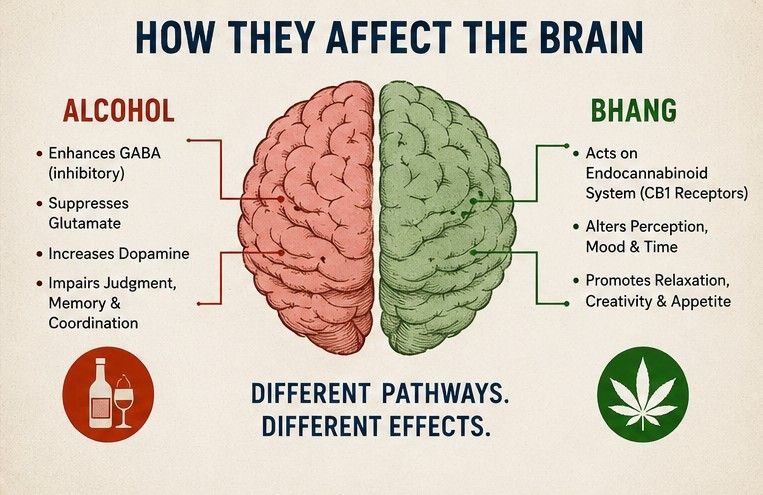
Within the brain, alcohol modifies communication between nerve cells by enhancing the activity of gamma-aminobutyric acid (GABA), the principal inhibitory neurotransmitter, while suppressing glutamate, the principal excitatory neurotransmitter. It also increases dopamine release within the brain’s reward system, producing pleasurable sensations.
The initial effects of alcohol include mild euphoria, increased confidence, greater sociability, reduced anxiety, and lowered inhibitions. As alcohol concentration rises, however, its depressant effects become more pronounced. Judgment becomes impaired because the frontal cortex is affected. Emotional control weakens, coordination deteriorates, speech becomes slurred, and reaction time slows considerably.
Alcohol also interferes with the normal functioning of the hippocampus, the brain structure responsible for memory formation. This disruption explains why heavy drinkers may experience blackouts, during which they remain conscious but later cannot remember events that occurred while intoxicated.
At very high concentrations, alcohol suppresses the brainstem centres that regulate breathing and heart function, making acute alcohol poisoning potentially fatal.
Bhang and Its Effects on the Human Body
Bhang is traditionally prepared from the leaves and flowering tops of Cannabis sativa. Its principal psychoactive constituent is delta-9-tetrahydrocannabinol (THC), although the plant contains numerous other biologically active compounds, including cannabidiol (CBD).
Unlike alcohol, THC primarily acts upon the body’s endocannabinoid system. It binds to cannabinoid CB1 receptors located throughout the brain, particularly in regions responsible for memory, movement, emotion, reward, appetite, and sensory perception.
Because bhang is consumed orally, THC is absorbed more slowly than smoked cannabis. The onset of effects generally occurs between thirty and ninety minutes after ingestion, although it may be delayed depending on the composition of the meal. Peak blood concentrations usually occur within one to three hours, and the psychoactive effects may persist for several hours because THC is converted in the liver into active metabolites.
Rather than producing the pronounced disinhibition commonly associated with alcohol, bhang typically induces relaxation, calmness, altered sensory perception, changes in time perception, increased appetite, and feelings of pleasure. Many users describe enhanced appreciation of music, colours, and artistic experiences, while others report increased introspection or creativity.
However, bhang is not without risks. High doses may produce anxiety, panic attacks, confusion, impaired concentration, temporary memory impairment, reduced coordination, and, in susceptible individuals, short-lived psychotic symptoms. Regular heavy cannabis use may also lead to cannabis use disorder in a proportion of users.
Scientific Differences Between Alcohol and Bhang
Although both alcohol and bhang influence the central nervous system, they do so through fundamentally different biological pathways.
Alcohol is a central nervous system depressant that acts broadly upon multiple neurotransmitter systems. It affects judgment, emotional regulation, balance, coordination, speech, memory, and behaviour. Its toxic effects extend well beyond the brain, damaging the liver, pancreas, heart, digestive system, and numerous other organs.
Bhang acts primarily through cannabinoid receptors within the endocannabinoid system, a naturally occurring signalling network involved in regulating mood, appetite, pain perception, and memory. Its effects are generally characterized by altered perception and relaxation rather than the behavioural disinhibition typical of alcohol intoxication.
Alcohol intoxication is frequently associated with aggressive behaviour, violent crime, domestic abuse, and serious road traffic accidents. Cannabis intoxication also impairs driving ability and reaction time and therefore increases accident risk, but it is generally less associated with aggressive behaviour. Nevertheless, operating vehicles or machinery after consuming either alcohol or bhang is unsafe.
Alcohol overdose may result in respiratory depression, coma, and death. By contrast, fatal overdose caused solely by THC has not been documented in humans. This does not imply that cannabis is harmless, as excessive consumption can still produce severe intoxication requiring medical attention.
Alcohol has a high potential for physical dependence, and withdrawal can become life-threatening. Cannabis dependence also occurs, although withdrawal symptoms are generally milder and rarely medically dangerous.
Health Consequences
The World Health Organization estimates that alcohol contributes to approximately three million deaths each year worldwide. Excessive alcohol consumption increases the risk of liver cirrhosis, pancreatitis, hypertension, stroke, cardiomyopathy, depression, suicide, road traffic injuries, and several cancers, including cancers of the mouth, throat, oesophagus, liver, colon, and breast.
Modern scientific research has also identified therapeutic uses for cannabis-derived medicines in carefully selected clinical situations. Certain cannabinoid-based medications have demonstrated effectiveness in treating chemotherapy-induced nausea and vomiting, chronic pain, spasticity associated with multiple sclerosis, and some forms of epilepsy. These medical applications differ from recreational consumption and are usually administered under medical supervision.
Traditional Ayurvedic literature attributes additional medicinal properties to cannabis preparations, including relief from digestive disorders, fever, dysentery, fatigue, and reduced appetite. Although some traditional claims remain under scientific investigation, modern medicine recognises that further high-quality clinical research is required before many historical therapeutic uses can be fully validated.
Cultural and Religious Importance of Bhang
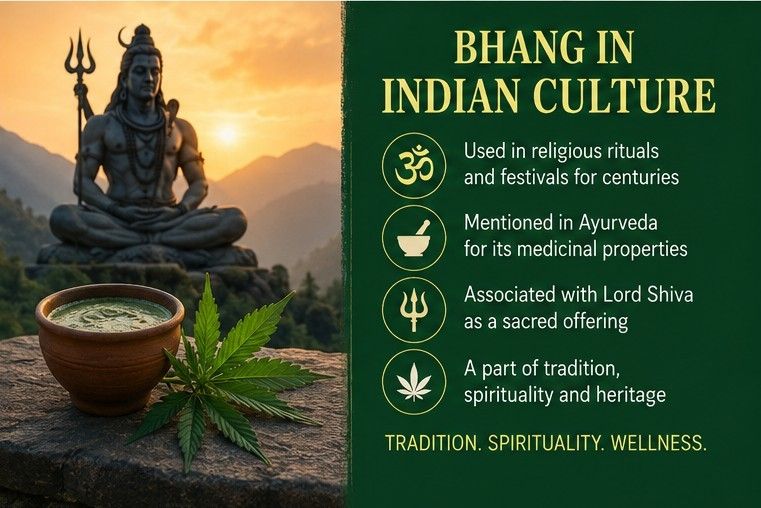
Bhang occupies a distinctive position within Indian civilization. References to cannabis appear in ancient Sanskrit literature, and its association with Lord Shiva has been preserved through centuries of religious practice.
During festivals such as Holi and Mahashivaratri, bhang is traditionally prepared by grinding cannabis leaves and flowering tops into a paste using a mortar and pestle. This paste is mixed with milk, curd, sugar, nuts, spices, and aromatic herbs to produce beverages such as bhang thandai and bhang lassi. It is also incorporated into sweets, halwa, chutneys, and small edible preparations known as bhang goli.
In cities such as Mathura and Varanasi, the preparation and consumption of bhang remain closely connected with temple traditions and religious ceremonies. Many devotees regard it as a sacred offering associated with meditation, devotion, and spiritual celebration rather than merely a recreational intoxicant.
Legal Status
The international legal status of cannabis changed significantly following the United Nations Single Convention on Narcotic Drugs of 1961, which placed cannabis under international control alongside other narcotic substances. Nevertheless, India’s domestic legal framework has historically distinguished traditional bhang from cannabis resin and flowering tops.
Under the Narcotic Drugs and Psychotropic Substances Act, 1985, the regulation of cannabis products focuses primarily on resin (charas) and flowering tops (ganja). In several Indian states, bhang continues to be legally sold through government-authorised outlets under state regulations.
Industrial hemp cultivation has also been permitted under regulated conditions in states such as Uttarakhand for fibre, seed, and industrial applications.
Public Health Considerations
Scientific evidence clearly demonstrates that neither alcohol nor bhang is completely free from health risks. The safest choice for health is not to use intoxicating substances. For those who do consume them, moderation, awareness of risks, and adherence to applicable laws are essential.
From a public health perspective, alcohol contributes substantially to disease burden, injury, and mortality worldwide. Cannabis presents a different profile of benefits and risks, including recognised medical applications for certain conditions alongside potential adverse effects, particularly with heavy or early-age use.
Discussions about the future regulation of bhang in India should therefore be guided by scientific evidence, public health priorities, cultural traditions, and appropriate safeguards to minimise misuse, protect minors, and ensure product quality.
Conclusion
Alcohol and bhang differ fundamentally in their chemistry, mechanisms of action, physiological effects, and historical significance. Alcohol primarily depresses the central nervous system and is associated with substantial morbidity and mortality, including liver disease, cardiovascular disorders, cancers, accidents, and social harm. Bhang acts mainly through the endocannabinoid system, producing altered perception, relaxation, and changes in mood and appetite. Although it has recognised cultural importance and potential therapeutic applications, it also carries risks, including impaired cognition, reduced coordination, dependence in some users, and adverse mental health effects in susceptible individuals.
India possesses one of the world’s oldest traditions of bhang consumption, particularly in religious and cultural settings. Future policy decisions regarding its cultivation, distribution, and use should continue to be informed by rigorous scientific research, public health evidence, constitutional and legal considerations, and respect for India’s cultural heritage. An evidence-based regulatory approach, rather than one based solely on historical practice or contemporary perception, offers the most balanced path for protecting both individual health and public welfare.
References
World Health Organization. Global Status Report on Alcohol and Health. Geneva: WHO.
World Health Organization. Cannabis: Health Effects and Regulatory Considerations.
National Institute on Alcohol Abuse and Alcoholism (NIAAA). Alcohol’s Effects on the Body.
National Institute on Drug Abuse (NIDA). Cannabis (Marijuana) Research Report.
United Nations Office on Drugs and Crime (UNODC). World Drug Report.
Pertwee, R. G. “The Pharmacology of Cannabinoid Receptors.” British Journal of Pharmacology.
Mechoulam, R., & Parker, L. A. “The Endocannabinoid System and the Brain.” Annual Review of Psychology.
Government of India. Narcotic Drugs and Psychotropic Substances Act, 1985.
United Nations. Single Convention on Narcotic Drugs, 1961.