
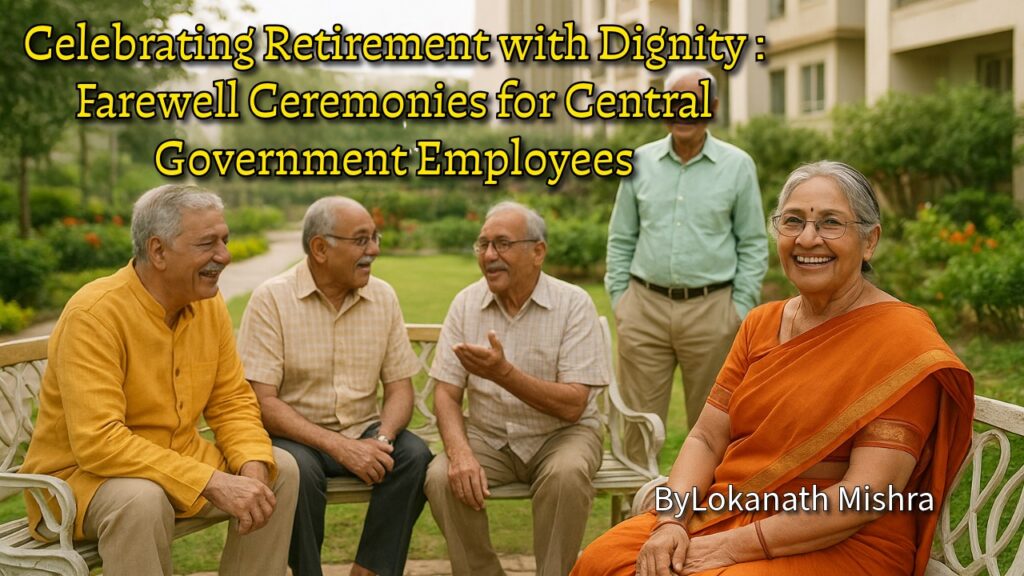
Celebrating Retirement with Dignity : Farewell Ceremonies for Central Government Employees
By Lokanath Mishra, The Chief Adviser, The All India Pensioners Association of CBIC
Retirement marks the culmination of a government servant’s years of dedicated service to the nation. It is a moment of transition from structured professional life to personal pursuits, and it often evokes deep emotions among colleagues, friends, and family. A thoughtful farewell ceremony can honour the contributions of a retiring employee, foster goodwill within the organisation, and provide closure to a long journey of public service. But in the context of Central Government service in India, such celebrations must be held within well-defined rules and guidelines that prioritise austerity, propriety and administrative discipline.
Why Celebrate Retirement?
Retirement is more than the end of service—it is recognition of years of commitment, sacrifice and professional contribution to national development. A modest farewell:
• Honours the individual’s contribution in front of colleagues and juniors,
• Strengthens organisational culture by reinforcing respect across hierarchies,
• Provides emotional closure, helping colleagues and the retiring employee mark this life transition,
• Encourages younger employees by showcasing the long-term value of public service.
These intangible benefits improve morale and cohesion within government offices.
Regulatory Framework: CCS (Conduct) Rules, 1964 and DoPT Guidelines
While celebrations are appropriate, they are strictly regulated under Central Government rules to prevent excess, misuse of public time and funds, and inappropriate displays that may contravene the ethos of public service.
Rule 14: Public Demonstrations in Honour of Government Servants
The Central Civil Services (Conduct) Rules, 1964 clearly govern how retiring employees are to be honoured. Rule 14 states that:
“No Government servant shall, except with the previous sanction of the Government, receive any complimentary or valedictory address or accept any testimonial or attend any meeting or entertainment held in his honour…” 
However, the same Rule includes TWO key exceptions that are directly relevant to retirement:
1. Farewell Entertainment:
A farewell of a “substantially private and informal character” held in honour of a government servant on retirement or transfer is permitted without prior sanction. 
2. Simple and Inexpensive Functions:
Simple and inexpensive entertainments organised by public bodies or institutions can be accepted without Government sanction. 
These provisions recognise the legitimacy of informal farewells and modest celebrations, while guarding against extravagance or formal receptions that resemble public honours requiring special approvals.
Restrictions on Contributions
The Rule’s NOTE clearly forbids any pressure or influence to make voluntary contributions for a farewell—especially contributions extracted from lower-grade employees for the benefit of a higher-ranked officer. 
This ensures that retirement celebrations remain voluntary, dignified, and free from undue financial expectations.
Other Restrictions in Practice
Separate circulars, for example from the Railway Ministry, have expressly discouraged lavish gifts such as gold-plated medals on retirement, reinforcing that extravagance is inconsistent with government austerity norms. (Though specific rail examples vary, the underlying message is consistent with overall government policy on simplicity and austerity.)
Integrating Farewell Celebrations with Administrative Duties
A key DoPT instruction links farewell events to timely processing of retirement benefits. One Office Memorandum specifically advises that farewell functions can be used by heads of offices to review and ensure the pension cases of all employees retiring in the next six months are on track. This emphasises:
• Advance preparation: pension forms should be submitted months before retirement,
• Monitoring by heads of offices to ensure there are no delays,
• Opportunity for the team to reflect on administrative readiness. 
This guidance integrates the spirit of a farewell with the practical necessity of ensuring that pension papers and other retirement dues are completed on time, underscoring that farewells should also serve constructive, functional purposes.
Principles for a Proper Farewell Ceremony
Based on rules and practical considerations, a well-conducted retirement celebration should follow these principles:
- Maintain Simplicity and Dignity
Farewells should be warm but modest in scale and cost. Elaborate celebrations or expensive functions may contravene the rule’s intent and attract scrutiny.
• Avoid costly venues or high-end catering.
• Refrain from expensive gifts from office funds or collective employee contributions.
These practices uphold the ethos of simplicity emphasised in the guidelines. 
- Informal and Private Nature
Organise the event to feel informal and personal, rather than an official “public event”. This aligns with the Rule 14 exception for celebrations that are not formal public demonstrations. 
- Voluntary Participation Only
Employees should be free to choose whether to participate or contribute. No person should be pressured to donate or subscribe to any farewell arrangement. 
- Incorporate Administrative Review
Use the farewell as an opportunity to glance over administrative matters such as pension processing and dues—strengthening organisational discipline and ensuring a smooth retirement transition. 
Celebration Within the Framework of Responsibility:
A farewell for a retiring Central Government employee is justified and beneficial when conducted with thought, dignity, and respect for official rules. The Government of India’s instructions—especially Rule 14 of the CCS (Conduct) Rules and DoPT guidance—clearly allow informal and modest farewells, while safeguarding against undue public ceremonies and financial impositions. 
Celebrations that emphasise simple, heartfelt recognition, uphold austerity, respect voluntary participation, and integrate administrative readiness for retirement benefits capture both the emotional and practical aspects of an employee’s final day. This balanced approach honours personal contribution without compromising professional integrity or propriety—a fitting tribute to a lifetime of service to the nation.
Role of Recreation Clubs in Organising Farewell Meetings
To further ensure compliance with Government instructions on austerity and propriety, the organisation of retirement farewell meetings may be appropriately entrusted to Recreation Clubs functioning within the office or establishment.
Farewell by the Recreation Club
A farewell meeting may be organised by the Recreation Club of the office, utilising only the club’s own funds, which are voluntarily contributed by members for welfare and cultural activities. Since such clubs function independently of government budgetary allocations, this arrangement:
• Avoids any expenditure from public funds,
• Aligns with the principle of simplicity and austerity, and
• Keeps the event within the ambit of a private and informal gathering, as permitted under Rule 14 of the CCS (Conduct) Rules, 1964.
The use of Recreation Club funds also ensures transparency, voluntary participation, and financial propriety.
Presiding Role of the Head of Office
The Head of Office may preside over the farewell meeting in an ex-officio and non-ceremonial capacity. This serves multiple purposes:
• It lends institutional dignity to the occasion without converting it into a formal public function,
• Provides an opportunity for the Head of Office to acknowledge the employee’s service in a restrained and official manner, and
• Reinforces organisational continuity and respect for service, while remaining within the scope of permissible informal farewells.
Such presiding does not amount to a public demonstration or valedictory address requiring special sanction, provided the function remains simple and informal.
Presentation of Memento and Felicitation Certificate:
In keeping with the ban on lavish gifts and the emphasis on modesty, it is appropriate that:
• A simple memento, symbolic in nature and of nominal value, and
• A felicitation certificate recording the years of service and contribution be handed over to the retiring employee during the farewell meeting.
These items serve as non-monetary tokens of appreciation, preserving memories of service without violating norms related to expensive gifts or testimonials.
Farewell by the Concerned Service Association:
In addition to the Recreation Club function, a similar farewell meeting may be organised separately by the concerned Service Association (staff association or recognised union), subject to the following conditions:
• Participation and contributions must be purely voluntary,
• No pressure—direct or indirect—should be exerted on any member to contribute, and
• The meeting should remain informal, inexpensive, and respectful.
This ensures inclusive participation across cadres while fully complying with the Conduct Rules.
Symbolic Retirement Gifts for Memory and Utility:
Certain simple, traditional, and utilitarian items may be presented as part of the farewell, not as luxury gifts but as symbolic reminders of life after service. These may include:
• An umbrella – symbolising protection and preparedness,
• A torch light – representing guidance and illumination beyond service life,
• A shawl or a pair of shoes – traditional items associated with respect, warmth, and movement into a new phase of life.
When these items are modest in cost, procured from voluntary funds, and presented without compulsion, they remain consistent with the spirit of austerity and simplicity mandated by Government guidelines.
Such gifts are not merely material objects but emotional anchors, helping the retired employee recall their association with colleagues and the institution even after retirement.
Overall Justification
Organising farewell meetings through Recreation Clubs and Service Associations, presided over by the Head of Office, and marked by the presentation of simple mementos and symbolic gifts, represents a balanced and compliant model of retirement celebration. It:
• Respects the legal framework of CCS (Conduct) Rules,
• Upholds financial discipline and austerity,
• Encourages voluntary and inclusive participation, and
• Preserves the human and emotional dimension of public service.
Such an approach ensures that retirement is celebrated not with extravagance, but with dignity, gratitude, and lasting memory—values befitting a Central Government employee’s lifelong service to the nation.