
Europe – A Continent of History, Civilization and Modern Progress
Chapter 2: The United Kingdom, Brexit, Economy, Agriculture, Science and Education
By Lokanath Mishra, M.A., LL.B., IRS (Retired)
In the first chapter, we learned about the geographical location of Europe, its forty-four sovereign countries, its ancient history and the formation of the European Union. In this chapter, I shall discuss why the United Kingdom left the European Union, and explain the remarkable progress Europe has made in industry, agriculture, science, education and technology.
Why Did the United Kingdom Leave the European Union?
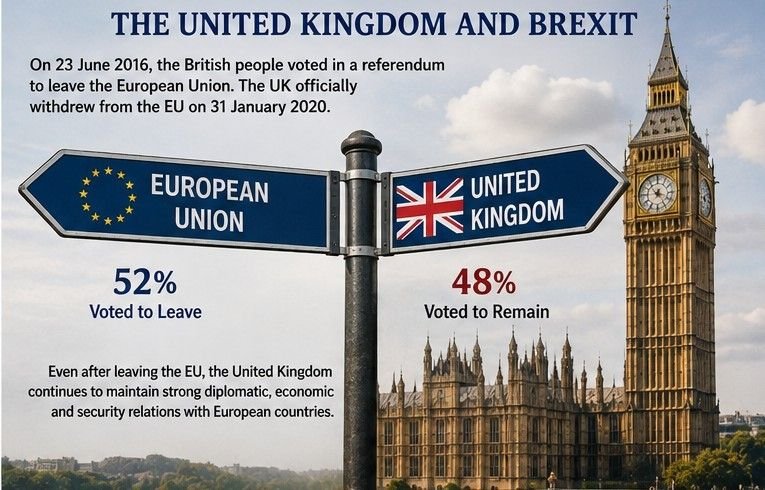
The United Kingdom (UK) is geographically a part of Europe, but it is no longer a member of the European Union (EU).
On 23 June 2016, the British people voted in a nationwide referendum on whether the country should remain in or leave the European Union. About 52% voted to leave, while 48% voted to remain. After several years of negotiations, the UK officially withdrew from the European Union on 31 January 2020. This historic event is popularly known as Brexit, meaning “Britain’s Exit.”
Those who supported Brexit believed that the United Kingdom should have greater control over its own laws, immigration policies, fisheries, agriculture and international trade agreements. They also wished Parliament in London to have greater authority over decisions affecting the country.
Many people who preferred to remain in the European Union argued that close economic cooperation with neighbouring countries benefited trade, investment, employment and scientific research. Brexit therefore reflected a difference of opinion among British voters rather than a single national viewpoint.
Even after leaving the European Union, the United Kingdom continues to maintain close diplomatic, economic and security relations with European countries. It remains one of Europe’s leading economies and an influential member of international organisations such as the United Nations, NATO, the G7 and the Commonwealth.
Why Is Europe Economically Prosperous?
One question frequently arose during my travels through Belgium, the Netherlands, Germany, Switzerland, Austria, France and Italy:
Why are so many European countries economically prosperous?
The answer lies in several factors that have developed over centuries.
Investment in Education
European nations have long regarded education as the foundation of national development.
Children receive quality primary and secondary education, while universities encourage scientific research, innovation and critical thinking. Technical institutions produce highly skilled engineers, doctors, scientists and technicians who contribute to national development.
Education has enabled Europe to transform knowledge into economic prosperity.
Scientific Research
Europe has produced many of the world’s greatest scientists.
The discoveries of Isaac Newton, Albert Einstein, Galileo Galilei, Marie Curie, Louis Pasteur, Johannes Kepler, Nikola Tesla and many other pioneers transformed modern science.
Today, European governments invest billions of euros annually in scientific research, artificial intelligence, biotechnology, medicine, renewable energy and space technology.
Research institutions and universities work closely with industries to convert scientific discoveries into useful products and services.
Industrial Development
Europe is widely regarded as the birthplace of the Industrial Revolution.
Beginning in Britain during the eighteenth century, the invention of steam engines, mechanised textile production and improved transportation transformed the world economy.
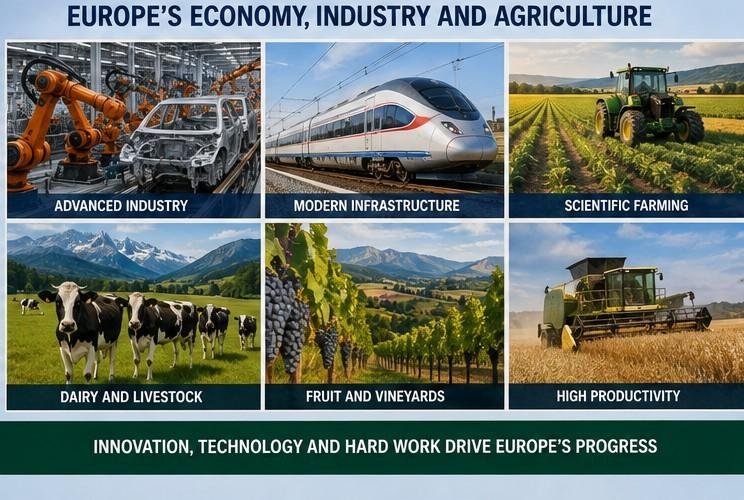
Today, Europe remains one of the world’s leading industrial regions.
Major industries include:
- Automobile manufacturing.
- Aerospace engineering.
- Railway equipment.
- Pharmaceuticals.
- Precision machinery.
- Chemicals.
- Electronics.
- Medical equipment.
- Robotics.
- Renewable energy technology.
- Shipbuilding.
- Luxury goods.
- Food processing.
Germany is internationally recognised for automobiles and engineering.
France excels in aerospace, luxury goods and pharmaceuticals.
Italy is famous for fashion, machinery, furniture and food products.
Switzerland leads in banking, watches, pharmaceuticals and precision instruments.
The Netherlands is renowned for agriculture, logistics and port management.
Agriculture – Scientific Farming
Although Europe is highly industrialised, agriculture remains one of its greatest strengths.
During my journey, I observed extensive cultivation of wheat, maize, barley, potatoes, vegetables, grapes and fruit orchards.
European farmers use modern agricultural techniques, including:
- Mechanised cultivation.
- Precision irrigation.
- Scientific soil testing.
- High-quality seeds.
- Modern harvesting equipment.
- Efficient cold storage.
- Digital farm management.
These methods increase productivity while conserving water and protecting the environment.
Many countries also promote dairy farming, poultry, horticulture and organic agriculture.
The vineyards of France, Italy, Germany and Austria produce internationally renowned wines, while the dairy industries of Switzerland, the Netherlands and Denmark produce world-famous cheeses and milk products.
Transportation and Infrastructure
One of the most impressive aspects of Europe is its infrastructure.
Throughout my journey, I travelled on:
- Multi-lane express highways.
- High-speed railways.
- Long mountain tunnels.
- Modern bridges.
- International airports.
- Efficient metro systems.
- Inland waterways.
The highways are carefully designed with service stations, emergency facilities, electronic traffic management and strict safety standards.
Many tunnels through the Alps represent extraordinary engineering achievements that have greatly improved transport while preserving the natural landscape.
Education – The Foundation of Progress
Europe is home to some of the world’s oldest and most prestigious universities.
Institutions such as:
- University of Bologna.
- University of Oxford.
- University of Cambridge.
- Sorbonne University.
- Heidelberg University.
have educated scholars, scientists and statesmen for centuries.
European education encourages independent thinking, scientific inquiry and practical learning.
Many universities collaborate closely with industries, ensuring that research contributes directly to economic development.
Healthcare and Social Welfare
Most European countries provide extensive public healthcare systems and social welfare programmes.
Citizens generally have access to:
- Healthcare.
- Public education.
- Pension systems.
- Social security.
- Unemployment support.
Although each country follows its own policies, the common objective is to provide a reasonable standard of living while maintaining economic productivity.
Innovation and Environmental Protection
Europe has become a global leader in renewable energy and environmental conservation.
Countries invest heavily in:
- Wind power.
- Solar energy.
- Hydroelectric power.
- Waste recycling.
- Water conservation.
- Forest protection.
- Sustainable urban planning.
Climate change has encouraged governments to promote cleaner technologies and reduce carbon emissions.
Lessons for India
As an Indian visitor, I observed many practices from which India can continue to learn.
Greater investment in education, scientific research, vocational training, infrastructure and environmental conservation can further strengthen India’s already impressive progress.
At the same time, Europe can also learn from India’s strengths, including its rich cultural heritage, youthful population, entrepreneurial spirit and remarkable achievements in information technology, digital public services and space exploration.
Nations grow stronger when they learn from one another rather than compete unnecessarily.
Conclusion
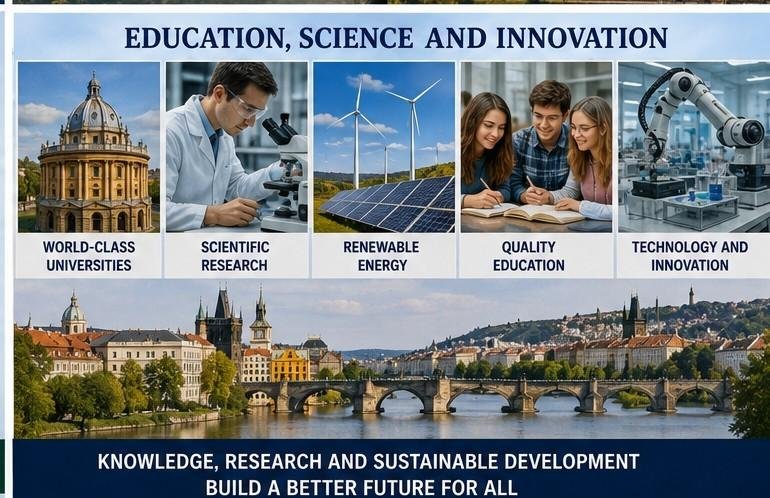
Europe’s prosperity has not been created overnight. It is the result of centuries of investment in education, scientific research, industrial innovation, good governance and infrastructure.
The United Kingdom’s decision to leave the European Union illustrates that democratic societies may reach different conclusions about how best to govern themselves, while still maintaining close cooperation with their neighbours.
During my journey through Europe, I came to appreciate that the continent’s greatest strength lies not only in its wealth or technology, but also in its commitment to education, scientific inquiry, cultural preservation and international cooperation.
These lessons remain valuable for every developing nation seeking sustainable progress in the twenty-first century.
(To be continued in Chapter 3: Rivers, Mountains, Climate, Transportation and Tourism in Europe.)