
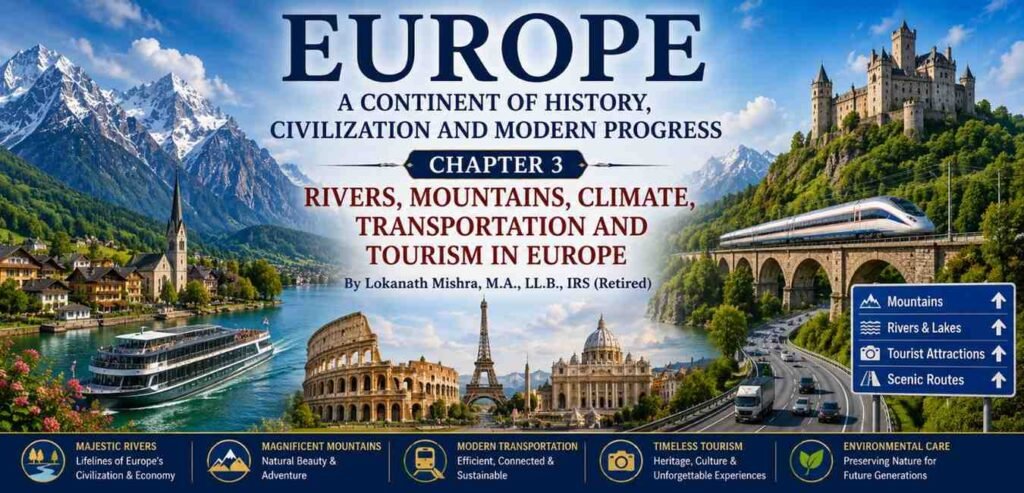
Europe – A Continent of History, Civilization and Modern Progress
Chapter 3: Rivers, Mountains, Climate, Transportation and Tourism in Europe
By Lokanath Mishra, M.A., LL.B., IRS (Retired)
In the previous chapters, we discussed Europe’s history, the European Union, Brexit, education, science, industry and agriculture. During my fifteen-day tour through Belgium, the Netherlands, Germany, Switzerland, Liechtenstein, Austria, Italy, France and Vatican City, I was deeply impressed by Europe’s magnificent natural beauty, well-planned infrastructure and excellent transport system.
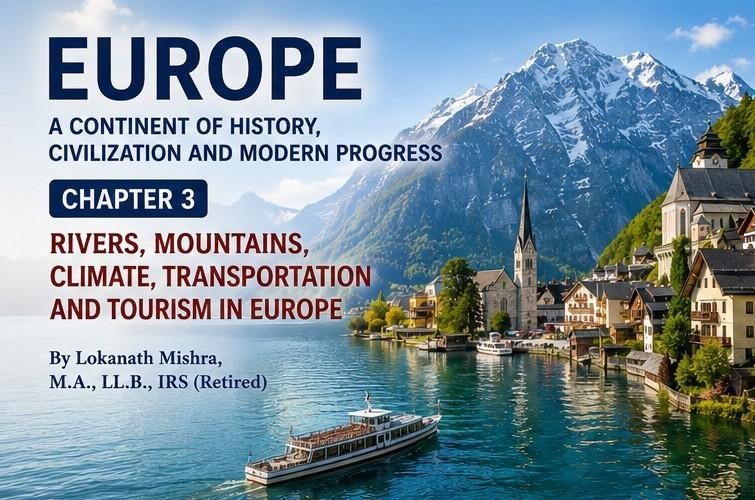
The continent is richly blessed with rivers, mountains, forests, lakes and fertile plains. These natural resources have played a vital role in shaping Europe’s civilization, economy and cultural heritage.
The Great Rivers of Europe
Europe has hundreds of rivers, many of which are navigable throughout the year. Unlike many tropical rivers that experience extreme seasonal fluctuations, several European rivers maintain relatively stable water levels because of moderate rainfall, regulated reservoirs and, in some regions, snowmelt from the Alps. However, climate change has brought more frequent floods and droughts to parts of Europe in recent years.
The Rhine River
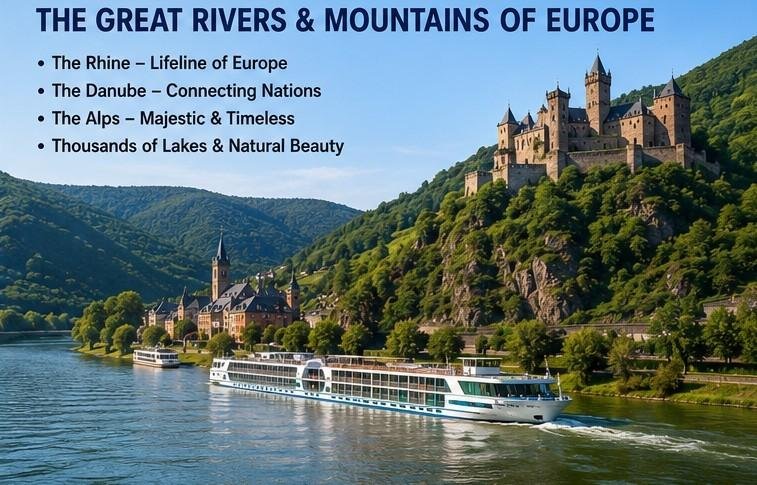
The Rhine is one of Europe’s most famous rivers. It originates in the Swiss Alps, flows through or along the borders of Switzerland, Liechtenstein, Austria, Germany, France and the Netherlands before entering the North Sea.
Stretching for about 1,230 kilometres, the Rhine is often called the “Economic Lifeline of Europe.” It carries millions of tonnes of cargo every year, linking inland industries with major seaports such as Rotterdam.
During my visit to Germany, I enjoyed a memorable boat cruise on the Rhine. On both sides of the river stood medieval castles, vineyards, charming villages and green hills. The journey revealed how closely history, commerce and nature coexist along this magnificent waterway.
The Danube
The Danube is Europe’s second-longest river after the Volga. It flows through or borders ten countries before reaching the Black Sea. Because it connects Central and Eastern Europe, the Danube has served for centuries as an important route for trade, diplomacy and cultural exchange.
Other Important Rivers
Europe is also home to many other famous rivers, including:
- The Seine, flowing through Paris.
- The Thames, flowing through London.
- The Rhône, connecting Switzerland and France.
- The Po, the longest river in Italy.
- The Elbe, flowing through Czechia and Germany.
- The Volga, Europe’s longest river, entirely within Russia.
These rivers support transportation, agriculture, hydroelectric power generation, fisheries, tourism and urban development.
Magnificent Mountain Ranges
Europe’s mountain ranges are among the most beautiful in the world.
The Alps
The Alps extend across eight countries, including France, Switzerland, Italy, Germany and Austria.
Snow-covered throughout much of the year, the Alps attract millions of tourists for skiing, mountaineering, hiking and scenic travel.
During my visit to Switzerland, travelling through the Alpine region was one of the most unforgettable experiences of my life. Beautiful villages, crystal-clear lakes, waterfalls and green meadows surrounded the towering snow-capped peaks.
Other Mountain Ranges
Europe also possesses several other important mountain systems:
- The Pyrenees, separating France and Spain.
- The Carpathian Mountains in Central and Eastern Europe.
- The Scandinavian Mountains in Norway and Sweden.
- The Apennines, running through Italy.
These mountains influence rainfall, climate, river systems and biodiversity across the continent.
Europe’s Beautiful Lakes
Europe is blessed with thousands of lakes, many formed during the Ice Age.
Some of the most famous include:
- Lake Geneva, shared by Switzerland and France.
- Lake Zurich, one of Switzerland’s most beautiful urban lakes.
- Lake Lucerne, surrounded by mountains.
- Lake Constance, bordering Germany, Switzerland and Austria.
These lakes provide drinking water, hydroelectric power, irrigation, tourism and recreational opportunities.
During my journey, I admired the remarkable cleanliness of Swiss lakes. Their clear waters reflected the surrounding mountains like mirrors, creating scenes of extraordinary natural beauty.
Climate
Europe enjoys diverse climatic conditions.
Northern Europe experiences long, cold winters and short summers.
Southern Europe enjoys a Mediterranean climate with warm summers and mild winters.
Central Europe has moderate seasonal variations, while the Alpine regions receive heavy snowfall.
Compared with tropical countries, much of Europe experiences more evenly distributed rainfall, though weather patterns are changing because of global climate change.
Forests and Biodiversity
Large areas of Europe remain covered by forests.
The famous Black Forest in Germany is one of Europe’s best-known woodland regions. During our journey toward Switzerland, we admired its dense evergreen forests, rolling hills and picturesque scenery.
European forests provide timber, wildlife habitats, clean air and opportunities for eco-tourism. Sustainable forest management has become an important environmental priority throughout the continent.
Transportation – A Model for the World
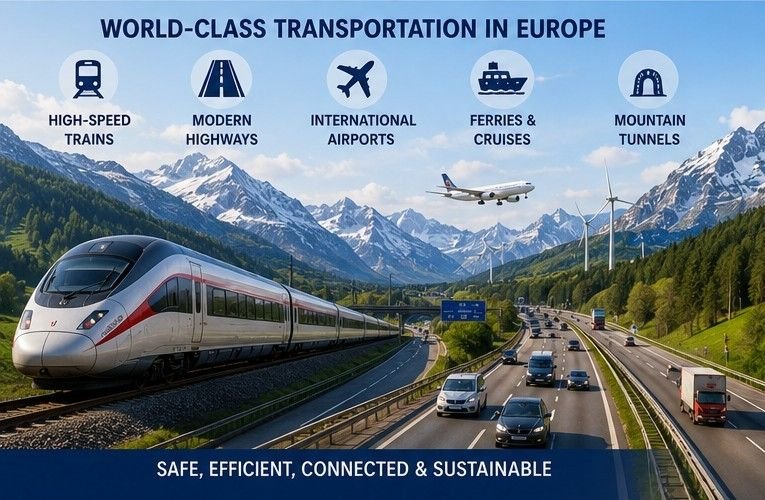
Europe possesses one of the world’s most efficient transport systems.
During my journey, I experienced:
- Multi-lane expressways.
- High-speed trains.
- Mountain railways.
- Cable cars.
- Modern airports.
- River cruises.
- International ferry services.
The highways are carefully maintained and supported by excellent traffic management systems.
Travelling from London across the English Channel by ferry, with our coach carried on board, demonstrated the remarkable coordination between road and maritime transport.
Throughout the journey, we passed through numerous long tunnels beneath mountains. These engineering achievements reduce travel time while protecting the natural landscape.
Tourism – Europe’s Living Heritage
Tourism is one of Europe’s largest industries.
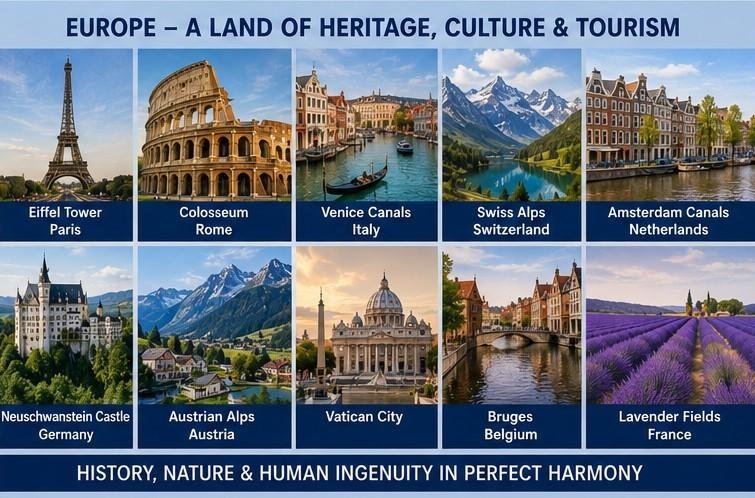
Every year, hundreds of millions of visitors travel to Europe to experience its history, art, architecture and natural beauty.
Some of the continent’s most famous destinations include:
- The Eiffel Tower in Paris.
- The Colosseum in Rome.
- The Vatican Museums.
- The Swiss Alps.
- Venice and its canals.
- Amsterdam’s canals.
- German castles.
- Austrian mountain villages.
- Belgian historical squares.
- Dutch windmills and tulip gardens.
These attractions preserve Europe’s cultural heritage while contributing significantly to national economies.
Environmental Conservation
One feature that impressed me greatly was Europe’s commitment to environmental protection.
Many cities have:
- Well-maintained public parks.
- Protected forests.
- Clean rivers.
- Extensive cycling routes.
- Efficient public transport.
- Strict waste management systems.
Many countries actively encourage renewable energy, tree plantation, recycling and sustainable urban planning.
Although environmental challenges remain—including climate change, biodiversity loss and pollution—European governments continue investing in conservation and green technologies.
Lessons for Developing Nations
Europe demonstrates that natural resources alone do not create prosperity. Effective planning, scientific research, disciplined administration, environmental protection and public participation are equally important.
Countries such as India possess immense natural wealth and human talent. By strengthening infrastructure, river management, environmental conservation and scientific education while preserving cultural values, developing nations can continue their path toward sustainable progress.
Conclusion
My journey across Europe revealed that the continent’s beauty lies not only in its mountains, rivers and historic cities but also in the harmonious relationship between nature, science and human endeavour.
The majestic Alps, the mighty Rhine, the peaceful lakes, the efficient transport system and the carefully preserved historical monuments together represent centuries of planning, hard work and respect for heritage.
Travelling through Europe strengthened my conviction that every nation can achieve lasting progress through education, innovation, environmental stewardship and cooperation among its people.
(To be continued in Chapter 4: The People of Europe – Society, Culture, Languages, Festivals and Daily Life.)
Finding a secure gaming spot in Malaysia used to be tough until I discovered this site. They keep my personal data locked down tight and the bonus structure is actually rewarding. Everything runs smoothly and customer service is just a chat away. alibaba66malaysia