Europe – A Continent of History, Civilization and Modern Progress
Chapter 4: The People of Europe – Society, Culture, Languages, Festivals and Daily Life
By Lokanath Mishra, M.A., LL.B., IRS (Retired)
Europe is not merely a continent of magnificent mountains, beautiful rivers and historic monuments; it is also a continent of diverse cultures, languages and traditions. Although Europe covers a comparatively small geographical area, it is home to hundreds of millions of people belonging to different ethnic groups, religions and linguistic communities. Each nation has preserved its own identity while also contributing to a shared European civilization.
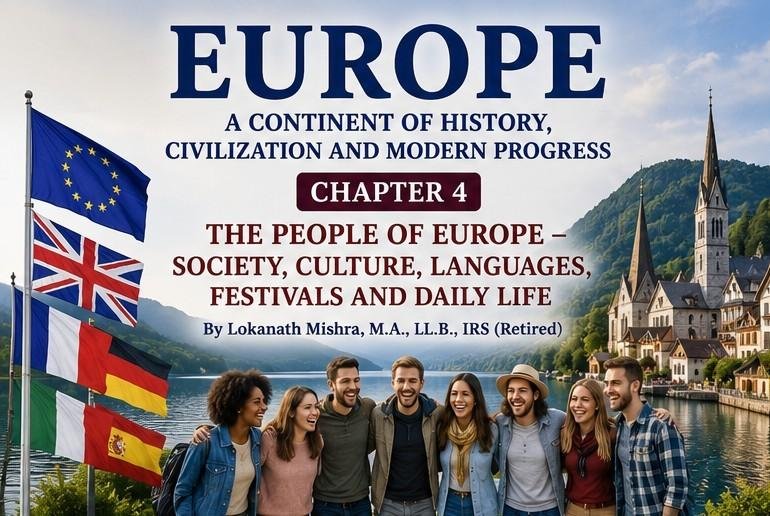
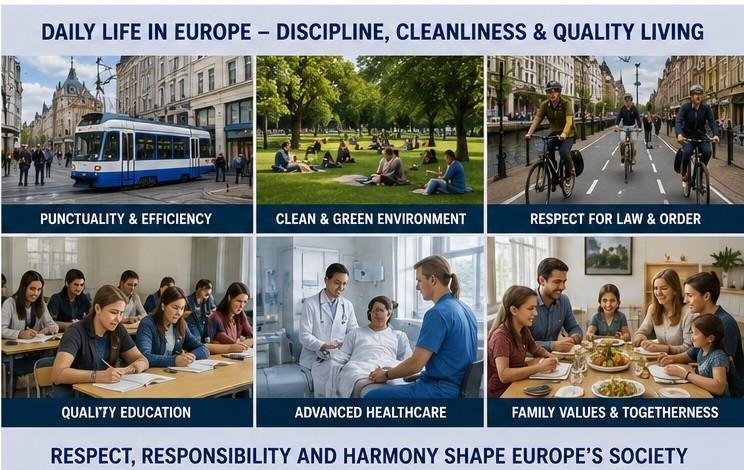
During my fifteen-day coach tour across Belgium, the Netherlands, Germany, Switzerland, Liechtenstein, Austria, Italy, France and Vatican City, I had the opportunity to observe the daily life of the people. Although each country possesses its own customs and traditions, certain common characteristics such as discipline, cleanliness, punctuality and respect for law are visible almost everywhere.
Population and Diversity
Europe has a population of approximately 740 million people. Despite its relatively small size, it is one of the world’s most economically developed and culturally influential continents.
The population consists of numerous ethnic communities including Germans, French, Italians, Dutch, Belgians, Swiss, Austrians, Spaniards, Portuguese, Scandinavians, Slavic peoples and many others. In recent decades, immigration from Asia, Africa and the Middle East has further increased Europe’s cultural diversity.
Today, many European cities are multicultural, where people of different nationalities, religions and languages live and work together.
Languages of Europe
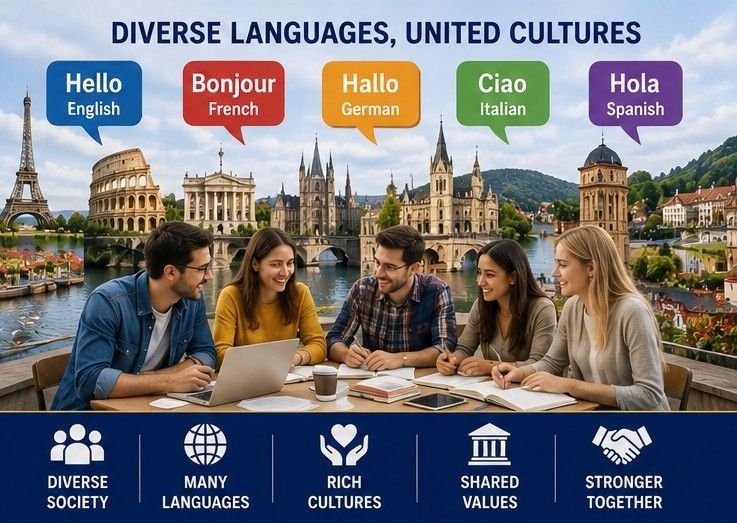
Europe has no single common language. More than 200 languages are spoken across the continent.
Some of the major languages include:
- English
- French
- German
- Italian
- Spanish
- Portuguese
- Dutch
- Russian
- Polish
- Swedish
- Norwegian
- Danish
- Finnish
English has become the principal language for international business, higher education and tourism, making communication easier for visitors from different countries.
Religion
Christianity has profoundly influenced European history, art and culture.
The major Christian traditions are:
- Roman Catholicism
- Protestantism
- Eastern Orthodoxy
Europe is also home to significant Muslim, Jewish, Hindu, Buddhist and Sikh communities, particularly in large cities.
At the same time, many Europeans today identify themselves as non-religious or secular while continuing to value historic churches, cathedrals and religious festivals as part of their cultural heritage.
Family Life
The traditional European family has changed considerably during the past century.
Smaller families have become common, and many young adults live independently before marriage. Women participate actively in education, business, government, science and public life.
Most countries promote equal educational and employment opportunities for both men and women. Laws generally seek to protect the rights and dignity of all citizens regardless of gender, religion or ethnic background.
Education
One of Europe’s greatest strengths is its educational system.
Most children receive free or heavily subsidised school education. Universities encourage scientific research, innovation and independent thinking.
Many of the world’s oldest universities, including Oxford, Cambridge, Bologna and Heidelberg, continue to attract students from across the globe.
Education is viewed not merely as a means of employment but as the foundation of responsible citizenship and national development.
Health Care
Many European countries maintain comprehensive public healthcare systems.
Citizens generally have access to hospitals, emergency services, preventive care …