
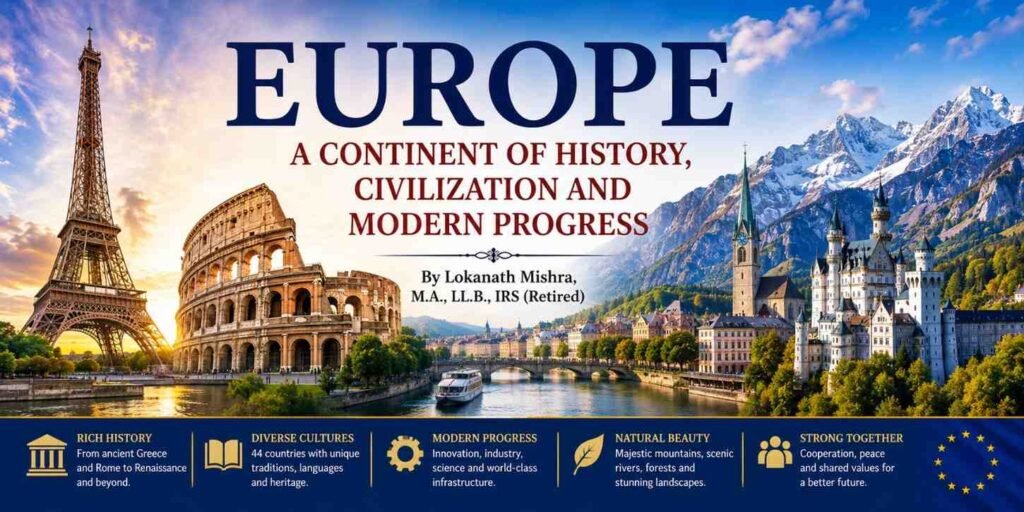
Europe – A Continent of History, Civilization and Modern Progress:
By Lokanath Mishra, M.A., LL.B., IRS (Retired)
Europe is one of the seven continents of the world. Although it is the second-smallest continent after Australia in terms of land area, Europe has played an extraordinary role in shaping world history, science, literature, democracy, industry and modern civilization. During my recent fifteen-day tour across several European countries, I had the opportunity to witness its rich cultural heritage, advanced infrastructure, scientific achievements and disciplined society. The journey inspired me to understand why Europe has remained one of the world’s most influential regions for centuries.
A Continent of Forty-Four Countries
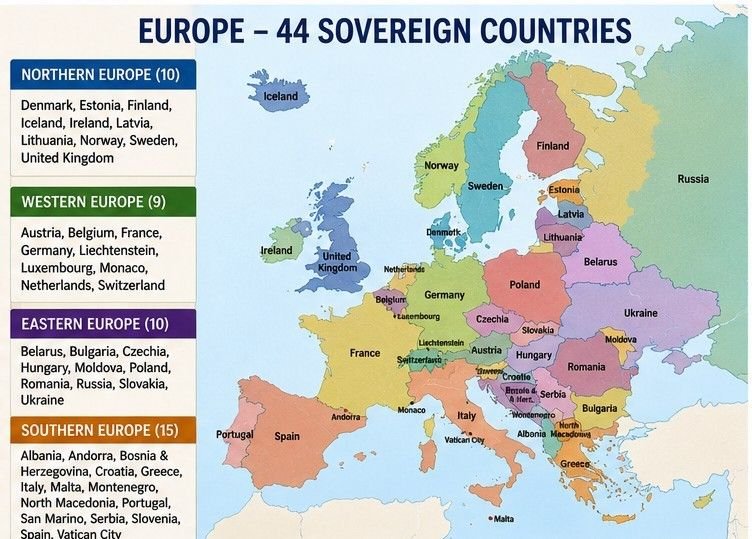
According to the United Nations geographical classification, Europe consists of 44 sovereign countries. The exact number sometimes varies in different publications because a few countries, such as Russia, Türkiye (Turkey), Georgia, Azerbaijan and Kazakhstan, lie in both Europe and Asia. Some organizations also differ on whether to include partially recognised states. Nevertheless, the UN’s geographical classification recognises 44 sovereign states in Europe.
These 44 countries are:
Northern Europe: Denmark, Estonia, Finland, Iceland, Ireland, Latvia, Lithuania, Norway, Sweden and the United Kingdom.
Western Europe: Austria, Belgium, France, Germany, Liechtenstein, Luxembourg, Monaco, the Netherlands and Switzerland.
Eastern Europe: Belarus, Bulgaria, Czechia, Hungary, Moldova, Poland, Romania, Russia, Slovakia and Ukraine.
Southern Europe: Albania, Andorra, Bosnia and Herzegovina, Croatia, Greece, Italy, Malta, Montenegro, North Macedonia, Portugal, San Marino, Serbia, Slovenia, Spain and Vatican City (Holy See).
Together these nations have a combined population of approximately 750 million people.
Geography
Europe covers an area of about 10.2 million square kilometres, nearly seven per cent of the Earth’s land surface.
It is surrounded by:
- The Arctic Ocean in the north.
- The Atlantic Ocean in the west.
- The Mediterranean Sea in the south.
- Asia to the east.
The continent is blessed with fertile plains, mighty rivers, beautiful lakes, snow-covered mountains and extensive forests.
The Alps, Pyrenees, Carpathians and Scandinavian Mountains are among Europe’s most famous mountain ranges.
Important rivers include the Rhine, Danube, Seine, Rhône, Thames, Po, Elbe, Volga and Loire.
A Brief History
The history of Europe stretches back thousands of years.
Ancient Greece laid the foundations of democracy, philosophy, mathematics and science.
The Roman Empire built magnificent roads, cities and legal systems that continue to influence the modern world.
During the Middle Ages, Christianity became an important force in shaping European society, while universities, monasteries and centres of learning preserved knowledge.
The Renaissance, beginning in Italy during the fourteenth century, revived art, literature and scientific inquiry.
The Scientific Revolution produced pioneers such as Copernicus, Galileo, Newton and many others.
The Industrial Revolution, beginning in Britain during the eighteenth century, transformed manufacturing, transportation and commerce across the world.
Europe also experienced two devastating World Wars during the twentieth century. These conflicts caused immense suffering but eventually inspired greater international cooperation and efforts to maintain peace.
The European Union
One of the greatest achievements of post-war Europe has been the formation of the European Union (EU).
The EU currently consists of 27 member countries that cooperate in trade, environmental protection, education, research, agriculture and many other fields.
Citizens of most member states can travel, work and study freely across much of the Union.
The common currency, the Euro, is used by many—but not all—EU member countries.
Why Did the United Kingdom Leave the European Union?
The United Kingdom remains geographically part of Europe but left the European Union on 31 January 2020, following the 2016 referendum.
Supporters of Brexit believed that the UK should have greater control over immigration, law-making and trade policy. Others preferred continued EU membership because of the economic and political benefits of close integration.
Although no longer an EU member, the United Kingdom continues to cooperate with European countries in many fields.
Economy and Industrial Development
Europe possesses one of the world’s largest and most diversified economies.
Major industries include:
- Automobile manufacturing.
- Aircraft production.
- Pharmaceuticals.
- Chemicals.
- Machinery.
- Electronics.
- Precision engineering.
- Shipbuilding.
- Banking and finance.
- Renewable energy.
- Tourism.
Countries such as Germany, France, Italy, Switzerland and the Netherlands are internationally recognised for their technological excellence and industrial innovation.
Agriculture
Despite extensive industrialisation, agriculture remains highly productive.
European farmers use:
- Scientific farming methods.
- Mechanisation.
- Precision irrigation.
- Improved seeds.
- Soil analysis.
- Modern storage facilities.
Major agricultural products include:
- Wheat.
- Barley.
- Maize.
- Potatoes.
- Sugar beet.
- Grapes.
- Apples.
- Pears.
- Olives.
- Dairy products.
The vineyards of France, Italy, Germany and Austria produce some of the world’s finest wines.
Education and Scientific Research
Education has been one of Europe’s greatest strengths.
Many of the world’s oldest universities, including Oxford, Cambridge, Bologna, Heidelberg and the Sorbonne, have educated generations of scholars.
European governments invest substantially in scientific research, technological innovation and higher education.
This continuous investment has contributed significantly to economic prosperity.
Transportation
During my journey, I was deeply impressed by Europe’s transport infrastructure.
We travelled through:
- Multi-lane highways.
- Long mountain tunnels.
- High-speed rail networks.
- Modern airports.
- Efficient metro systems.
- Navigable rivers.
- International seaports.
The engineering standards observed throughout Europe are remarkable.
Tourism
Europe is one of the world’s leading tourist destinations.
Millions of visitors travel every year to experience:
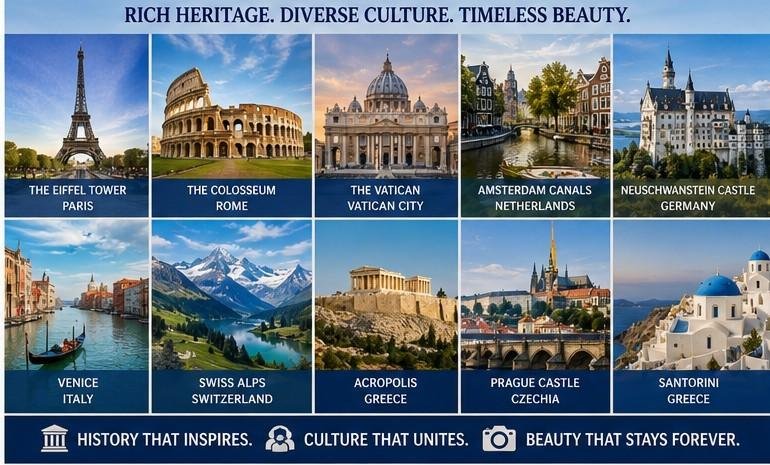
- The Eiffel Tower.
- The Colosseum.
- The Vatican.
- The Swiss Alps.
- Venice.
- Amsterdam’s canals.
- German castles.
- Austrian mountains.
- Historic cathedrals.
- World-class museums.
Tourism contributes significantly to national economies while encouraging the preservation of historical monuments.
Culture
Europe is a continent of extraordinary cultural diversity.
Each country possesses its own language, traditions, cuisine, architecture and festivals.
At the same time, Europe shares many common values, including respect for education, scientific inquiry, democratic institutions and cultural heritage.
Art, music, literature and architecture have flourished here for centuries.
Comparison with India
India and Europe are both rich in history, culture and intellectual traditions.
India has one of the world’s oldest civilizations and has made remarkable progress in information technology, pharmaceuticals, space research, digital innovation and infrastructure.
Europe, with generally smaller populations in individual countries and long-established industrial economies, has developed highly efficient public services, transportation networks and scientific institutions.
Rather than comparing one as superior to the other, it is more meaningful to recognise that each has unique strengths. India can continue to learn from Europe’s achievements in urban planning, environmental management and scientific research, while Europe can also benefit from India’s youthful population, technological innovation and rich cultural heritage.
Lessons from Europe
My visit taught me several valuable lessons.
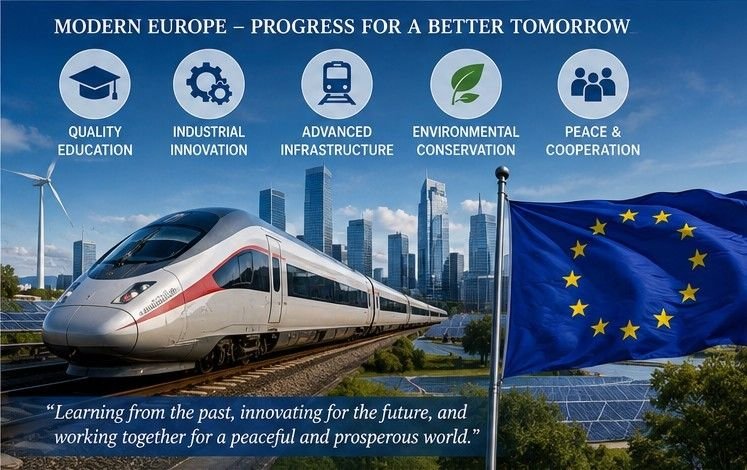
Investment in education creates skilled citizens.
Scientific research drives industrial growth.
Efficient public administration strengthens development.
Well-maintained infrastructure supports economic prosperity.
Environmental conservation protects natural resources.
Preservation of historical monuments encourages tourism and national pride.
Above all, international cooperation contributes to peace and progress.
Conclusion
Europe is not merely a continent of beautiful landscapes and magnificent monuments. It is a living example of how centuries of education, scientific advancement, industrial development and cultural preservation can transform societies.
As an Indian traveller, I returned with greater admiration for Europe’s achievements and renewed confidence in India’s immense potential. Every nation has its own strengths and challenges, but by learning from one another and working together, humanity can build a future based on peace, knowledge, sustainable development and mutual respect.
Travel broadens the mind, deepens understanding and reminds us that although countries differ in language, customs and traditions, the hopes and aspirations of people everywhere remain remarkably similar.