
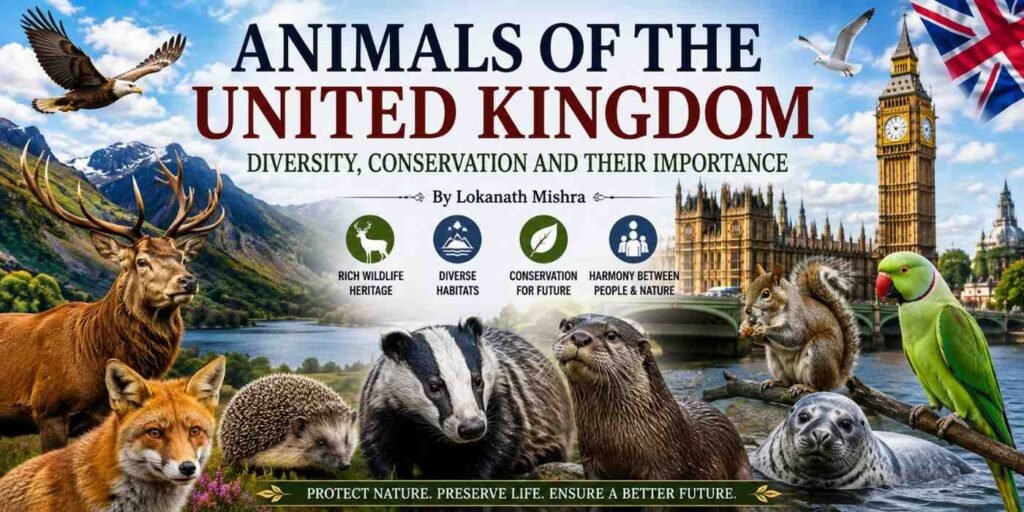
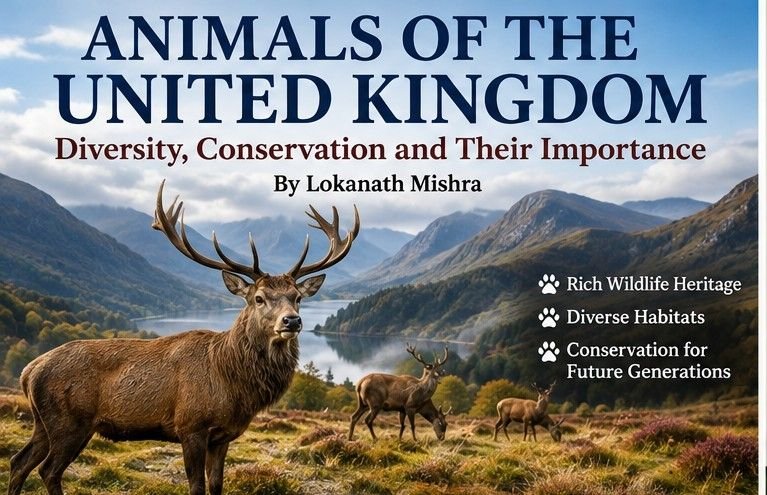
Animals of the United Kingdom: Diversity, Conservation and Their Importance:
By Lokanath Mishra
Introduction
The United Kingdom UK, consisting of England, Scotland, Wales, and Northern Ireland, is known for its rich cultural heritage as well as its diverse wildlife. Although it is a highly developed and densely populated country, the UK has preserved a wide range of natural habitats such as forests, grasslands, rivers, wetlands, moorlands, mountains, and coastal regions. These environments support a variety of mammals, birds, reptiles, amphibians, fish, and marine life.
Unlike tropical countries, the UK does not naturally support large wild animals such as tigers, lions, elephants, or native monkeys. However, through historical introductions, zoos, wildlife parks, and deer parks, several non-native species—including monkeys from India and exotic birds like Indian parrots—can also be seen in controlled environments.
Geography and Climate
The UK has a temperate maritime climate with moderate rainfall throughout the year. Summers are cool and winters are mild compared to other countries at similar latitudes. This climate supports deciduous forests, grasslands, wetlands, and coastal ecosystems, which are suitable for a wide range of animal life.
Mammals of the United Kingdom
Around seventy species of mammals are found in the UK.
- Red Deer
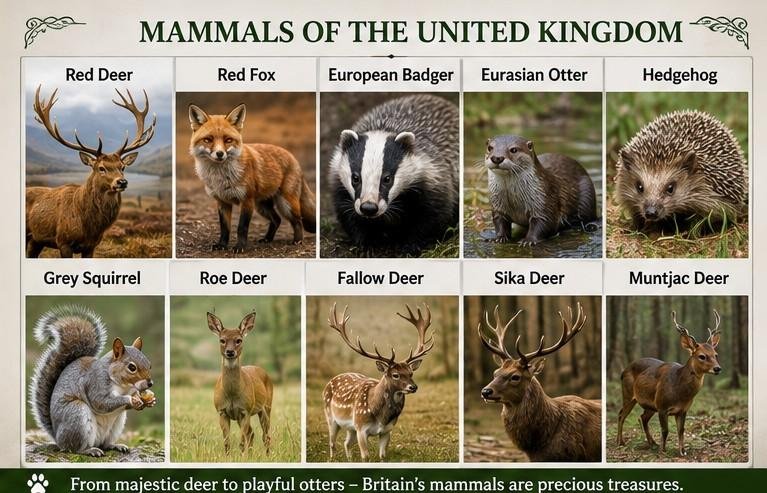
The red deer is the largest native land mammal in Britain. It is especially common in the Scottish Highlands and is a national symbol of Scotland.
- Roe Deer
Roe deer are small and shy animals found in woodlands and farmlands across the UK.
- Fallow Deer
Fallow deer were introduced centuries ago and are now widely seen in southern England, especially in parks and estates.
- Deer Parks and Multiple Deer Species
The UK is famous for its deer parks, many of which are historical estates or protected wildlife areas. These parks often contain multiple deer species, including:
- Red deer
- Fallow deer
- Roe deer
- Sika deer introduced from East Asia
- Muntjac deer introduced from Asia
These parks provide semi-natural habitats where deer live freely but are protected and managed.
- Red Fox
The red fox is one of the most adaptable mammals in Britain and is commonly seen even in urban areas like London.
- European Badger
Badgers live in underground setts and are mostly active at night.
- European Hedgehog
A well-loved species in Britain, the hedgehog is now declining due to habitat loss and road accidents.
- Grey Squirrel and Red Squirrel
The grey squirrel, introduced from North America, is widespread, while the native red squirrel survives mainly in Scotland and protected areas.
- Otter
The Eurasian otter has recovered significantly due to conservation efforts.
- Bats
The UK has 18 bat species, all legally protected.
Non-Native and Introduced Animals
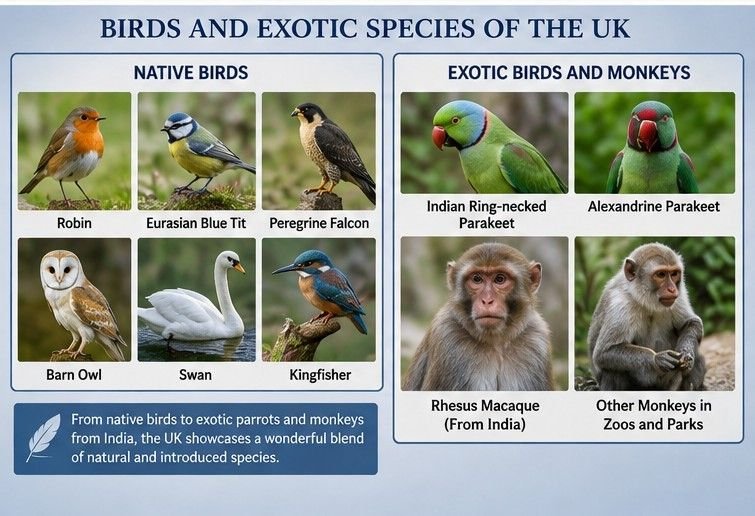
Although the UK has no native monkeys, some monkeys from India and other tropical regions are found in:
- Zoos
- Wildlife parks
- Research centres historically
These include species such as rhesus macaques and other Asian monkeys, which are kept under strict care and cannot survive in the wild UK climate.
Similarly, several exotic birds from India, especially parrots, are also seen in captivity and aviaries. These include:
- Indian ring-necked parakeet now also feral in parts of London
- Alexandrine parakeet
- Other ornamental parrot species in zoos and bird parks
Interestingly, the ring-necked parakeet, originally from South Asia, has established small wild populations in parts of the UK, especially in urban parks and gardens.
Marine Mammals
The seas around the UK support rich marine life, including:
- Seals harbour and grey seals
- Dolphins
- Porpoises
- Whales
- Orcas occasionally in Scottish waters
Reptiles
The UK has few reptile species:
- Grass snake
- Adder only venomous snake
- Smooth snake
- Common lizard
- Sand lizard
Amphibians
Common amphibians include frogs, toads, and newts, all dependent on clean water bodies.
Freshwater Fish
Important fish species include salmon, trout, pike, perch, carp, and eel. Salmon migration is one of the most remarkable natural events in British rivers.
Farm Animals
Farm animals play an important role in the UK economy:
- Cattle
- Sheep
- Pigs
- Horses
- Goats
- Poultry
The UK is well known for dairy farming and wool production.
Animals in National Parks
The UK has 15 National Parks, including:
- Lake District
- Peak District
- Yorkshire Dales
- Cairngorms
- Snowdonia Eryri
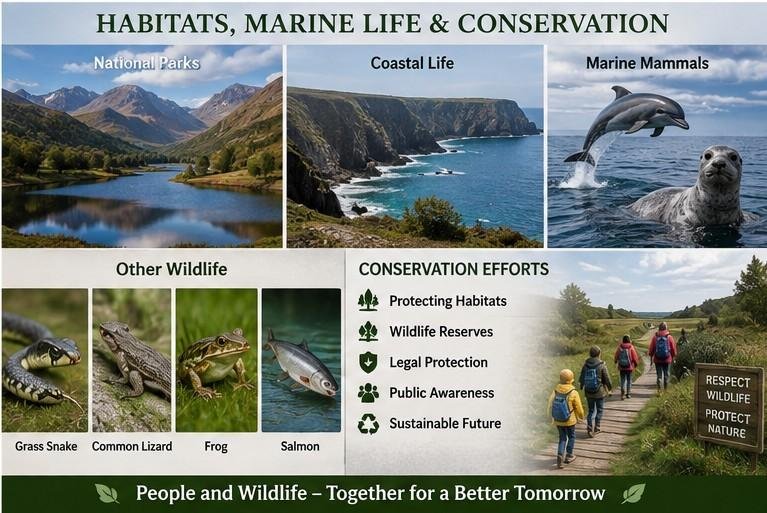
These parks protect wildlife such as deer, otters, birds, and small mammals.
Threats to Wildlife
British wildlife faces several challenges:
- Urban expansion
- Habitat loss
- Climate change
- Pollution
- Plastic waste
- Road accidents
- Invasive species
Wildlife Conservation
The UK has strong conservation laws and protected areas. Efforts include:
- Wildlife reserves
- Habitat restoration
- Legal protection of species
- Public awareness programs
- Wildlife-friendly gardening
These measures have helped many species recover.
Relationship Between People and Animals
People in the UK generally respect wildlife. Bird feeding, nature walks, and visits to parks and zoos are common activities. Educational programs also promote awareness of biodiversity.
Comparison with India
India has far greater biodiversity, including elephants, tigers, lions, rhinoceroses, and wild monkeys. The UK, in contrast, has fewer large wild animals but excels in conservation management and habitat protection.
However, through zoos and wildlife parks, the UK also maintains a connection with exotic species from countries like India, including monkeys and parrots.
Conclusion
The animals of the United Kingdom reflect a unique balance between native wildlife and carefully managed introduced species. From red deer in the Highlands to foxes in cities, from seals along the coast to exotic parrots in parks, the UK presents a diverse and well-managed ecological system.
Deer parks, wildlife reserves, and conservation areas play a vital role in protecting both native and introduced species. Although the UK does not naturally support monkeys or tropical wildlife, its zoos and parks maintain global biodiversity connections.
Protecting animals and their habitats is essential for ecological balance and future generations. The UK’s example shows how human society and wildlife can coexist through careful planning, respect, and conservation efforts.