
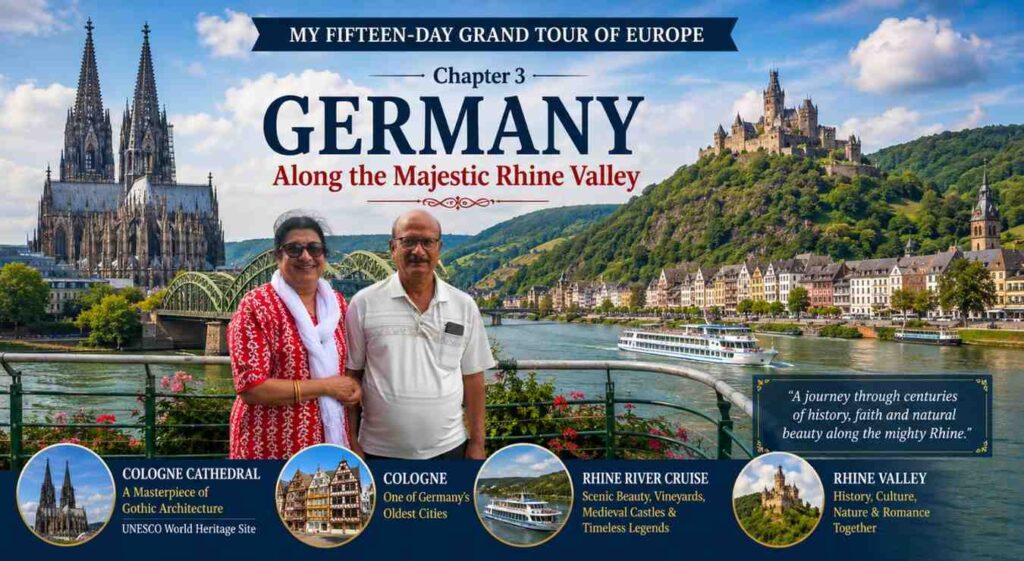
My Fifteen-Day Grand Tour of Europe
Chapter 3: Germany – Along the Majestic Rhine Valley
By Lokanath Mishra, M.A., LL.B., IRS (Retired)
On the morning of 15th July 2026, we bid farewell to the beautiful Netherlands and continued our exciting European journey towards Germany, the largest economy in Europe and one of the most influential nations in the world. As our Star Tour luxury coach crossed the border, the scenery gradually changed into rolling hills, dense forests, vineyards and picturesque villages.
Germany is a country rich in history, philosophy, science, engineering and culture. It is the birthplace of great personalities such as Albert Einstein, Johann Wolfgang von Goethe, Ludwig van Beethoven, Martin Luther and Johannes Gutenberg. Today, Germany is renowned for its technological excellence, world-class industries, efficient transport system and well-preserved historical monuments.
Our destination for the day was the historic city of Cologne (Köln), situated on the banks of the mighty River Rhine.
Cologne – One of Germany’s Oldest Cities:
Cologne is one of the oldest cities in Germany, having been founded nearly 2,000 years ago by the Romans. During the Roman Empire, it became an important military and commercial centre. Over the centuries, Cologne developed into a flourishing city of trade, religion and education.
Today, it is famous for its magnificent cathedral, charming Old Town, museums, universities and its position on the River Rhine. The city successfully rebuilt itself after suffering heavy destruction during the Second World War and today stands as a symbol of Germany’s resilience and determination.
The Magnificent Cologne Cathedral
The highlight of our visit was the world-famous Cologne Cathedral, known in German as Kölner Dom.
Standing majestically beside the Rhine, the cathedral is one of the greatest masterpieces of Gothic architecture in the world and the most visited landmark in Germany.
Construction of the cathedral began in 1248 under Archbishop Konrad von Hochstaden. Owing to financial difficulties, political changes and wars, the construction remained incomplete for centuries. Finally, after more than 630 years, the cathedral was completed in 1880, exactly according to its original medieval design.
The cathedral rises to an astonishing height of 157 metres (515 feet), making it one of the tallest cathedrals in the world. For several years after its completion, it was the tallest building on Earth.
The exterior of the cathedral is decorated with countless statues, pinnacles, arches and intricate carvings, reflecting the extraordinary skill of medieval craftsmen. Inside, visitors are greeted by lofty vaulted ceilings, magnificent stained-glass windows, beautifully carved altars and impressive religious artwork.
One of the cathedral’s greatest treasures is the Shrine of the Three Kings, believed by Christian tradition to contain the relics of the Three Wise Men who visited the infant Jesus in Bethlehem. This sacred shrine has attracted millions of pilgrims for centuries.
During the Second World War, although Cologne suffered extensive bombing, the cathedral miraculously remained standing despite sustaining damage. It became a symbol of hope and faith for the German people.
In 1996, UNESCO declared Cologne Cathedral a World Heritage Site, recognising its outstanding architectural and historical significance.
Standing before this magnificent monument, I felt humbled by the devotion, artistic brilliance and engineering skills of generations of builders who dedicated their lives to creating one of humanity’s greatest architectural achievements.
Indian Lunch in Cologne
After completing our sightseeing, we proceeded to an Indian restaurant for lunch.
The delicious Indian cuisine provided a welcome taste of home after several days of travelling through Europe. We enjoyed freshly prepared vegetarian dishes, rice, dal, vegetables, chapatis and traditional Indian desserts. It was heartening to observe that Indian restaurants have become popular throughout Europe, reflecting the growing appreciation of Indian culture and cuisine.
After lunch, we resumed our journey towards one of the most scenic regions of Germany—the enchanting Rhine Valley.
The Legendary River Rhine
The River Rhine is one of Europe’s most important rivers. Originating in the Swiss Alps, it flows for approximately 1,230 kilometres through Switzerland, Liechtenstein, Austria, Germany, France and the Netherlands before emptying into the North Sea.
For over two thousand years, the Rhine has served as a major trade route connecting Central Europe with the sea. Along its banks stand medieval castles, vineyards, ancient churches and charming towns that have inspired poets, painters and musicians for centuries.
The Rhine Valley has also witnessed many important historical events, including Roman expansion, medieval commerce, the rise of powerful kingdoms and the development of modern Germany.
A Memorable Rhine River Cruise:
By afternoon we reached the beautiful riverside town of Boppard, one of the most popular departure points for cruises through the scenic Middle Rhine Valley.
We boarded a comfortable sightseeing boat for our unforgettable cruise along the River Rhine.
As the boat gently sailed downstream, breathtaking scenery unfolded before our eyes. On both sides of the river rose steep hills covered with endless vineyards producing Germany’s famous wines. Perched high on the hilltops stood numerous medieval castles and ancient fortresses, each narrating stories of kings, knights, merchants and noble families.
The cruise passed several picturesque towns with colourful houses, elegant churches and historic market squares. Every village appeared like a painting brought to life.
One of the most famous landmarks on the journey was the legendary Lorelei Rock.
According to German folklore, a beautiful maiden named Lorelei sat upon this towering cliff, singing enchanting songs that distracted sailors navigating the dangerous river currents below. Mesmerised by her beauty and voice, many ships were wrecked upon the rocks. Though only a legend, Lorelei has inspired countless poems, songs and works of art, becoming one of Germany’s most beloved cultural symbols.
As our boat continued its peaceful journey, we admired magnificent castles such as Marksburg and Katz Castle standing proudly above the river, reminders of medieval Germany’s turbulent history.
The gentle breeze, sparkling waters and green vineyards created an atmosphere of complete tranquillity. Passengers from different countries gathered on the open deck, taking photographs and enjoying the magnificent panorama. The guide explained the history of the Rhine Valley and the strategic importance of the castles that once protected important trading routes.
The Rhine cruise was undoubtedly one of the most memorable experiences of our entire European tour. It was not merely a boat ride but a journey through centuries of European history, culture and natural beauty.
Reflections on Germany
Our visit to Germany revealed a nation that has beautifully preserved its rich historical heritage while emerging as one of the world’s most advanced industrial powers.
The majestic Cologne Cathedral reflected centuries of religious devotion and architectural genius, while the peaceful Rhine Valley demonstrated nature’s generosity and Germany’s commitment to preserving its cultural landscape.
As evening descended, our coach proceeded to our hotel for the night’s stay. The memories of Cologne’s magnificent cathedral and the enchanting Rhine River remained vivid in our minds. We looked forward with great excitement to the next stage of our fifteen-day European adventure.
(To be continued in Chapter 4…)