
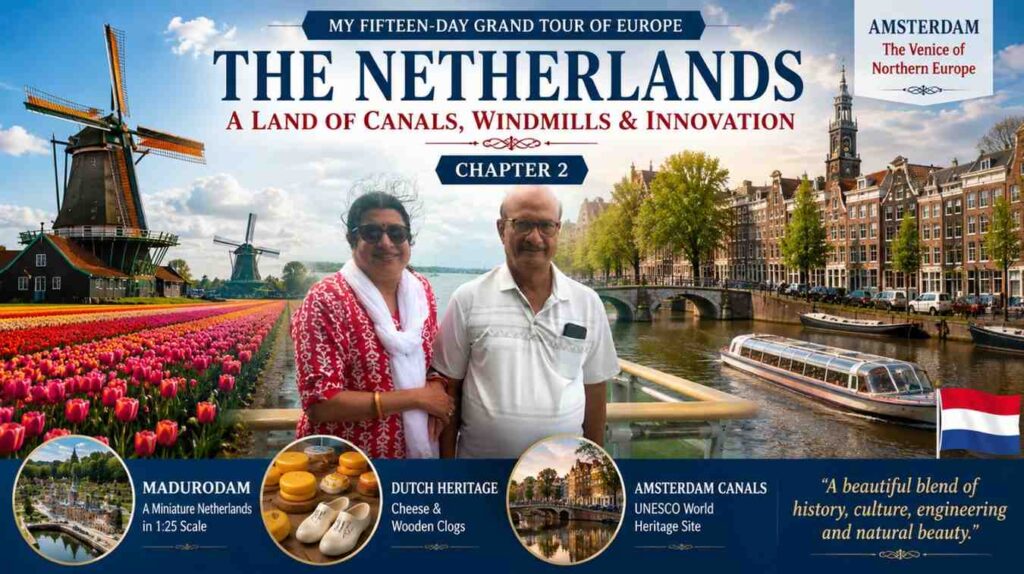
My Fifteen-Day Grand Tour of Europe
Chapter 2: The Netherlands – A Land of Canals, Windmills and Innovation
By Lokanath Mishra, M.A., LL.B., IRS (Retired)
After spending a memorable first day in Belgium, we woke up early on 14th July 2026 with renewed enthusiasm. Our luggage was loaded into the Star Tour luxury coach, and after a hearty breakfast we began our journey towards the Kingdom of the Netherlands, popularly known as Holland.
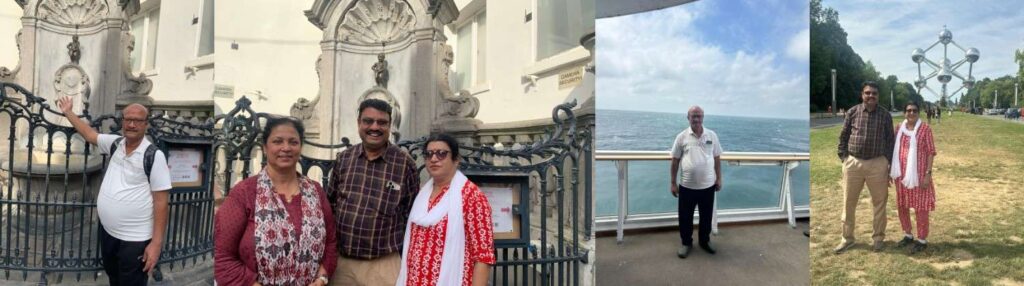
The drive from Brussels to the Netherlands was delightful. The highways were among the finest in Europe, bordered by green meadows, colourful flower fields, grazing cattle, modern farms and picturesque villages. The countryside reflected the discipline, prosperity and environmental consciousness of the Dutch people.
The Netherlands – A Country Created by Human Determination
The Netherlands is one of the most fascinating countries in Europe. A large part of its land lies below sea level, and for centuries the Dutch people have successfully reclaimed land from the sea by constructing dykes, dams, canals and pumping stations. Their remarkable engineering skills have made the country an international model in water management.
Despite its relatively small geographical size, the Netherlands has made enormous contributions to global trade, agriculture, science, navigation, architecture and art. Great painters such as Rembrandt and Vincent van Gogh, renowned philosophers like Erasmus, and modern innovators have all enriched world civilization.
The Dutch are known for their honesty, punctuality, liberal outlook and respect for law. Bicycles are an integral part of everyday life, and the country is regarded as one of the world’s most environmentally friendly nations.
Madurodam – A Miniature Netherlands:
Our first destination was the famous Madurodam, one of the most popular tourist attractions in the Netherlands.
Madurodam is not merely a miniature park but a remarkable educational and cultural institution. It was inaugurated in 1952 in memory of George Maduro, a courageous Dutch Jewish law student and military officer who fought bravely against the German invasion during the Second World War. George Maduro died in the Dachau concentration camp in 1945 at the age of only twenty-eight. His parents donated funds to establish this unique miniature city in his memory.
Spread over beautifully landscaped gardens, Madurodam presents miniature replicas built at a scale of 1:25 of the Netherlands’ most famous landmarks, including airports, seaports, canals, windmills, bridges, railways, government buildings, churches and historical monuments.
The remarkable craftsmanship was astonishing. Tiny trains moved along miniature railway tracks, aircraft taxied on runways, ships sailed through small canals and bridges opened and closed exactly like their real counterparts. Every model demonstrated extraordinary precision and attention to detail.
Walking through Madurodam felt like travelling across the entire Netherlands within a few hours. The park beautifully illustrates Dutch history, engineering, architecture and innovation, making it an invaluable educational destination for visitors of all ages.
Visit to a Traditional Cheese and Wooden Shoe Factory:
Our next stop was a traditional Dutch factory where we witnessed the manufacture of two products for which the Netherlands is internationally famous—cheese and wooden shoes (clogs).
The guide warmly welcomed us and explained the complete process of cheese production.
Fresh cow’s milk is first pasteurised before beneficial bacterial cultures and natural enzymes are added. These transform the milk into curd. The curd is separated from the whey, pressed into circular moulds and immersed in brine for preservation. The cheese is then matured in carefully controlled storage rooms for several weeks or even months. During the ageing process, skilled workers regularly clean and turn each cheese wheel to ensure uniform texture and flavour.
The factory displayed various varieties of Dutch cheese, including the world-famous Gouda and Edam, available in different flavours such as herbs, garlic, cumin, pepper and smoked varieties. We had the opportunity to taste several kinds of cheese before purchasing some as souvenirs.
The second section of the factory demonstrated the traditional manufacture of wooden clogs, locally known as klompen.
An artisan selected freshly cut poplar wood and placed it in a specially designed carving machine. Within a few minutes the machine shaped the exterior and hollowed out the interior to produce a perfectly fitting wooden shoe. The craftsman explained that before modern footwear became common, these wooden shoes were worn daily by Dutch farmers and fishermen because they were waterproof, durable and provided excellent protection in muddy fields.
Today, although mostly replaced by modern footwear, wooden clogs remain an important symbol of Dutch heritage and are treasured as decorative souvenirs throughout the world.
The visit to the factory offered us a fascinating glimpse into Dutch craftsmanship, rural traditions and small-scale industries that continue to preserve the country’s cultural identity.
Arrival at Amsterdam:
By afternoon we reached Amsterdam, the capital city of the Netherlands.
Founded as a small fishing village during the thirteenth century, Amsterdam gradually developed into one of Europe’s greatest commercial centres during the Dutch Golden Age. Today it is renowned for its beautiful canals, museums, historic buildings, liberal traditions and vibrant cultural life.
The city immediately impressed us with its elegant canal houses, tree-lined streets, numerous bicycles and harmonious blend of historic architecture and modern urban planning.
Amsterdam Central Station
Our coach first passed the magnificent Amsterdam Centraal station, one of the busiest railway stations in Europe.
Completed in 1889, the station was designed by the famous Dutch architect Pierre Cuypers, who also designed the Rijksmuseum. Constructed on thousands of wooden piles driven deep into the marshy ground, the station remains an engineering masterpiece.
Every day hundreds of thousands of passengers pass through this grand terminal, connecting Amsterdam with cities throughout the Netherlands and Europe.
Victoria Hotel
Adjacent to the station stands the historic Park Plaza Victoria Amsterdam, commonly known as the Victoria Hotel.
Established in the nineteenth century, the hotel has welcomed royalty, diplomats, artists, business leaders and travellers from around the world. Its elegant architecture has become one of Amsterdam’s most recognisable landmarks.
Dam Square and the Royal Palace
Our next destination was Dam Square, the heart of Amsterdam.
The square has served as the city’s principal public gathering place for centuries. It is surrounded by impressive historical buildings, restaurants, shops, cafés and museums.
Facing the square is the magnificent Royal Palace Amsterdam, originally constructed in the seventeenth century as Amsterdam’s City Hall during the Dutch Golden Age.
The palace is regarded as one of the finest examples of classical architecture in Europe. Later it became one of the official residences of the Dutch Royal Family and is still used for important state ceremonies, royal receptions and official functions.
Nearby stands the National Monument, commemorating Dutch citizens who sacrificed their lives during the Second World War.
Walking around Dam Square, we admired the lively atmosphere created by tourists, street performers, musicians and artists from many parts of the world.
Amsterdam – The City of Canals
The highlight of our visit was undoubtedly the famous canal cruise.
Amsterdam possesses more than one hundred kilometres of canals, crossed by approximately 1,500 bridges, earning it the title “The Venice of Northern Europe.” The canal network, constructed mainly during the seventeenth century, has been recognised as a UNESCO World Heritage Site.
Boarding a comfortable sightseeing boat, we slowly cruised through the historic canals.
From the water, Amsterdam appeared even more beautiful. Elegant narrow houses with decorative gables stood gracefully along both banks. Many were built during the prosperous trading era and reflected the wealth of Dutch merchants.
The boat passed beneath numerous historic bridges, including the famous Magere Brug (Skinny Bridge), while our guide narrated the history of various neighbourhoods and important buildings. We also observed charming houseboats permanently moored along the canals, many of which serve as comfortable private residences.
The reflections of centuries-old buildings in the calm waters created scenes of remarkable beauty. Colourful flower boxes decorated windows, while cyclists crossed bridges and boats glided silently through the waterways.
The canal cruise revealed why Amsterdam is regarded as one of Europe’s most romantic and picturesque cities. The carefully preserved historical environment, efficient urban planning and harmonious coexistence of land and water made an unforgettable impression upon us.
Reflections on the Second Day
Our second day in Europe introduced us to the remarkable achievements of the Dutch people—their victory over the sea, their excellence in engineering, their dedication to preserving traditional crafts and their ability to harmoniously combine history with modern progress.
From the miniature wonders of Madurodam to the centuries-old canals of Amsterdam, every destination reflected the creativity, discipline and cultural richness of the Netherlands.
As dusk descended over Amsterdam, the illuminated bridges and shimmering canal waters created a magical atmosphere. We retired for the night with hearts full of admiration and minds enriched by another unforgettable day of our European journey.
(To be continued in Chapter 3…)