
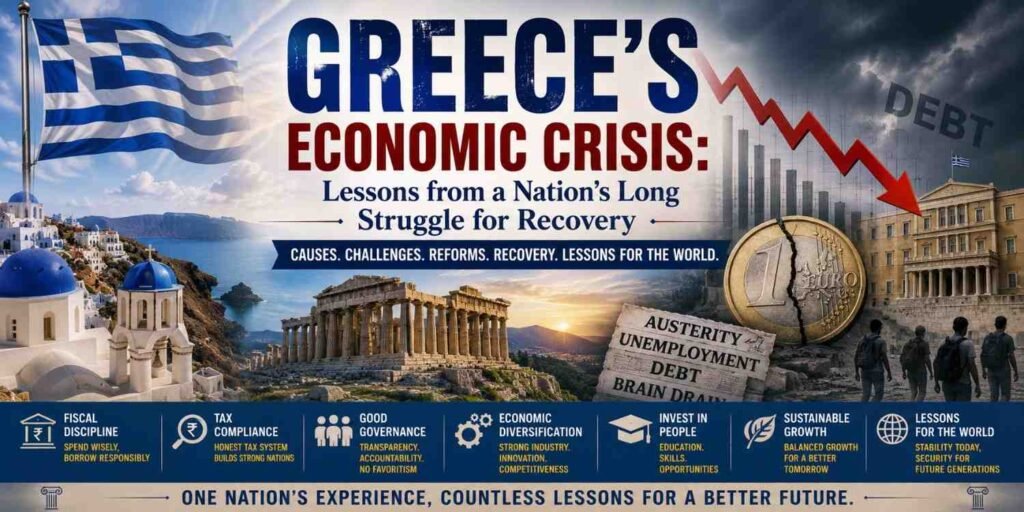
Greece’s Economic Crisis : Lessons from a Nation’s Long Struggle for Recovery:
By Lokanath Mishra
Greece, the cradle of Western civilization and the birthplace of democracy, philosophy and the Olympic Games, has also witnessed one of the most painful economic crises in modern European history. A country blessed with magnificent islands, a rich cultural heritage, a strategic geographical location and one of the world’s most vibrant tourism industries, Greece nevertheless suffered a devastating sovereign debt crisis that shook not only the country but the entire European Union.
The Greek economic crisis was not the result of a single mistake or an isolated event. It emerged from a combination of long-standing structural weaknesses, excessive public borrowing, weak fiscal discipline, administrative inefficiency and the limitations imposed by membership of the Eurozone. When the global financial crisis of 2008 struck, these accumulated weaknesses were exposed with extraordinary severity.
For many years, Greece lived with economic problems that remained partially hidden beneath the surface. One of the most serious challenges was widespread tax evasion. A significant section of self-employed professionals and higher-income groups historically found ways to avoid or reduce their tax liabilities. As a result, the government often failed to collect sufficient revenue to meet its growing expenditure. When a state spends continuously without collecting adequate revenue, it inevitably turns towards borrowing. Greece gradually became increasingly dependent upon debt to finance its public expenditure.
Another major problem was the expansion and mismanagement of the public sector. Successive governments were accused of allowing politically motivated appointments and excessive recruitment into government institutions. Public employment became, in many cases, linked with political patronage rather than economic necessity. Large public sector payrolls and high expenditure placed an enormous burden on the national budget.
At the same time, Greece struggled with bureaucracy, administrative complexity and corruption. Starting or expanding a business could involve complicated procedures, delays and excessive paperwork. Such an environment discouraged both domestic entrepreneurship and foreign investment. Investors generally seek stability, transparency and efficiency. Where bureaucracy becomes excessive and administrative decisions become unpredictable, investment naturally moves elsewhere.
The Greek economy also suffered from a structural imbalance in its production base. Greece has traditionally depended heavily upon services, shipping and tourism. Tourism is undoubtedly one of Greece’s greatest economic strengths, attracting millions of visitors every year to Athens, Santorini, Mykonos, Crete, Rhodes and numerous other destinations. However, an economy cannot depend indefinitely upon tourism and services alone. Greece faced difficulties in developing a sufficiently strong industrial and manufacturing base capable of competing effectively in international markets.
Agriculture remained important, producing world-famous products such as olive oil, olives, fruits, wine and other Mediterranean goods. Yet the country did not develop enough large-scale value-added manufacturing based upon its agricultural resources. The consequence was a persistent imbalance between imports and exports, contributing to a high trade deficit.
The introduction of the euro brought both opportunities and dangers. When Greece adopted the common European currency, it gained access to international financial markets at interest rates significantly lower than those it might otherwise have faced. Investors assumed that membership of the Eurozone offered a degree of security and stability.
Cheap credit encouraged excessive borrowing.
For a time, the system appeared sustainable. The Greek government could borrow money relatively easily, while the deeper weaknesses of the economy remained concealed. Public debt continued to rise, but the full danger was not immediately visible.
However, joining the Eurozone also meant surrendering control over an independent national currency. Before the adoption of the euro, a country facing an economic crisis could sometimes devalue its currency to make its exports cheaper and more competitive internationally. Greece no longer possessed this option.
When the global financial crisis erupted in 2008, international confidence collapsed. Financial markets began to examine the real financial position of heavily indebted countries. Greece’s deficits and debt levels became a matter of serious international concern. The country found it increasingly difficult to borrow at affordable interest rates.
What followed was a full-scale sovereign debt crisis.
Greece required international financial assistance to avoid financial collapse. Rescue packages were provided with the involvement of European institutions and the International Monetary Fund. However, these financial bailouts came with strict conditions.
The Greek government was required to reduce public expenditure, reform pension systems, increase taxes, privatize state assets and introduce structural reforms. These policies became collectively known as austerity measures.
The purpose of austerity was understandable from a fiscal perspective. A heavily indebted country could not continue indefinitely spending beyond its means. Government accounts had to be stabilized and public debt had to be controlled.
But the social consequences were extremely painful.
Massive reductions in public expenditure reduced economic activity. Businesses faced declining demand. Unemployment increased dramatically, particularly among young people. Salaries and pensions were reduced. Families experienced financial insecurity, and many small businesses closed their doors.
The crisis created a vicious economic cycle. As government spending was reduced and taxes increased, consumer spending declined. When consumers spent less, businesses earned less. When businesses earned less, they reduced employment. Rising unemployment further reduced consumption and weakened economic activity.
The result was a severe contraction of the Greek economy.
Perhaps one of the most tragic consequences was the phenomenon known as the “brain drain.” Hundreds of thousands of educated young Greeks left their country in search of employment and better opportunities abroad. Doctors, engineers, scientists, academics and skilled professionals migrated to Germany, Britain, Australia, the United States and other countries.
For Greece, the loss was not merely demographic. The country had invested resources in educating a generation of young people, only to see many of them contribute their knowledge and labour to foreign economies.
The Greek crisis therefore raises an important question for every developing and developed nation: Can economic recovery be measured merely through government accounts and financial indicators?
A country may reduce its fiscal deficit, but what happens when young people cannot find employment? Public debt may become more manageable, but what happens when families struggle with falling incomes? Economic reforms may satisfy international lenders, but what happens when an entire generation loses confidence in its own future?
The Greek experience demonstrates that economic discipline is necessary, but economic policies must also consider human consequences.
At the same time, Greece’s crisis offers important lessons about the dangers of excessive borrowing. Governments cannot permanently finance expenditure through debt. Borrowed money may create temporary prosperity, but if it is not invested productively, the burden eventually falls upon future generations.
The experience also highlights the importance of tax compliance. A state cannot function effectively if only a limited section of society honestly contributes to public revenue while others systematically evade taxation. Economic justice requires that the burden of taxation be distributed fairly.
Similarly, public employment must be based upon genuine administrative requirements rather than political patronage. Governments should create conditions in which the private sector, entrepreneurship, manufacturing and innovation can grow. A healthy economy cannot depend exclusively upon government employment or borrowed money.
Greece’s story, however, is not only a story of crisis.
It is also a story of resilience.
Despite years of economic hardship, Greece has continued to attract millions of tourists, develop its infrastructure and rebuild confidence in its economy. Its shipping industry remains globally significant. Its agricultural products continue to enjoy international recognition. Greek entrepreneurs, despite enormous difficulties, continue to establish businesses and explore new opportunities.
The country possesses extraordinary natural and cultural resources. From the ancient monuments of Athens to the beaches of the Greek islands, from the olive groves of Kalamata to the historic landscapes of the Peloponnese, Greece remains one of the world’s most attractive destinations.
Yet tourism alone cannot provide a complete answer to the country’s economic challenges. Sustainable prosperity requires a diversified economy capable of creating employment beyond seasonal tourism. Greater investment in technology, renewable energy, agriculture-based industries, manufacturing, research and innovation can provide new opportunities for future generations.
Greece’s economic crisis should therefore be studied not merely as a European financial disaster but as a global lesson in economic governance.
The crisis teaches us that hidden structural weaknesses eventually become visible. Excessive borrowing cannot continue forever. Tax evasion weakens the foundations of the state. Political patronage damages administrative efficiency. Bureaucracy discourages investment. Overdependence on limited economic sectors creates vulnerability.
Most importantly, Greece demonstrates that economic collapse affects ordinary people far more deeply than statistics can reveal.
Behind every percentage of unemployment was a person searching for work. Behind every pension reduction was an elderly citizen adjusting to a smaller income. Behind every emigrating young professional was a family watching a son or daughter leave home and perhaps never return permanently.
Economic policies are often discussed in the language of deficits, debt ratios, interest rates and gross domestic product. But the Greek experience reminds the world that economics is ultimately about people.
The true success of an economy should therefore not be judged only by the strength of its financial markets or the size of its national income. It should also be measured by whether ordinary citizens can find dignified employment, afford a decent life, educate their children and look towards the future with hope.
Greece has travelled through an extraordinarily difficult chapter of its modern history. Its journey from prosperity built partly on borrowed money, through financial collapse and harsh austerity, towards recovery is a powerful lesson for the entire world.
The lesson is simple but profound: A nation’s economy can survive financial shocks, but long-term prosperity requires honesty in governance, fiscal discipline, productive investment, strong institutions and, above all, policies that protect the dignity and future of its people.
— Lokanath Mishra IRS ( rtd)