
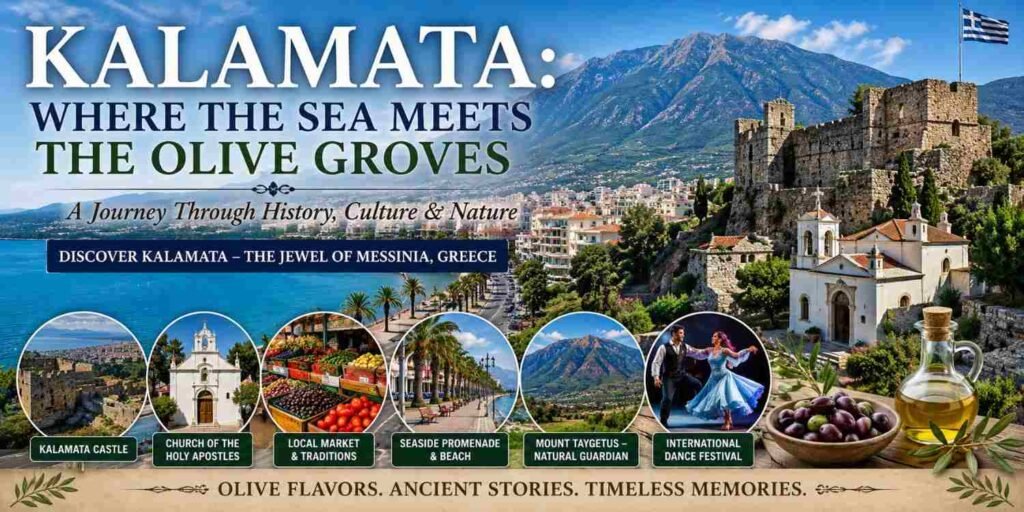
Kalamata: Where the Sea Meets the Olive Groves:
By Lokanath Mishra IRS ( rtd)
There are some cities that one visits merely as a traveller, and there are others that quietly become part of one’s memory. Kalamata, lying beside the sparkling Messinian Gulf in the southern Peloponnese of Greece, belongs to the second kind.
I arrived in Kalamata on a warm Mediterranean morning. The road from Athens had carried me through changing landscapes—green valleys, rugged mountains and scattered villages—until suddenly the blue waters of the Messinian Gulf appeared before me. Behind the city stood the majestic Mount Taygetus, its slopes rising like a natural guardian over Kalamata.
The first impression was one of peace. Palm trees lined the seaside promenade, cafés opened their doors to the morning sun, and the sound of the waves mixed with the voices of people beginning their day.
But Kalamata was not merely a beautiful seaside city. It was a place where history, food, culture and nature seemed to live together.
The Castle Above the City
My first destination was Kalamata Castle, the old Frankish fortress standing above the city.
As I climbed towards it, the modern city gradually disappeared behind me. The ancient stones seemed to tell stories of another age—of rulers, soldiers, merchants and ordinary people who had lived beneath the shadow of the fortress.
From the castle heights, the view was unforgettable. Kalamata stretched below, with its red-roofed houses and narrow streets leading towards the brilliant blue gulf. Beyond the city, the mountains formed a magnificent backdrop.
Standing there, I realised that Kalamata was not simply a modern Greek city. Beneath its contemporary life lay centuries of history.
A Church and a Nation’s Memory
Later, I walked towards the Church of the Holy Apostles, one of the city’s most important historic landmarks.
The little church carries a special place in Greek history. It is associated with the events of 23 March 1821, when the Greek War of Independence reached Kalamata and the city was liberated from Ottoman rule.
As I stood before the church, I imagined the people who must have gathered there nearly two centuries ago. For them, freedom was not an abstract word. It was a dream for which generations had waited.
The quiet surroundings of the church contrasted with the dramatic history associated with it. Yet perhaps that was what made the place so moving.
History often survives not in enormous monuments but in small buildings where ordinary people once stood with extraordinary hopes.
The City of the Olive
If Kalamata has a soul, perhaps it can be found in its olive groves.
The name Kalamata is known throughout the world because of its famous dark purple Kalamata olives. Everywhere I went, olives and olive oil seemed to be part of everyday life.
At a local market, I saw baskets filled with olives, bottles of golden olive oil, fresh vegetables, honey, local cheeses and traditional sweets. The market was alive with conversation.
An elderly vendor offered me some olives to taste.
I took one.
Its rich, slightly salty flavour seemed completely different from the olives I had eaten elsewhere. Perhaps food tastes better when one knows the land from which it comes.
The vendor smiled and said something in Greek. I could not understand every word, but his expression needed no translation.
He was proud of his land.
The Market of Everyday Greece
The open-air market was perhaps more fascinating than any tourist attraction.
Farmers arrived with produce from the surrounding countryside. There were tomatoes glowing under the morning sun, fresh fruits, herbs, honey, cheeses and traditional pastelli, the delicious sesame-and-honey bar.
There was no artificial glamour.
This was real Greece—the Greece of farmers, families, small businesses and generations-old traditions.
I walked slowly through the market, watching people bargain, laugh and greet one another. It reminded me that travelling is not only about seeing famous monuments. Sometimes the true character of a country can be discovered in its markets.
The Sea and the Promenade
In the afternoon, I went towards Kalamata Beach.
The coastline seemed almost endless. The clear Mediterranean water reflected the afternoon sunlight, while palm trees moved gently in the sea breeze.
The promenade was full of life. Families walked beside the sea, young people sat in cafés, cyclists passed along the waterfront and visitors rested beneath umbrellas.
I found a quiet place overlooking the water.
For a while, I did nothing.
I simply watched the sea.
The waves came towards the shore and disappeared again. The rhythm was almost like meditation.
Perhaps this is one of the gifts of the Mediterranean: it teaches a traveller to slow down.
Under the Shadow of Mount Taygetus
The following day, I looked towards Mount Taygetus.
The mountain seemed enormous from the city, its rugged slopes rising dramatically behind Kalamata.
For those who love nature, the mountain offers hiking and outdoor adventures. But even for someone who does not climb its trails, its presence gives Kalamata a special character.
The city lives between two great landscapes—the sea in front and the mountains behind.
It is this combination that makes Kalamata so beautiful.
A City That Dances
Kalamata is also famous for its International Dance Festival, an important cultural event that brings dancers, choreographers and visitors from different parts of the world.
Dance, like music, does not always need translation.
A dancer can tell a story through movement. A performance can communicate emotions that words sometimes cannot express.
During the festival season, Kalamata becomes even more vibrant, with performances and cultural activities bringing people together from different countries.
It is a reminder that a city can preserve its history while simultaneously welcoming new forms of artistic expression.
An Evening by the Gulf
That evening, I returned to the promenade.
The sun was slowly descending towards the horizon. The mountains turned darker, while the sky above the gulf changed from blue to gold.
People gathered at seaside cafés. Conversations continued around me. Somewhere nearby, music was playing.
I ordered a simple Greek meal accompanied by local olive oil.
There was nothing extravagant about the dinner.
Yet it felt perfect.
Fresh food, warm air, the sound of the sea and the mountains in the distance—sometimes happiness requires very little.
The Journey Beyond Kalamata
Kalamata can also become a base for exploring the wider region of Messenia.
Among the places worth visiting is Ancient Messene, an extraordinary archaeological site surrounded by mountains and countryside. Walking among its ancient remains offers another journey through Greek history.
From the modern city to the ancient ruins, the traveller begins to understand how deeply the past and present are connected in this part of Greece.
The journey from Athens to Kalamata by road also becomes part of the experience. The route takes travellers through some of the beautiful landscapes of the Peloponnese, while Kalamata International Airport provides direct access for those arriving by air.
The Memory of Kalamata
On my final evening, I stood beside the sea and looked back towards the city.
I thought about the castle above the rooftops.
I thought about the little church associated with the struggle for independence.
I thought about the farmers at the market, the olive groves, the golden oil, the dancers, the mountain and the endless sea.
Kalamata had taught me something simple.
A city does not become memorable merely because it possesses monuments.
It becomes memorable when its landscape, history, food, people and culture come together to create a feeling.
Kalamata had given me that feeling.
As darkness slowly covered the Messinian Gulf, the lights of the promenade began to shine. The sea remained restless, the mountain stood silently behind the city, and somewhere in the darkness the olive trees continued their ancient existence.
I walked away carrying no great treasure—only the taste of Kalamata olives, the image of the blue Mediterranean, and the quiet memory of a Greek city where the mountains meet the sea and history lives beside everyday life.
And perhaps that is why some journeys remain in the heart long after the traveller has returned home.