
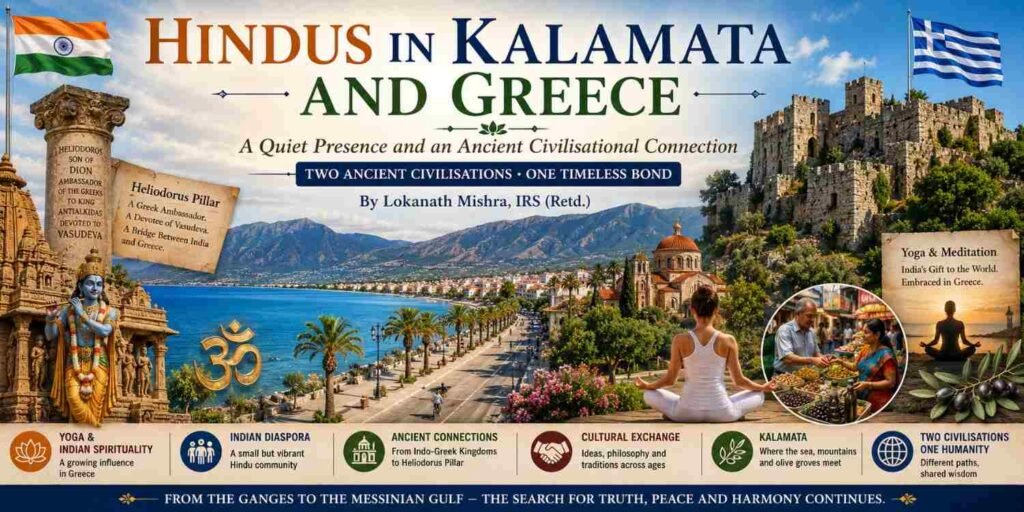
Hindus in Kalamata and Greece: A Quiet Presence and an Ancient Civilisational Connection
By Lokanath Mishra
Greece and India are separated by thousands of kilometres, different languages, geographical landscapes and distinct historical experiences. Yet, when one looks beyond geography, an interesting world of cultural, philosophical and spiritual connections emerges between these two ancient civilisations.
Greece is known throughout the world as the birthplace of democracy, Western philosophy and the Olympic Games. India, on the other hand, is known as one of the world’s oldest continuing civilisations and the birthplace of Hindu philosophy, Buddhism, Jainism and several profound spiritual traditions.
Today, Greece remains predominantly associated with the Greek Orthodox Christian tradition. Hinduism constitutes only a small religious presence in the country, mainly among members of the Indian diaspora and followers of Indian spiritual and yogic traditions. Nevertheless, Hindu thought, yoga, meditation and Indian philosophy have gradually found admirers in different parts of Greece.
This is the story of a small but significant spiritual bridge between India and Greece.
A Small Hindu Presence in Greece.
The Hindu community in Greece is comparatively small. It consists largely of people of Indian origin who have migrated to Greece for employment, business and other opportunities. Indian communities can be found mainly in and around Athens and in other parts of the country.
Over the years, Hindu religious and spiritual organisations have also introduced Greek citizens to different aspects of Indian philosophy. Yoga centres and organisations associated with traditions such as ISKCON, Sahaja Yoga, Satyananda Yoga, Brahma Kumaris and other Indian spiritual movements have contributed to the spread of Indian philosophical and spiritual ideas in Greece. (Wikipedia)
For many Greeks, Hinduism may not necessarily be understood only as a religion practised through temple rituals. Their first introduction to Indian spirituality often comes through yoga, meditation, breathing exercises and philosophical ideas concerning inner peace and self-realisation.
In this sense, Indian spiritual traditions have travelled much further than the Indian diaspora itself.
Kalamata: A Mediterranean City Open to the World.
Kalamata, situated in the southern Peloponnese and surrounded by the beauty of the Messinian Gulf and Mount Taygetus, is internationally famous for its olives, olive oil, beaches and historical heritage.
It is not generally known as a major centre of Hindu population in Greece. Like many smaller European cities, however, Kalamata increasingly reflects the wider phenomenon of cultural exchange created by travel, migration, education and globalisation.
A visitor walking through Kalamata may encounter a city deeply rooted in Greek traditions and Orthodox Christianity, while at the same time observing the influence of a rapidly globalising world.
Yoga classes, meditation practices, vegetarian food preferences and interest in Eastern philosophies are no longer confined to India or Asia. Such ideas have travelled across continents and have become part of a wider international culture.
For a Hindu visitor from India, living in or visiting a place like Kalamata can therefore become an interesting experience.
The surroundings may be completely different from India. There may be no large Hindu temple nearby, no familiar sound of temple bells and no large Hindu festival procession through the streets. Yet the philosophical search for peace, self-knowledge and harmony with nature can be understood across cultural boundaries.
Yoga: One of India’s Most Visible Cultural Gifts.
Perhaps the strongest connection between modern Greece and Hindu philosophical traditions is yoga.
Yoga has crossed geographical, linguistic and religious boundaries and become a global phenomenon. In Greece too, yoga and meditation have attracted people searching for physical fitness, mental peace and spiritual balance.
The relationship between Greece and Indian yogic traditions is not merely a recent development. Satyananda Yoga, for example, established an organised presence in Greece decades ago, with activities beginning in Kalamata before expanding to other parts of the country. This represents an interesting and little-known connection between the city of Kalamata and the wider spread of Indian spiritual traditions in Greece. (Wikipedia)
Yoga, in its deeper philosophical meaning, is not merely a system of physical exercises. It represents the ancient Indian search for harmony between body, mind and consciousness.
This message has universal appeal.
In a modern world marked by stress, competition, loneliness and anxiety, the ancient Indian concept of inner balance has attracted people irrespective of nationality or religious background.
A Greek practising yoga may not necessarily become a Hindu. But through yoga, he or she may come into contact with ideas that originated in ancient Indian spiritual traditions.
Thus, cultural influence does not always travel through migration. Sometimes it travels through ideas.
Ancient Greece and Ancient India: Two Civilisations in Dialogue.
The relationship between Greece and India is not confined to modern times.
Ancient contacts between the Greek world and the Indian subcontinent created one of the most fascinating chapters in world history. Following the campaigns of Alexander and the subsequent emergence of Indo-Greek kingdoms, Greek and Indian cultures came into closer contact.
The interaction between Greek and Indian traditions influenced art, politics, philosophy and religion.
Archaeological and historical evidence from the Indo-Greek period demonstrates that Greek individuals living in the Indian cultural world sometimes engaged deeply with Indian religious traditions. One of the most remarkable examples is the famous Heliodorus pillar in central India.
The inscription on the pillar identifies Heliodorus, a Greek ambassador, as a devotee associated with the Bhagavata tradition centred on Vasudeva. This remarkable historical evidence illustrates that cultural and religious interaction between the Greek and Indian worlds was taking place more than two thousand years ago. (Wikipedia)
The significance of this historical connection is profound.
It reminds us that civilisations were never completely isolated from one another. Ideas travelled with merchants, diplomats, philosophers, soldiers and travellers.
Long before the modern age of aircraft and the internet, India and Greece had already entered into a dialogue.
Philosophy Beyond Borders.
Ancient Greece produced philosophers such as Socrates, Plato and Aristotle. Ancient India produced philosophical traditions represented in the Upanishads, the Bhagavad Gita and numerous schools of Hindu thought.
The two civilisations developed independently, yet both were deeply interested in some of the same fundamental questions.
What is the nature of reality?
What is the purpose of human life?
What is the relationship between the body and the soul?
What constitutes a good and meaningful life?
How can human beings achieve wisdom?
Greek philosophers searched for knowledge through reason and dialogue. Indian sages explored knowledge through meditation, introspection, philosophical debate and spiritual discipline.
The methods were not identical, and their religious and philosophical systems were distinct. Yet the human search behind them was often remarkably similar.
Perhaps this is why Indian philosophy continues to interest people across the world, including in Europe.
The Indian Community and Religious Freedom.
The presence of Indian communities in Greece has also raised practical questions concerning religious and cultural traditions.
For Hindu families living outside India, maintaining religious customs can sometimes be challenging. Festivals, rituals, community gatherings and traditional practices are often easier to organise when there is a sufficiently large and established community.
One important issue for Hindus and other communities was the question of cremation. Greece historically had legal and religious traditions that made cremation difficult, but changes in legislation allowing cremation were welcomed by sections of the Indian community. (Wikipedia)
Such developments demonstrate the changing nature of modern Europe.
As societies become more diverse, governments increasingly face the challenge of respecting cultural and religious traditions while preserving their own historical identity.
Religious diversity does not necessarily weaken a nation.
When handled with understanding and mutual respect, it can enrich society.
Living as a Hindu in Greece.
For a Hindu living in Greece, everyday life may involve a unique combination of adaptation and cultural preservation.
The Greek people have their own deep religious traditions. Churches, religious festivals and Orthodox customs remain an important part of Greek social life.
A Hindu living in Greece experiences a different religious environment.
Yet there are also similarities between the Mediterranean and Indian approaches to family and tradition. Both societies place importance on family relationships, festivals, food, hospitality and respect for cultural heritage.
A Hindu family in Greece may celebrate Diwali, Holi, Janmashtami or other festivals privately or within a small community.
Traditional Indian food may be prepared at home.
Children may learn about Indian customs from parents and grandparents.
Modern technology has also made cultural preservation easier. Through television, social media and digital communication, an Indian living thousands of kilometres away from home can remain connected with religious ceremonies, festivals and family traditions.
The physical distance remains, but cultural distance has become smaller.
Kalamata and the Spirit of Cultural Coexistence.
Kalamata is known for its historical identity, traditional products and beautiful natural surroundings.
Its famous olive groves represent an ancient relationship between human beings and nature. In India too, nature occupies an important position in religious and cultural traditions.
Trees, rivers, mountains and animals have often acquired symbolic and spiritual significance in Hindu civilisation.
Standing beside the Messinian Gulf, with Mount Taygetus rising in the background, a visitor from India may find an unexpected connection.
The landscape is Greek.
The history is Greek.
The language is Greek.
But the human response to nature is universal.
A mountain can inspire reverence irrespective of whether it stands in Greece or the Himalayas.
A sunrise over the Mediterranean can produce the same sense of wonder as a sunrise over the Ganges.
The language of nature requires no translation.
From Kalamata to India: A Bridge of Ideas.
The future relationship between Greece and India need not be limited to tourism and commerce.
There is enormous potential for cultural dialogue.
Indian classical music and dance can be introduced to Greek audiences. Greek philosophy can be studied by Indian students. Yoga and meditation can create opportunities for spiritual exchange. Universities can encourage research into the ancient connections between Greek and Indian civilisations.
Tourism can also become a bridge between the two countries.
Greeks increasingly travel to India to experience its culture, spirituality and historical monuments. Indians visiting Greece discover the extraordinary heritage of Athens, Delphi, Olympia, Corinth, Kalamata and the beautiful Greek islands.
Every traveller carries something home.
Sometimes it is a photograph.
Sometimes it is a memory.
And sometimes it is a new idea.
A Small Community, a Large Cultural Legacy.
The number of Hindus in Greece may be relatively small, and Kalamata may not be known as a major centre of Hindu religious life. Yet numbers alone do not determine the importance of cultural influence.
Indian civilisation has travelled across the world through its philosophy, spirituality, literature, music, food and traditions.
Yoga is practised on every continent.
Meditation has entered modern healthcare and psychology.
The Bhagavad Gita continues to be studied by readers from different cultures.
Indian festivals are celebrated far beyond India.
In Greece, as elsewhere in Europe, Hinduism may remain a minority faith. But Indian thought has found a wider audience.
This distinction is important.
A religion may have a small number of formal followers while its philosophical ideas influence millions.
The Deeper Connection.
Perhaps the most interesting relationship between Greece and India lies not in numbers but in ideas.
Greece gave the world the tradition of philosophical questioning.
India gave the world profound traditions of spiritual introspection.
Greek civilisation repeatedly asked human beings to think.
Indian civilisation repeatedly asked human beings to look within.
Neither tradition belongs exclusively to one nation today.
The wisdom of Socrates can be studied in India.
The Bhagavad Gita can be read beside the Mediterranean Sea.
Yoga can be practised in Kalamata.
Greek philosophy can be discussed in Delhi.
This is the true beauty of civilisation.
Ideas cross borders more easily than armies.
Culture survives longer than political power.
And wisdom belongs to humanity.
For the Hindu visitor or resident in Kalamata, Greece may initially appear distant from the familiar religious atmosphere of India. But beneath the differences of language, architecture and customs lies a deeper human connection.
Both India and Greece are ancient lands.
Both have preserved memories of great civilisations.
Both have produced thinkers who asked humanity to search for truth.
And perhaps that is where the Hindu presence in Greece finds its most meaningful place—not merely in temples or religious institutions, but in the continuing dialogue between two of the world’s great civilisations.
From the banks of the Ganges to the shores of the Messinian Gulf, the landscapes may be different.
But humanity’s search for meaning remains the same.
— Lokanath Mishra IRS ( rtd)