
An Invitation He Couldn’t Refuse
By Lokanath Mishra
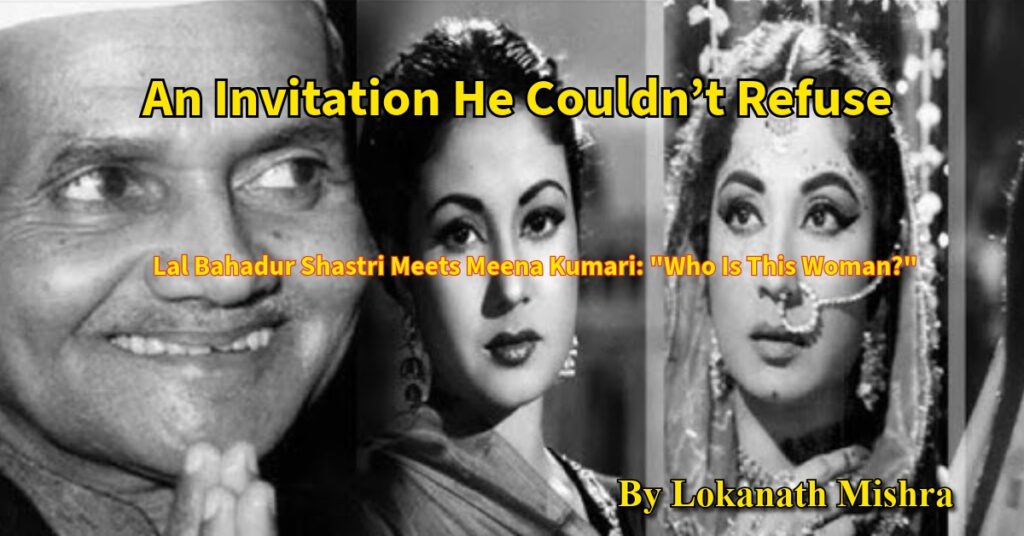
During his tenure as Prime Minister, Lal Bahadur Shastri was invited to a film studio in Mumbai to witness the shooting of Pakeezah. The invitation did not come lightly. According to accounts, there was considerable insistence from the then Chief Minister of Maharashtra, making it politically awkward for Shastri to decline. Reluctantly—but dutifully—he agreed and arrived at the studio.
The set was buzzing with activity. Pakeezah was an ambitious project, and several leading figures from the Hindi film industry were present. At the center of attention stood its luminous star, Meena Kumari, already a legend in her own lifetime.
A Question That Stunned the Crowd
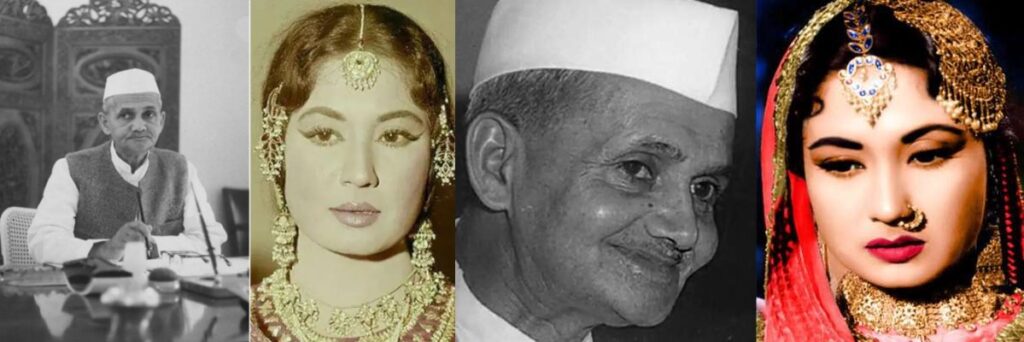
The incident is narrated by Kuldeep Nayyar in his book On Leaders and Icons: From Jinnah to Modi. Nayyar records that when Meena Kumari stepped forward and garlanded the Prime Minister, Shastri turned to him and asked, with complete sincerity:
“Who is this woman?”
Nayyar was taken aback. Assuming Shastri was joking, he replied with surprise that she was Meena Kumari. But Shastri’s expression did not change. He genuinely did not recognize her. Nayyar then began listing some of her famous films, hoping that might help.
Shastri listened patiently—and then said something even more astonishing:
“Sorry, Kuldeep. I have never seen any film till date.”
Innocence, Not Ignorance
Nayyar later wrote that he never imagined Shastri would admit such a thing publicly. In a country where cinema had already become a shared cultural language, not recognizing its biggest star could easily have been seen as aloofness or affectation. But this was neither.
What impressed Nayyar—and many others who later heard the story—was Shastri’s complete absence of pretense. He did not pretend to know what he did not. He did not mask his unfamiliarity with polite half-smiles or evasive comments. His honesty was total, and his simplicity disarming.
A Public Apology from the Prime Minister
Later that day, while addressing the gathering, Shastri did something even more remarkable. Turning toward Meena Kumari, he said—publicly and without hesitation:
“Meena Kumari ji, please forgive me. I have heard your name for the first time.”
The audience responded warmly. People were struck by the humility of a Prime Minister who could apologize openly to a film actress, without concern for ego or image. It was a rare moment of vulnerability in public life—and it resonated deeply.
The Silent Embarrassment of a Star
For Meena Kumari, however, the moment carried a different emotional weight. At the peak of her fame, adored by millions, she suddenly found herself standing before the highest political authority in the land—who had never heard of her until that day.
Nayyar notes that there was visible embarrassment on her face. Not humiliation, but a quiet, human awkwardness. In that instant, the glamour of stardom met the austere world of public service—and the contrast could not have been sharper.
What This Moment Tells Us About Shastri
This episode is remembered not because a Prime Minister visited a film set, but because of what followed:
• His detachment from celebrity culture, even at its peak
• His refusal to feign familiarity for social convenience
• His moral courage to apologize publicly, without being prompted
Lal Bahadur Shastri’s life was defined by restraint, integrity, and quiet strength. The story from the sets of Pakeezah may seem small, but it encapsulates those qualities perfectly.
In an age where public figures carefully curate every gesture, this forgotten moment from history reminds us that true greatness often lies in unaffected honesty—and the grace to say, simply and sincerely, “I’m sorry. I didn’t know.”