
Mahabharata in Prose – Part 56 (continued)
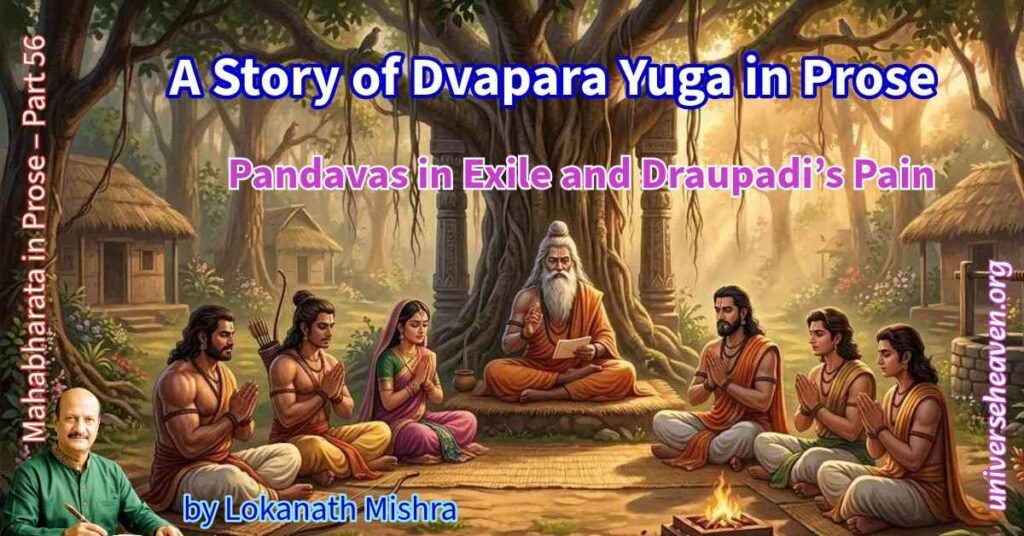
A Story of Dvapara Yuga in Prose
by Lokanath Mishra
With Arjuna’s return from the celestial realms, a new strength filled the hearts of the Pandavas.
The forest that had once echoed with sorrow and uncertainty now seemed alive with renewed purpose. Though still clothed in bark garments and living amidst hardship, the sons of Pandu no longer appeared like fallen kings.
There was a quiet power within them now.
The sages who visited their hermitage often spoke among themselves:
“These princes have been shaped by suffering. Destiny prepares them for something vast.”
Yet the Pandavas themselves remained disciplined and humble.
They continued their life in exile without complaint.
Every morning began with prayers, study, and service to the sages dwelling in the forest. Yudhishthira immersed himself in discussions of dharma. Bhima hunted and protected the hermitages from dangerous beasts and rakshasas. Arjuna practiced with celestial weapons in solitude, careful never to misuse them.
Nakula and Sahadeva tended horses, cared for the hermitage, and served their elder brothers with unwavering devotion.
And Draupadi, though born a queen, endured every hardship beside them with remarkable strength.
⸻
Draupadi’s Silent Pain
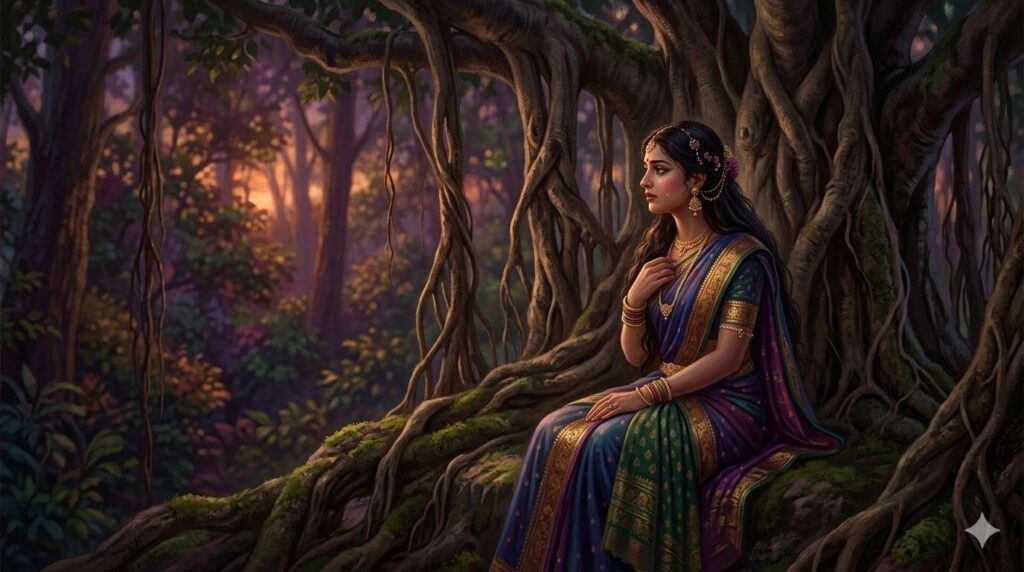
One evening, after the brothers had completed their daily duties, Draupadi sat quietly beneath a great banyan tree.
The fading light of sunset touched her face, but her eyes carried deep sorrow.
Bhima noticed her silence and approached gently.
“Krishnaa,” he said softly, “why does sadness still linger in your heart?”
For some time, Draupadi remained silent.
Then, slowly, the pain she had long restrained began to emerge.
“Tell me, Bhima,” she said, “is this truly justice?”
Her voice trembled—not with weakness, but with years of buried anguish.
“I was dragged into the Kuru assembly before kings and elders. I was humiliated while men who knew dharma remained silent. We were deprived of our kingdom through deceit. And still we wander in forests while those responsible sit upon thrones.”
Bhima’s eyes immediately burned with fury.
The memory of that dice hall still lived within him like an unhealed wound.
Draupadi continued:
“I do not fear hardship. I do not fear exile. But how long must adharma flourish while righteousness suffers?”
Bhima clenched his fists.
His mighty frame trembled with anger.
“Not forever,” he said in a low voice. “I swear to you, Krishnaa, the day will come when Duryodhana, Dushasana, Shakuni, and Karna shall pay for every insult inflicted upon you.”
His words carried the force of a vow.
And Bhima was not a man who spoke empty promises.
Yudhishthira’s Burden
Nearby, Yudhishthira had overheard their conversation.
Slowly, he approached.
There was pain in his eyes—not the pain of anger, but of responsibility.
“Draupadi,” he said quietly, “every word you speak is true. The injustice done to you can never be denied.”
Draupadi turned toward him.
“Then why do we remain silent?” she asked. “Why must patience always belong to the righteous alone?”
Yudhishthira lowered his gaze for a moment before answering.
“Because anger without restraint destroys wisdom. A king must know not only when to fight—but when to endure.”
Bhima responded sharply:
“Brother, there comes a time when endurance becomes weakness.”
The tension between the two brothers hung heavily in the air.
Yudhishthira remained calm.
“No,” he replied. “Endurance guided by dharma is strength. We have given our word to complete this exile. If we abandon righteousness for revenge, then how shall we remain different from those who wronged us?”
Bhima looked away, still burning within.
Though he respected Yudhishthira deeply, patience did not come naturally to him.
Arjuna, who had been listening silently, now spoke.
“Both of you speak truth,” he said. “Dharma must guide us—but the time for action will also come.”
His voice carried a calm certainty born from his time among the gods.
“When that day arrives,” Arjuna continued, “we shall not be unprepared.”
⸻
The Visit of Sage Markandeya
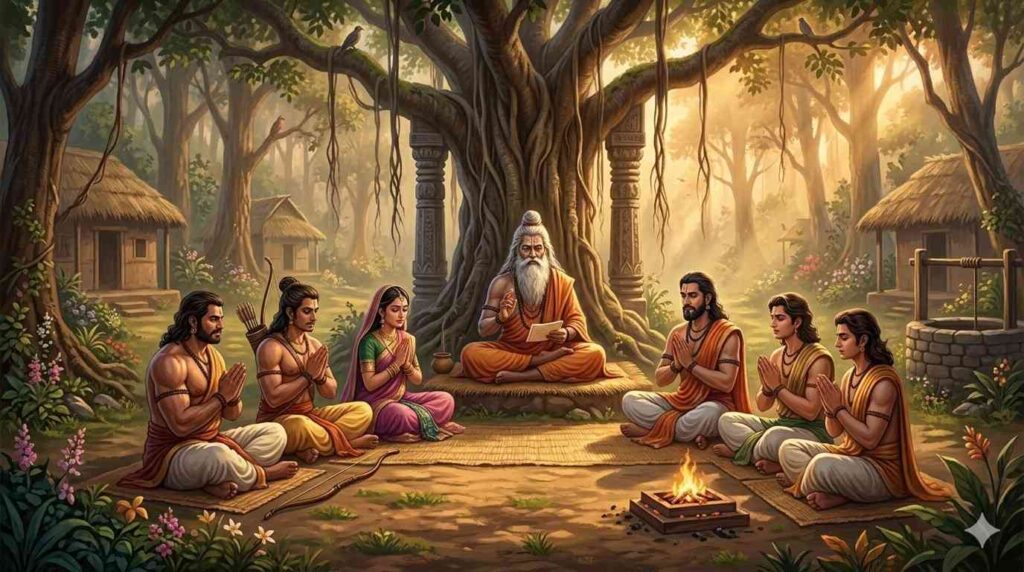
Not long after, the great sage Markandeya arrived at the Pandavas’ hermitage.
The brothers welcomed him with deep respect.
Markandeya possessed extraordinary wisdom and had witnessed the rise and fall of countless generations. His presence itself brought peace to troubled minds.
Seeing the sorrow lingering among the Pandavas, the sage spoke gently:
“O sons of Pandu, do not believe yourselves alone in suffering. Throughout every age, even the greatest souls have endured hardship.”
Yudhishthira bowed respectfully.
“Revered sage,” he asked, “has any king suffered more than we?”
Markandeya smiled faintly.
“There was once another prince,” he said, “who lost his kingdom, wandered forests, endured separation from his beloved, and fought against immense evil for the sake of dharma.”
The Pandavas listened carefully.
The sage then began narrating the sacred story of Rama.
⸻
The Story Within the Story
For many days, Markandeya narrated the tale of Rama—the exile to the forest, the devotion of Sita, the loyalty of Lakshmana, the abduction by Ravana, and the great war fought for righteousness.
As the Pandavas listened, they found reflections of their own lives within the ancient story.
Like Rama, they too had lost a kingdom.
Like Sita, Draupadi had endured suffering with dignity.
Like Lakshmana, Bhima and Arjuna stood fiercely loyal beside their elder brother.
And like Ravana, Duryodhana’s pride blinded him toward destruction.
The story gave them strength.
For they understood that suffering borne for dharma was never meaningless.
⸻
Bhima’s Oath Deepens
Yet even as wisdom soothed the others, Bhima’s anger remained alive.
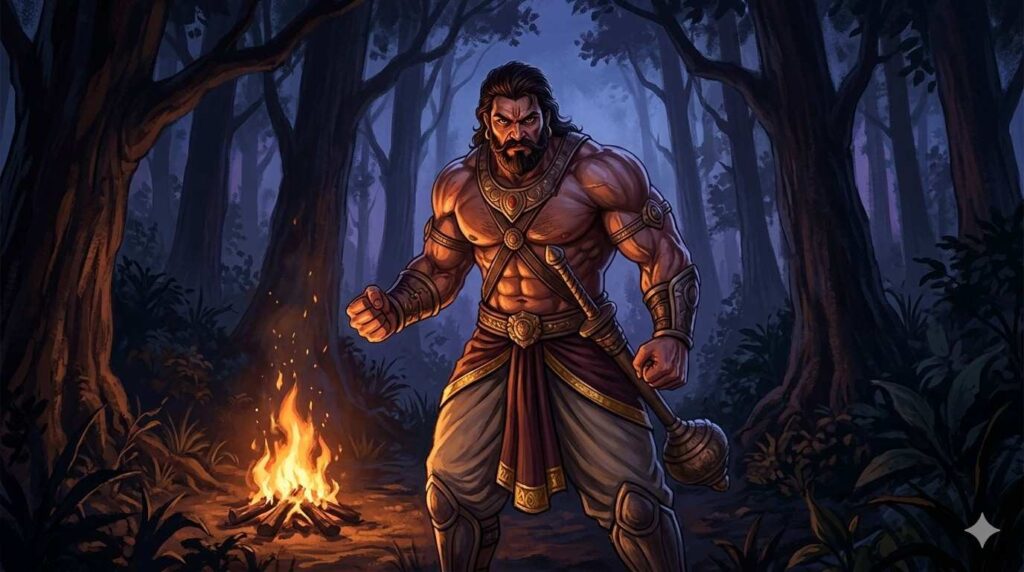
One night, sitting beside the fire beneath a moonless sky, he spoke quietly to Arjuna:
“Brother, I can still hear Dushasana’s laughter in that assembly hall.”
Arjuna said nothing.
Bhima’s voice hardened.
“I have made vows, and those vows shall be fulfilled. I shall break Duryodhana’s thigh. I shall tear open Dushasana’s chest. No power upon earth shall stop me.”
The firelight flickered across his face like the glow of a coming storm.
Arjuna placed a hand upon Bhima’s shoulder.
“The time will come,” he said calmly. “Until then, preserve your strength.”
Bhima nodded slowly.
But within him, vengeance continued to burn like an undying flame.
The Forest Watches
Thus the years of exile continued.
But the Pandavas were no longer merely enduring suffering.
Each trial was shaping them differently.
Yudhishthira grew deeper in wisdom.
Bhima became fiercer in resolve.
Arjuna gained divine mastery.
Nakula and Sahadeva matured in discipline and loyalty.
And Draupadi became the living embodiment of endurance and dignity amidst injustice.
The forest itself seemed to witness their transformation.
For destiny was steadily preparing them for the greatest confrontation of the age.
Far away in Hastinapura, Duryodhana believed time weakened his enemies.
He did not realize that exile had become their forge.
And when the final hour arrived, the world would see what that forge had created.
⸻
Thus passed another chapter of the Pandavas’ exile—
filled with pain, wisdom, vows, and preparation—
as destiny slowly advanced toward the great war of Kurukshetra.
⸻
(Continued in Part 57…)