
Mahabharata in Prose – Part 48 (continued)
A Story of Dvapara Yuga in Prose
by Lokanath Mishra
The humiliation of Jayadratha did not fade with time—it festered.
As he departed from the forest, stripped of pride and marked by disgrace, his mind burned with a single consuming thought: revenge.
The image of Draupadi’s firm rejection, the laughter of Bhima, and the silent judgment in Arjuna’s eyes haunted him. But more than all, it was the memory of being spared—not slain—that wounded him most deeply. Mercy, to a man swollen with ego, felt worse than death.

He wandered aimlessly for days, his सेना dispersed, his spirit restless. Sleep abandoned him. Food lost its taste. The world itself seemed to mock him.
At last, driven by desperation, Jayadratha turned toward the path of तपस्या.
He journeyed northward, away from kingdoms and men, into desolate regions where silence reigned and the air itself seemed heavy with austerity. There, upon the banks of a lonely river, beneath a withered tree, he resolved to invoke the grace of Mahadeva.
Casting aside royal comforts, he donned bark garments and began severe penance.
Days turned into weeks. Weeks into months.
He stood upon one leg, arms raised toward the sky, eyes fixed upon the blazing sun. He endured scorching heat by day and chilling winds by night. He consumed little, spoke nothing, and allowed his body to weaken while his will hardened like iron.
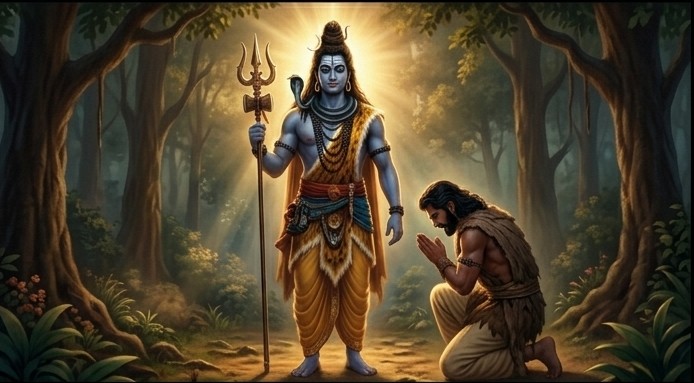
The forest watched in stillness.
Wild animals passed him by without fear. Seasons shifted. Leaves fell and grew again. Yet Jayadratha remained unmoved, his mind anchored to one desire—to gain the power to defeat the Pandavas.
At last, his तपस्या bore fruit.
One evening, as the sky turned crimson and the air trembled with unseen energy, a divine presence manifested before him.
Lord Shiva appeared.
Radiant, serene, and terrible in majesty, Mahadeva regarded Jayadratha with calm intensity.
“Rise, Jayadratha,” he spoke. “Your penance has pleased me. Ask for a boon.”
Jayadratha fell to his knees, his voice trembling with both reverence and urgency.
“O Lord of Lords, grant me the power to defeat the Pandavas in battle—to humble them as I was humiliated!”
For a moment, silence followed.
Then Shiva replied, his voice measured and absolute:
“What you ask cannot be granted in full. The Pandavas are destined for greatness, protected by forces beyond even your comprehension.”
Jayadratha’s heart sank—but before despair could take hold, Shiva continued:
“Yet, I shall grant you this:
On a single day in battle, you shall be able to hold back all the Pandavas—save Arjuna.”
Jayadratha’s eyes widened.
Though not the complete victory he desired, this boon carried immense power. To restrain warriors like Bhima, Yudhishthira, Nakula, and Sahadeva—even for a day—was no small gift.
He bowed deeply.
“I accept, O Mahadeva. Your grace is enough.”
With a final glance, Shiva vanished, leaving behind a silence filled with consequence.
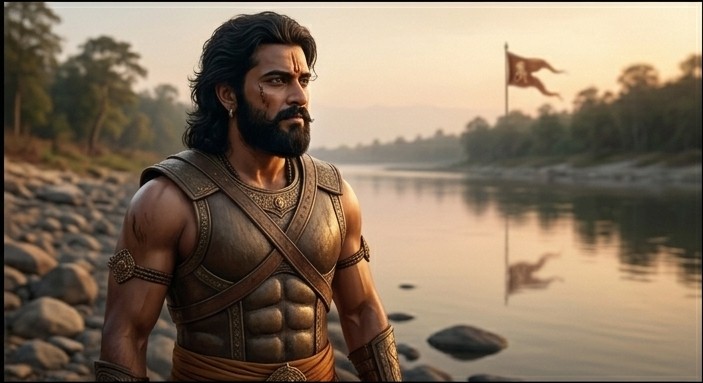
Jayadratha rose from his penance no longer broken—but transformed.
His humiliation had not been erased; it had been weaponized.
Within him now lived patience, sharpened by suffering, and a cold determination that awaited its moment.
He returned to his kingdom, outwardly composed, inwardly resolute.
And far away, the wheels of destiny continued to turn.
For the boon he had received would one day find its place—not in the forest, nor in quiet revenge—but amidst the thunder of war, on a day when the fate of a young warrior would be sealed.
A day when valor would be unmatched, and loss would be immeasurable.
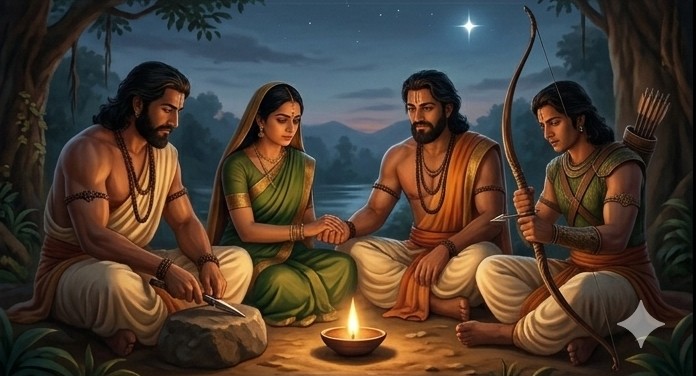
Meanwhile, in the forest, the Pandavas remained unaware of the storm that had begun to gather.
Their days continued in discipline and resilience.
Arjuna deepened his mastery of weapons. Bhima honed his strength against beasts and foes alike. Yudhishthira immersed himself in dharma and wisdom, guiding his brothers through hardship with calm resolve.
Draupadi, though strong in spirit, carried within her the memory of her abduction—a reminder of the dangers that still surrounded them.
Yet, together, they endured.
For exile was not merely a punishment—it was preparation.
And destiny, though unseen, was drawing ever closer.
Thus, what began as an act of arrogance in a quiet forest had now sown the seeds of a भविष्य घटना—
one that would unfold on the महान battlefield of Kurukshetra, shaping the very course of the Mahabharata.
(Continued in Part 49…)