
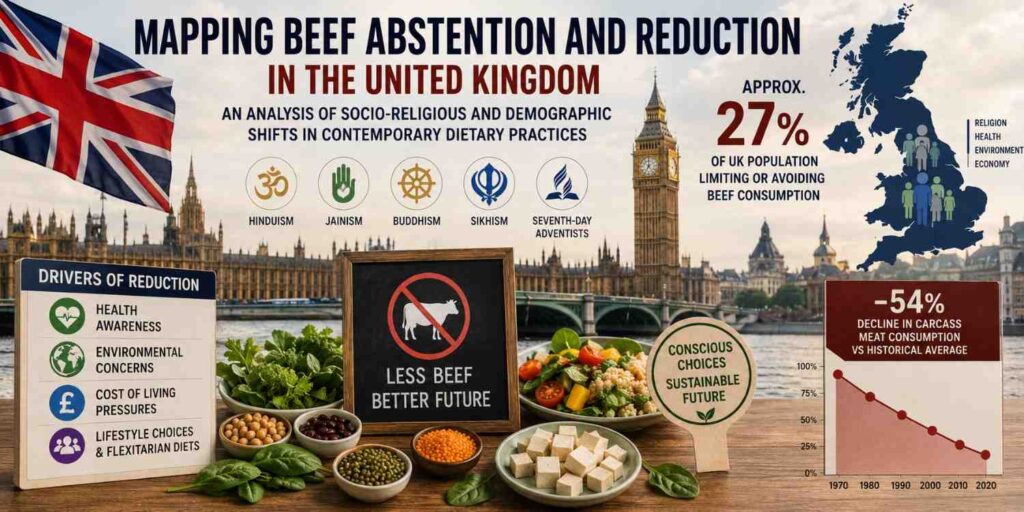
Mapping Beef Abstention and Reduction in the United Kingdom: An Analysis of Socio-Religious and Demographic Shifts in Contemporary Dietary Practices
By Lokanath Mishra
Abstract:
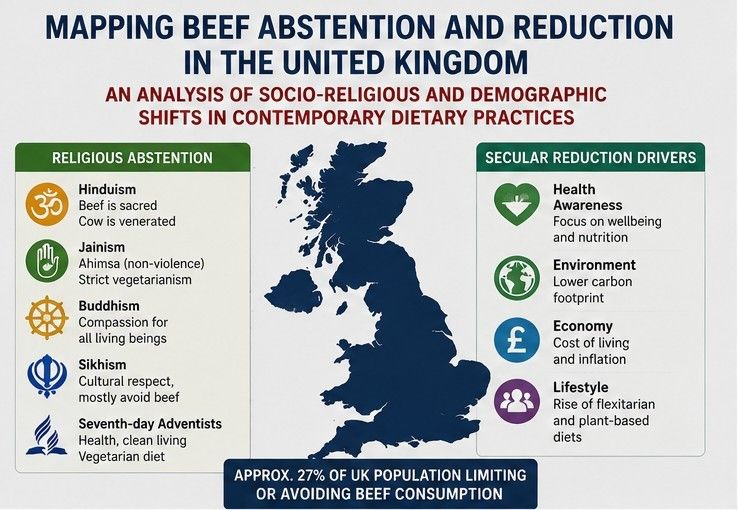
This paper explores the shifting landscape of beef consumption in the United Kingdom, focusing on the dual drivers of cultural-religious pluralism and secular dietary choices. By analyzing demographic data, religious doctrines, and market trends, we map out the segments of the UK population that strictly avoid or actively reduce beef intake. The findings indicate that while approximately 2% of the population abstains due to explicit Dharmic or specific Christian theological mandates, a much larger segment (up to 27% including flexitarians) is limiting carcass meat consumption due to health, environmental, and cost-of-living constraints. This intersection of permanent religious barriers and dynamic secular behaviors has resulted in a historic 54% drop in carcass meat consumption relative to long-term averages, signaling a profound structural shift in British food systems.
Introduction
Dietary choices within national populations are rarely uniform, acting instead as mirrors for changing demographics, evolving ethical frameworks, and economic pressures. In the United Kingdom, meat consumption habits—specifically regarding red meat and beef—have undergone a notable transformation over the past several decades. While beef historically stood as a centerpiece of the traditional British diet, contemporary data reveals a complex matrix of intentional avoidance and structured reduction.
This article evaluates the contemporary state of beef consumption in the UK through two primary lenses: structural abstinence dictated by religious adherence, and secular voluntary reduction driven by ethical, health, and macroeconomic factors. Combined, these vectors outline a society that is rapidly moving away from uniform meat-eating habits toward a highly fragmented and deliberate food landscape.
Religious Pluralism and Structural Beef Abstention
The UK’s multicultural fabric includes millions of citizens whose dietary practices are rooted in centuries-old religious doctrines. For several significant communities, the complete avoidance of beef is an absolute or culturally prioritized mandate, translating into lifelong structural abstinence.
2.1. Complete Avoidance in the Dharmic Traditions
The primary religious groups driving permanent beef exclusion in the UK belong to the Dharmic traditions, where principles of non-violence (ahimsa) and the sanctity of specific animals shape daily life:
Hindus: Within Hinduism, the cow holds a deeply revered status, symbolizing life, motherhood, and earth’s bounty. Consequently, the consumption of beef or any beef-derived ingredient (such as bovine gelatin) is strictly forbidden. The vast majority of the UK Hindu population observes a lacto-vegetarian diet, establishing a permanent baseline of beef exclusion within this demographic.
Jains: Jainism features perhaps the strictest application of ahimsa globally. Practicing Jains completely avoid any food product obtained through the harm or slaughter of a living creature. They observe strict vegetarianism or veganism, completely eliminating beef and all other animal flesh from their food supply.
Buddhists: While specific practices vary by lineage, many British Buddhists adhere to a vegetarian or vegan lifestyle. Guided by the First Precept (to abstain from taking life) and the cultivation of universal compassion, a high proportion of Buddhists exclude beef to avoid contributing to the suffering of sentient beings.
Sikhs: The relationship between Sikhism and meat consumption features minor internal variations, as scriptural views do not explicitly ban beef above other forms of meat slaughtered via specific rituals. However, out of historical respect for broader Dharmic traditions and the cultural frameworks of the Punjab region, a vast majority of practicing Sikhs avoid beef entirely, with many adopting fully vegetarian diets.

2.2. Christian Abrahamic Abstinence: Seventh-day Adventists
Beyond the Dharmic traditions, specific Christian denominations within the UK explicitly champion meat reduction. Seventh-day Adventists advocate for a holistic lifestyle centered on biblical health principles, treating the body as a temple. A substantial portion of this community follows a well-balanced vegetarian or vegan diet, directly excluding beef based on theological interpretations of clean living and stewardship.
2.3. Conditional Permissibility: Halal and Kosher Frameworks
It is critical to distinguish groups that abstain from beef from those that consume it under strict ritual parameters. British Muslims and Jews do not abstain from beef; rather, its consumption is contingent upon rigorous theological standards of slaughter and preparation:
For Muslims, beef must be certified Halal (permissible), requiring the animal to be healthy at the time of slaughter and processed via a swift incision while invoking the name of God. Similarly, for the British Jewish community, beef must be certified Kosher, adhering to the dietary laws of Kashrut, which dictate both humane slaughter techniques (shechita) and the total separation of meat and dairy products during storage, preparation, and consumption.
Quantitative Mapping of Beef Avoidance and Market Reductions
When compiling demographic datasets across the United Kingdom, measuring beef avoidance requires a synthesis of both absolute lifestyle categories (vegetarians and vegans) and fluid dietary behaviors (flexitarians and meat-reducers).
3.1. The Meat-Free Cohort
National surveys indicate that approximately 14% to 15% of the total UK population currently follows a meat-free diet, encompassing vegetarians, vegans, and pescetarians. Within this broad grouping, an estimated 7% to 9% completely exclude all forms of animal flesh, representing a permanent, baseline secular block of beef abstainers.
3.2. Compounding Religious and Dietary Data
Because standard UK market research often groups all meats together, researchers calculate total beef avoidance by cross-referencing religious census data with consumer preferences. Approximately 2% of the British public belongs to religious groups (primarily Hindu, Jain, and orthodox Buddhist communities) where beef consumption is completely barred by faith. When layered atop secular vegetarianism, a resilient, non-negotiable threshold of beef exclusion emerges.
3.3. The Rise of the Flexitarian and Market Contraction
The most dynamic impact on UK beef volumes comes from the flexitarian demographic—individuals who predominantly consume plant-based meals but occasionally include poultry, fish, or red meat. When flexitarians are combined with strict meat excluders, the share of the UK population actively limiting or entirely omitting meat from their weekly shopping basket rises to roughly 27%.
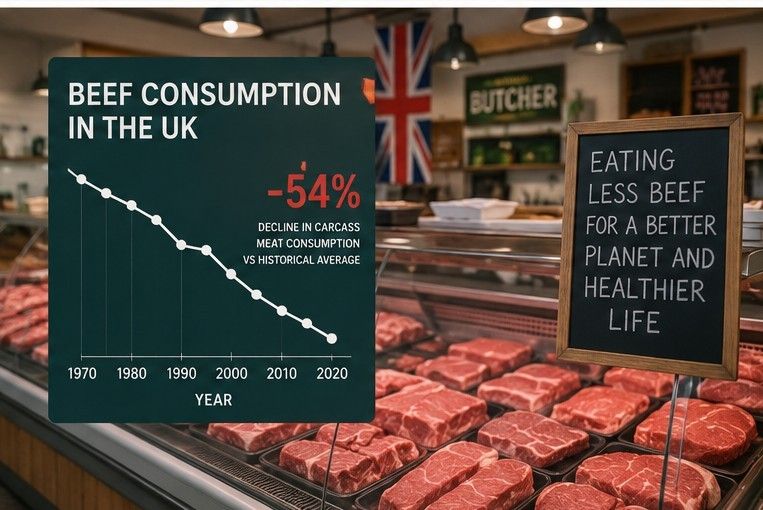
This behavioral shift has exerted a dramatic downward pressure on agricultural metrics. Long-term national statistics reveal that the consumption of classic carcass meats—a category comprised of beef, veal, and lamb—has plummeted by over 54% compared to historical post-war averages.
Socio-Economic and Environmental Tailwinds
The steep decline in UK beef consumption cannot be attributed to cultural or spiritual shifts alone; it is heavily reinforced by contemporary environmental messaging and economic realities.
Environmental and Carbon Awareness: Livestock production, particularly beef farming, carries a substantial environmental footprint. Public awareness campaigns emphasizing that beef generates significantly higher greenhouse gas emissions (CO_2e) per kilogram compared to poultry or plant alternatives have successfully driven climate-conscious consumers to reduce their red meat intake.
The Cost-of-Living Crisis: Macroeconomic pressures in the mid-2020s have accelerated these dietary shifts. Spiraling food price inflation and squeezed household incomes have transformed beef from a staple grocery item into a luxury purchase. Faced with tighter budgets, consumers are turning to alternative strategies: downgrading from premium cuts to lower-cost ground beef variants, reducing portion sizes, or swapping beef entirely for more affordable proteins like poultry or legumes.
Conclusion
Beef consumption in the United Kingdom is no longer a default cultural norm, but rather a highly calculated choice shaped by a diverse array of influences. Structural abstinence is firmly maintained by roughly 2% of the population due to deep-seated Dharmic and specific Christian beliefs, while an overlapping 7% to 9% maintain secular vegetarian commitments.
However, the broader market reality is dictated by the 27% of British consumers who are actively restricting meat intake. Driven by a volatile mix of environmental ethics, health considerations, and severe cost-of-living constraints, this massive consumer pivot has cut historical carcass meat consumption in half. For food policy planners, agricultural stakeholders, and public health officials, the evidence is clear: the UK is navigating a permanent, structural departure from its historical relationship with beef.