
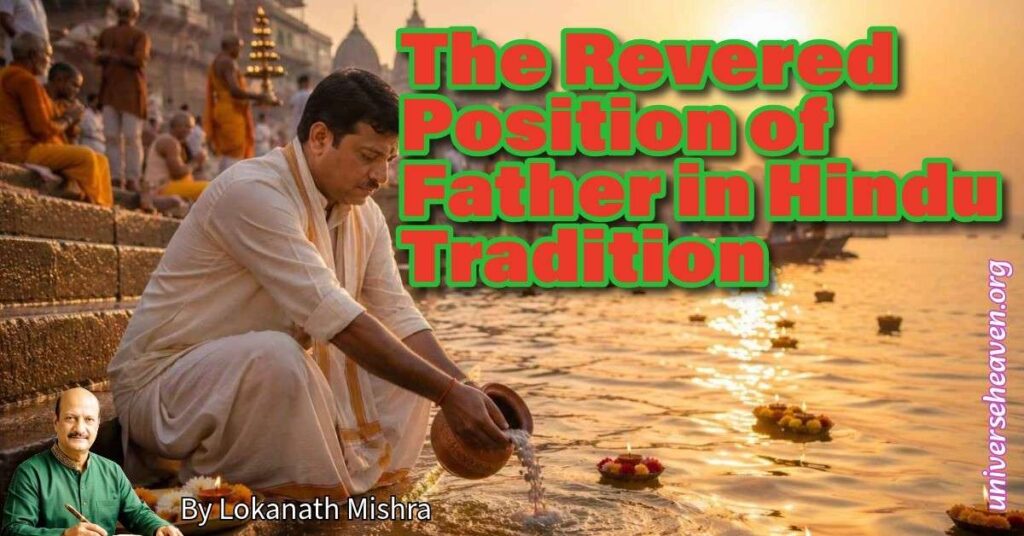
The Revered Position of Father in Hindu Tradition
By Lokanath Mishra, Jenamath Lane, Puri.
In the ancient Hindu way of life, the family is regarded as the fundamental unit of society, and the father occupies a position of immense dignity, responsibility, and spiritual significance within it. Far beyond being merely the head of the household, the father is viewed as the protector of the family, the guardian of Dharma, the preserver of lineage, and the first teacher who prepares his children to lead righteous and meaningful lives.
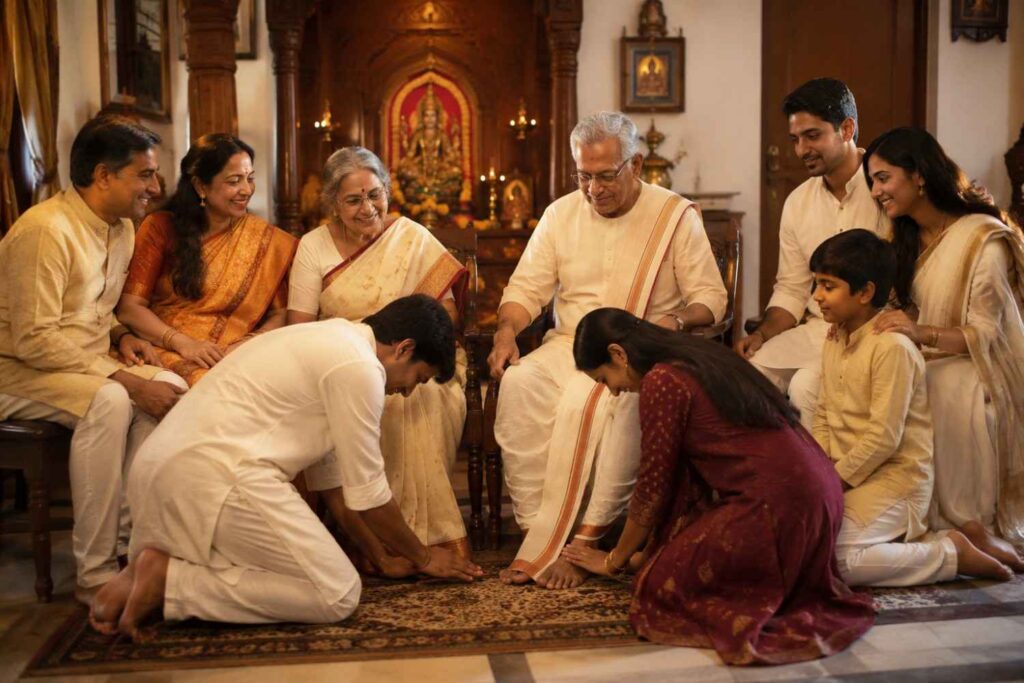
The Hindu scriptures repeatedly emphasize the sacred status of parents. The celebrated injunction from the Taittiriya Upanishad, “Matru Devo Bhava, Pitru Devo Bhava”—“Let the mother be unto you a deity; let the father be unto you a deity”—elevates parents to a divine position. This teaching does not imply that parents are worshipped as gods in a literal sense, but rather that they deserve the same reverence, gratitude, and service that one offers to the Divine. Since parents are the instruments through whom life is bestowed upon an individual, they are regarded as visible manifestations of God’s grace on earth.
In traditional Hindu families, the father has historically been viewed as the custodian of values, culture, and spiritual heritage. He bears the responsibility of educating his children, guiding them in moral conduct, teaching them the importance of truthfulness, discipline, compassion, self-restraint, and devotion to God. Through his example, children learn how to perform their duties towards family, society, and the nation. The father’s conduct often becomes the standard by which children shape their own character and worldview.
Ancient Hindu society considered fatherhood a sacred trust rather than merely a biological relationship. The birth of a child was seen as a continuation of the family lineage (Vamsha) and a means of preserving ancestral traditions. Therefore, the father was entrusted not only with the material welfare of his children but also with their intellectual, ethical, and spiritual development.
Pitru Rina: The Sacred Debt to Ancestors
Hindu philosophy teaches that every human being is born with certain obligations known as Rinas or debts. These are not financial liabilities but sacred responsibilities owed to those who have contributed to our existence and well-being.
The scriptures describe three primary debts:
- Deva Rina – the debt owed to the gods and cosmic forces that sustain life.
- Rishi Rina – the debt owed to the sages who preserved and transmitted knowledge and spiritual wisdom.
- Pitru Rina – the debt owed to parents and ancestors from whom one inherits life, family traditions, culture, values, and social identity.
Among these, Pitru Rina occupies a unique and deeply emotional place. Every individual inherits not only physical features from parents and forefathers but also language, customs, beliefs, traditions, and moral values accumulated over generations. Our very existence is the result of countless sacrifices made by parents and ancestors who nurtured, protected, and sustained the family lineage through difficult circumstances.
The Mahabharata and various Smritis explain that one can never fully repay the debt owed to parents. Their selfless love, sacrifices, sleepless nights, and lifelong concern for the welfare of their children transcend ordinary obligations. Nevertheless, Hindu Dharma prescribes ways by which one may honour and partially repay this sacred debt.
During their lifetime, parents should be served with affection, respect, obedience, and gratitude. Caring for them in old age, protecting their dignity, fulfilling their reasonable wishes, and ensuring their happiness are considered among the highest forms of Dharma.
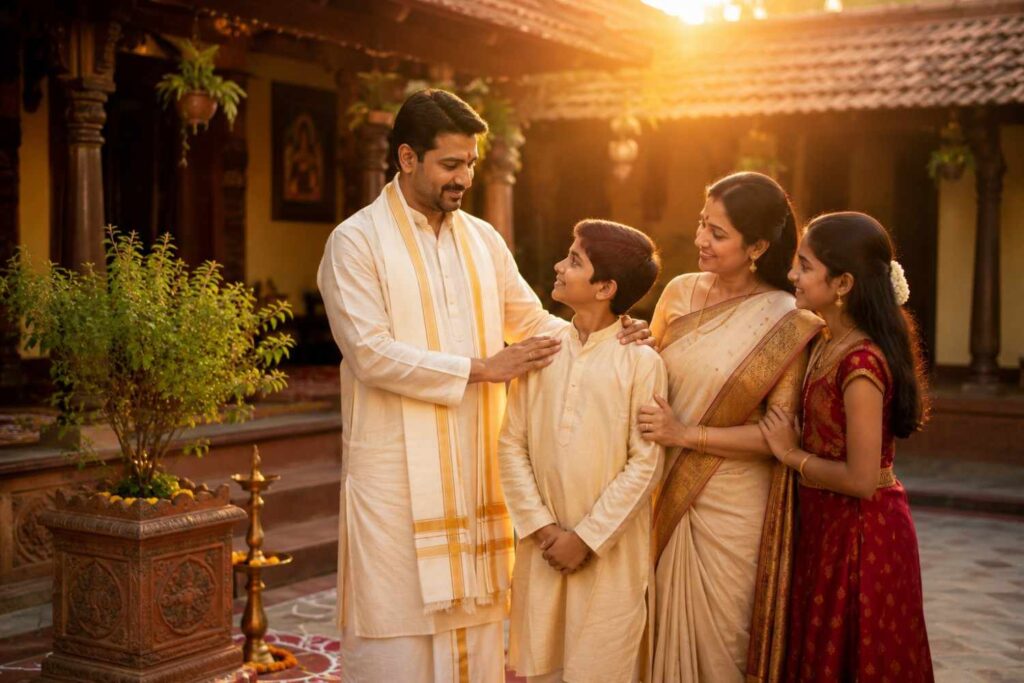
The scriptures declare that service to one’s parents is equivalent to pilgrimage, charity, and even certain forms of worship. A child who honours parents is believed to receive divine blessings, prosperity, and spiritual merit.
Duties Towards Parents After Death
Hinduism teaches that filial responsibility does not end with the death of parents. The relationship between generations extends beyond physical existence and enters the spiritual realm. Consequently, the scriptures prescribe a series of sacred rites intended to express gratitude, facilitate the onward journey of the departed soul, and maintain the bond between ancestors and descendants.
Among these rites, the most important are:
Antyeshti (Final Rites)
The final rites, known as Antyeshti Sanskara, constitute the last of the sixteen traditional Hindu sacraments. These rites symbolize the completion of the soul’s earthly journey and its transition into a new phase of existence.
The cremation ceremony is performed with solemn prayers and Vedic mantras. It acknowledges the impermanence of the physical body while affirming the immortality of the soul. According to the Bhagavad Gita, the soul neither dies nor is destroyed; it merely changes bodies as a person changes garments.
Pinda Daan
Following cremation, offerings known as Pinda Daan are made. The rice balls offered during these rituals symbolize nourishment and support for the departed soul during its spiritual journey.
Pinda Daan is especially significant at sacred places such as Gaya, Prayagraj, Varanasi, and other holy pilgrimage centres. Through these offerings, descendants express gratitude and pray for the peace and elevation of ancestral souls.
Shraddha
The word Shraddha is derived from the Sanskrit word Shraddha, meaning faith and devotion. Shraddha ceremonies are performed annually on the death anniversary of parents and ancestors, as well as during the sacred fortnight known as Pitru Paksha.
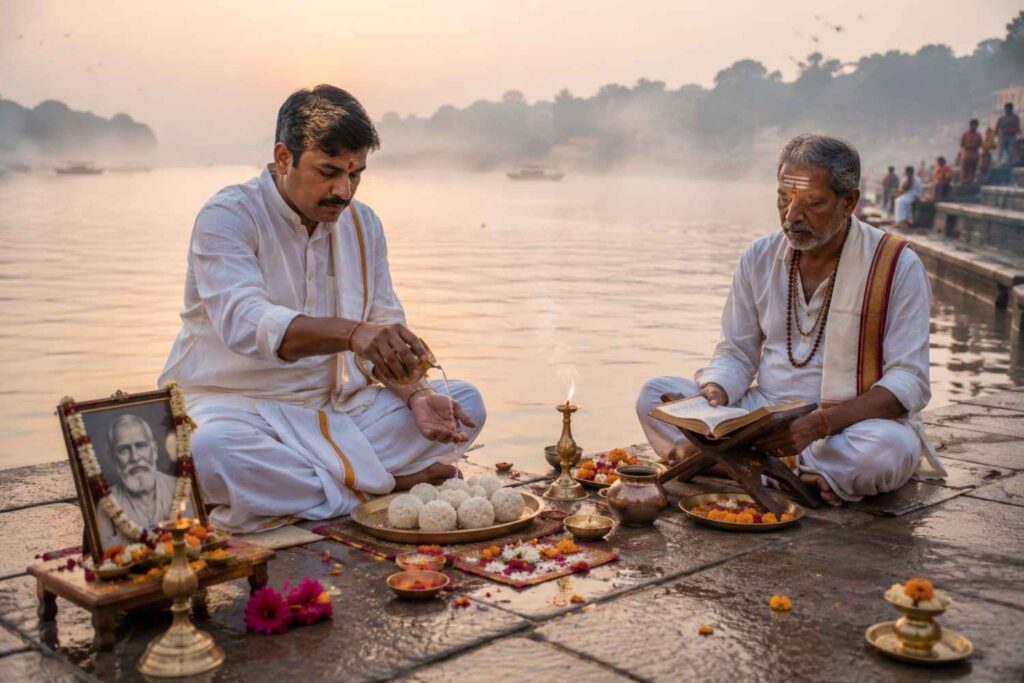
These ceremonies involve prayers, offerings of food and water, feeding Brahmins, helping the poor, and performing charitable acts in memory of departed ancestors. The rituals symbolize remembrance, gratitude, and continuity between generations.
The Garuda Purana and other scriptures teach that Shraddha performed with sincerity benefits both the departed souls and the descendants who perform the rites. It strengthens family bonds across generations and cultivates humility and gratitude among the living.
Asthi Visarjan and the Sacred Ganga
One of the most revered post-funeral rites in Hindu tradition is Asthi Visarjan—the immersion of cremated remains in sacred waters.
The River Ganga occupies a uniquely sacred place in Hindu spirituality. Revered as Goddess Ganga herself, the river is believed to possess the divine power to purify sins and assist souls in their spiritual progress. Since ancient times, millions of devotees have journeyed to her banks to perform sacred rites for departed family members.
After cremation, the ashes and bone fragments (Asthis) are carefully collected and immersed in the Ganga with prayers and offerings. This act symbolizes the return of the physical body to the five fundamental elements—earth, water, fire, air, and ether—from which it was formed.
The immersion is not merely a ritual act but a profound spiritual expression. It signifies surrender to the Divine Will and recognition of the eternal cycle of birth, death, and rebirth.
Many families undertake pilgrimages to sacred places such as Haridwar, Prayagraj, Varanasi, and Gangasagar for Asthi Visarjan. Particularly significant is Gangasagar, where the holy Ganga merges with the Bay of Bengal. This confluence is regarded as one of the most sacred sites in Hinduism and has attracted pilgrims for centuries.
The vast ocean symbolizes the infinite Divine into which all individual existence ultimately merges. Thus, the immersion of ashes at the meeting point of the Ganga and the Bay of Bengal represents the soul’s return to the cosmic source from which all life emerges.
Shraddha as an Expression of Gratitude
Contrary to common misconceptions, Shraddha is not merely a ritual performed out of fear or social obligation. It is fundamentally an act of gratitude.
Just as people celebrate birthdays and anniversaries to honour loved ones, Shraddha serves as a sacred remembrance of parents and ancestors. Through prayers, charity, feeding the needy, and acts of kindness performed in their memory, descendants acknowledge the immeasurable contributions of previous generations.
The observance teaches important spiritual values:
- Gratitude for sacrifices made by parents and forefathers.
- Humility in recognizing that our achievements rest upon the efforts of previous generations.
- Responsibility toward preserving family values and traditions.
- Awareness of the continuity of life beyond physical existence.
- Compassion through charitable acts performed in the name of ancestors.
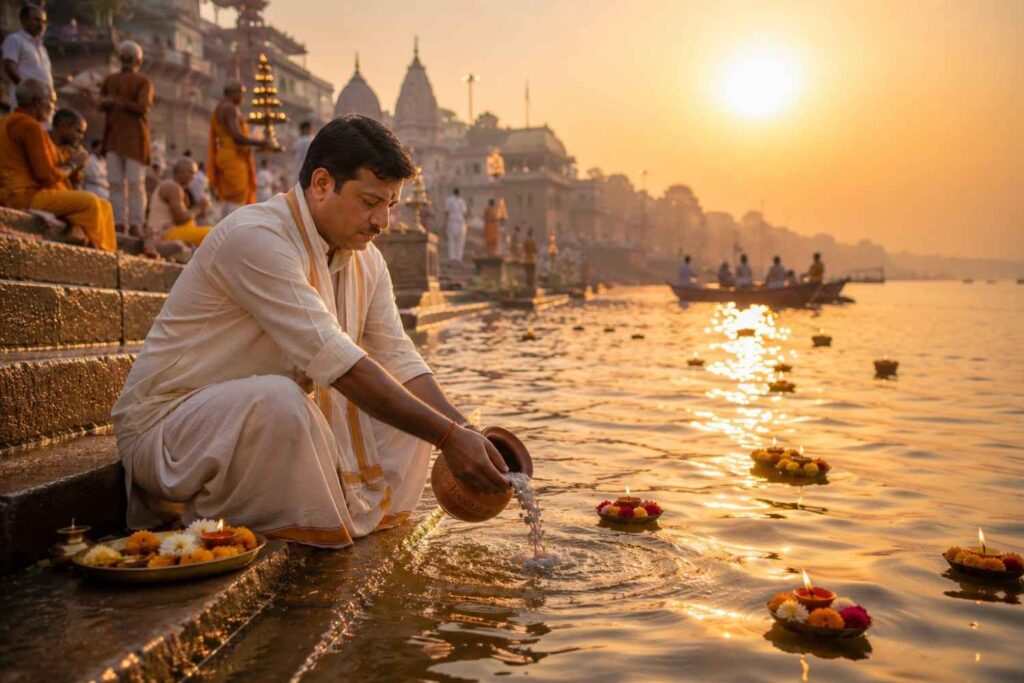
In this way, the repayment of Pitru Rina becomes not merely a religious duty but a lifelong spiritual discipline rooted in love, remembrance, reverence, and selfless service.
Father’s Day in the Light of Hindu Wisdom
Viewed through the lens of Hindu philosophy, Father’s Day acquires a deeper spiritual meaning. It becomes more than a celebration of a living parent; it becomes a day to honour the entire lineage of fathers and forefathers whose sacrifices have made our lives possible.
It is an occasion to express gratitude to living fathers through respect, affection, and service. At the same time, it is an opportunity to remember departed fathers through prayer, charity, remembrance, and acts of righteousness dedicated to their memory.
The true spirit of Father’s Day lies not in gifts alone but in living according to the values that fathers strive to impart—truthfulness, courage, integrity, compassion, self-discipline, and devotion to duty.
When we care for our parents during their lifetime and remember them with reverence after their departure, we fulfil one of the noblest obligations prescribed by Hindu Dharma. In doing so, we honour not only our fathers but also the timeless wisdom of our ancestors, whose blessings continue to guide and protect future generations.