
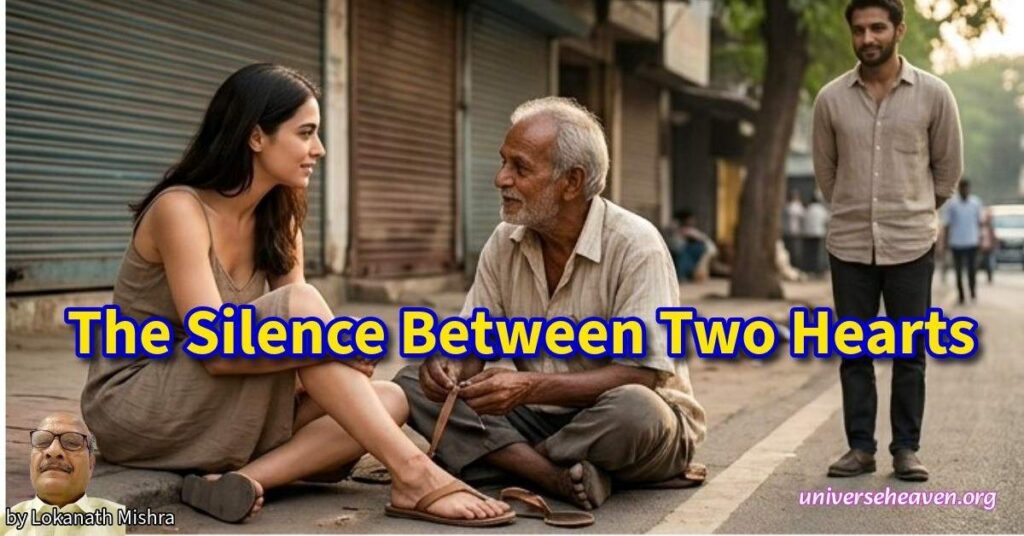
The Silence Between Two Hearts
By Lokanath Mishra
A reflective narrative for journal publication
There are stories that roar into existence with declarations, dramatic gestures, and unmistakable conclusions. And then there are stories that unfold quietly—so quietly, in fact, that the world barely notices them at all. Yet within their silence lies a depth more profound than any spoken confession.
This is one such story.

Raghav was a man whose presence seemed almost unreal. It was not merely his physical appearance—though that alone had earned him a reputation that preceded him into every room—but something subtler, something luminous. People often found themselves slightly disoriented around him, as though their carefully arranged thoughts had been gently rearranged without permission.
Emily discovered this within seconds of meeting him.
She had arrived in India with a firm sense of identity. Independent, articulate, and intellectually sharp, she was not easily impressed. She had traveled across continents, debated fiercely in academic halls, and prided herself on her ability to remain composed in unfamiliar environments.
Yet, when Raghav smiled and greeted her for the first time, something inexplicable shifted.
“Hi,” he said simply.
“Banana,” she replied.
The word escaped before she could stop it. For a brief moment, the universe seemed to pause—then collapse into laughter. Hers.
Raghav did not laugh. He only smiled, gently, almost curiously.
From that moment onward, Emily found herself unraveling in his presence—not in discomfort, but in a peculiar loss of control. Words slipped away from her. Sentences broke mid-thought. Ideas dissolved into laughter. She could not explain it, nor could she resist it.
And strangely, she did not want to.
Raghav, on the other hand, remained composed on the surface. But beneath that calm exterior lived a quiet storm.
He admired Emily deeply—not only her intelligence, but her authenticity. She was unguarded in ways that felt rare, almost sacred. She did not perform for the world; she simply existed within it, fully and unapologetically.
And somewhere along the way, admiration turned into affection.
But affection, in his case, remained unspoken.
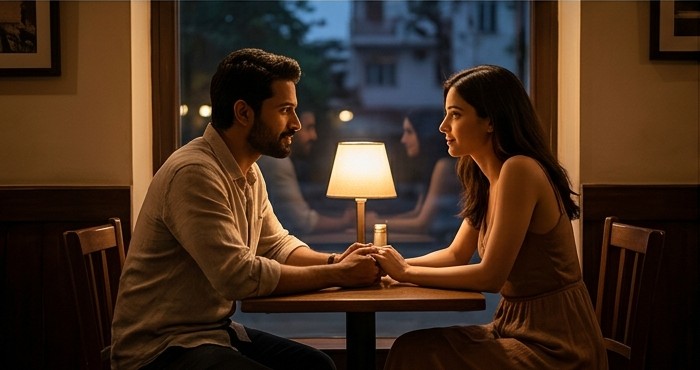
He feared disrupting what they already had—a friendship unburdened by expectation. There was a fragile beauty in their interactions, something effortless and unclaimed. To name it, he believed, might be to lose it.
So he chose silence.
Emily, too, remained silent—though for different reasons. She never fully recognized what she felt. What she experienced around Raghav was too unusual to categorize. It did not resemble the structured understanding of relationships she had known before. It was something softer, more elusive.
So she laughed instead of speaking.
And time moved quietly forward.
One afternoon, the rhythm of the city carried them to Janpath, where life unfolded in layers—vendors calling out, fabrics fluttering in the warm air, and the steady hum of humanity moving without pause.
It was there that Emily’s sandal gave way.
The strap snapped suddenly, rendering the footwear useless. Raghav instinctively suggested finding a nearby café while it was repaired, but Emily declined.
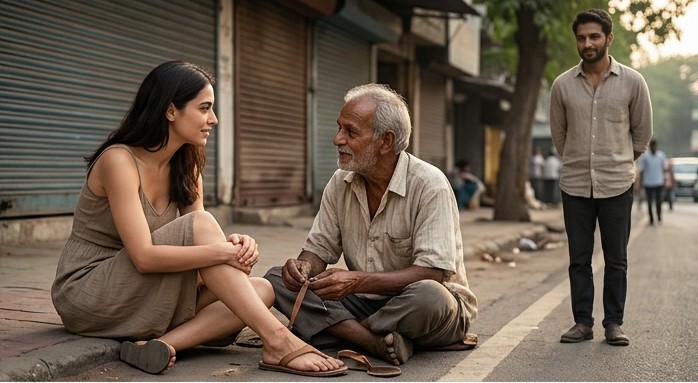
Instead, she sat down beside the roadside shoemaker.
Without hesitation. Without self-consciousness.
She folded herself onto the ground next to him, watching attentively as he examined the broken sandal. She asked him questions—not out of curiosity alone, but out of genuine interest. Who had taught him his craft? How long had he been working there? Did he enjoy what he did?
The shoemaker answered, at first cautiously, then with growing warmth.
Raghav stood a few steps away, observing quietly. There was something deeply moving in the simplicity of the moment. Emily, who came from a world so distant from this one, had bridged that distance without effort. She had not “lowered” herself to sit beside him; she had simply removed the invisible boundaries that others carried unconsciously.
When the repair was complete, Emily reached into her bag to pay him.
The shoemaker shook his head.
“No, madam,” he said softly. “Today, you gave me something more valuable.”
She looked at him, puzzled.
“Respect,” he explained.
Emily said nothing. Neither did Raghav.
Some moments do not require words.
Later that evening, Emily found herself in a situation that would have been amusing under different circumstances.
She had been entrusted with her infant nephew for the day—a responsibility she took seriously, though not without occasional confusion. When the child appeared restless and unwilling to feed, concern drove her to seek medical advice.
At the clinic, she explained the situation to the doctor, who listened carefully.
“Does the baby take breast milk?” the doctor asked.
“Yes,” Emily replied confidently.
The doctor nodded and proceeded with what she assumed was a routine examination.
Moments later, the doctor paused, her expression shifting.
“There is no milk production,” she said.
Emily blinked.
“Well… naturally,” she responded after a moment. “I am his aunt.”
The silence that followed was profound.
Even in that moment of absurdity, however, there was something quietly revealing. Life, Emily realized, was often a series of misunderstandings—some humorous, some significant, and some that carried consequences far beyond the moment.
Not all misunderstandings, she would later reflect, were as harmless.

Years passed.
Time, as it does, reshaped everything without asking permission.
Raghav moved forward in life, carrying with him the memory of a connection he had never fully explored. When he spoke of Emily, it was always with a softness that had not faded.
“She was extraordinary,” he would say. “I cared for her deeply.”
“Did you ever tell her?” people would ask.
He would shake his head.
Emily, too, carried her own version of the past.
“He had a presence,” she would say, searching for the right words. “Something about him made me forget myself.”
“Why didn’t you tell him how you felt?” they would ask.
She would pause, then smile faintly.
“I don’t think I understood it at the time.”
Their story never became a romance in the conventional sense. There were no declarations, no shared future, no defined beginning or ending.
And yet, it remained complete in its own way.
Because not all love is meant to be fulfilled through possession or permanence. Some forms of affection exist simply to be experienced—to shape us, to soften us, to remind us of the quiet courage required to speak what we feel.
Or, in their case, the quiet consequences of not speaking at all.

In the end, what remained was not regret, but recognition.
Recognition of a rare connection.
Recognition of a silence that had spoken volumes.
And perhaps, somewhere within that silence, a gentle understanding:
That even unspoken love has a life of its own.