
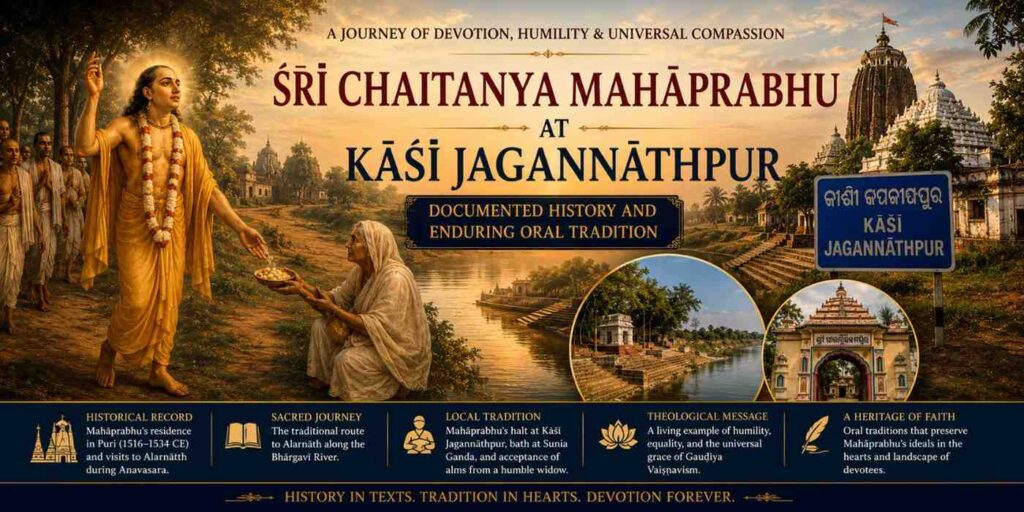
Title: SriChaitanya Mahaprabhu at Kasi Jagannathpur: Documented History and Enduring Oral Tradition
For Journal of Vaiṣṇava Studies ( by Lokanath Mishra)
Abstract
This article examines the documented history of Sri Chaitanya Mahaprabhu’s movements in the Puri region between 1510 and 1534 CE and situates within that framework a locally preserved tradition from Kasi Jagannathpur. Drawing on Chaitanya Charitamṛta, Chaitanya Bhagavata, Murari Gupta’s Kaḍacha and Puruṣottama Chandrika, we first outline the established chronology of Mahaprabhu’s life. We then present the oral tradition of his halt at Kasi Jagannathpur, his bath at Sunia Ganda on the Bhargavi River, and his acceptance of alms from a widowed devotee, while distinguishing this account from the textual record. The study concludes that such local traditions, though not textually attested, function as living expressions of Mahaprabhu’s ideals of humility and universal compassion.
- Introduction
Sri Chaitanya Mahaprabhu, 1486–1534 CE, is the central figure of Gauḍiya Vaiṣṇavism. His first arrival at Puri is dated to c. 1510 CE following his sannyasa in Katwa. After his South Indian tour and return to Nilachala, he resided in Puri for approximately the last eighteen years of his life, c. 1516–1534 CE. The primary biographical sources are Kṛṣṇadasa Kaviraja’s Chaitanya Charitamṛta, Vṛndāvana dasa Ṭhākura’s Chaitanya Bhagavata, Murāri Gupta’s Kaḍacha, and later regional texts such as Puruṣottama Chandrika.
This article has two aims. First, to summarize the documented movements of Mahaprabhu in the Puri-Brahmagiri tract. Second, to record and contextualize the oral tradition of Kasi Jagannathpur, presenting it as local memory rather than established historical fact.
- Chronology of Mahaprabhu’s Residence in Puri
- 1486 CE: Birth in Navadvipa.
- 1510 CE: Sannyasa at Katwa, journey to Puri. First darsana of Lord Jagannatha.
- 1510–1514 CE: Travels to South India and return to Puri.
- 1516–1534 CE: Permanent residence in Puri, primarily at the Gambhīrā in Kasi Misra’s house. Daily activities included kirtana, Bhagavata discourses, and interaction with associates like Svarupa Damodara, Ramananda Raya, and King Prataparudra.
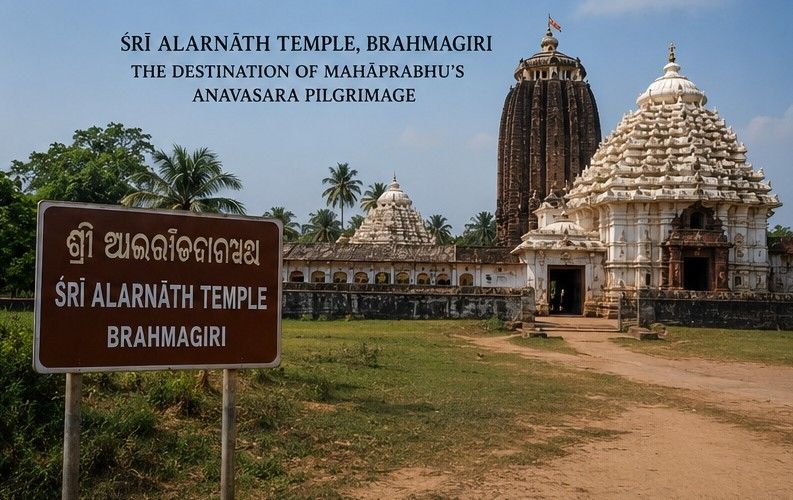
During this period, Mahāprabhu frequently visited nearby shrines. The most noted is his yearly journey to Alarnāth at Brahmagiri during Anavasara, the fortnight when Lord Jagannātha withdraws from public view. Chaitanya Charitāmṛta, Madhya 13, describes how Mahāprabhu, unable to bear separation from Jagannātha, would go to Alarnāth, whom he regarded as non-different from Jagannātha. The Sarvāṅga Śilā episode, where Mahāprabhu’s ecstatic embrace imprinted his form on the Alarnāth deity, is preserved in Gauḍīya tradition.
- The Route to Alarnāth: Textual and Geographic Evidence
The distance from Puri to Alarnāth is roughly 23 km. The traditional path follows the old Jagannātha Sadak along the Bhārgavī River, passing villages that still retain Vaiṣṇava cultural memory. While the core texts mention Mahāprabhu’s travel to Alarnāth, they do not detail every halt. This silence leaves space for regional traditions to preserve micro-histories of the journey. - The Oral Tradition of Kāśī Jagannāthpur
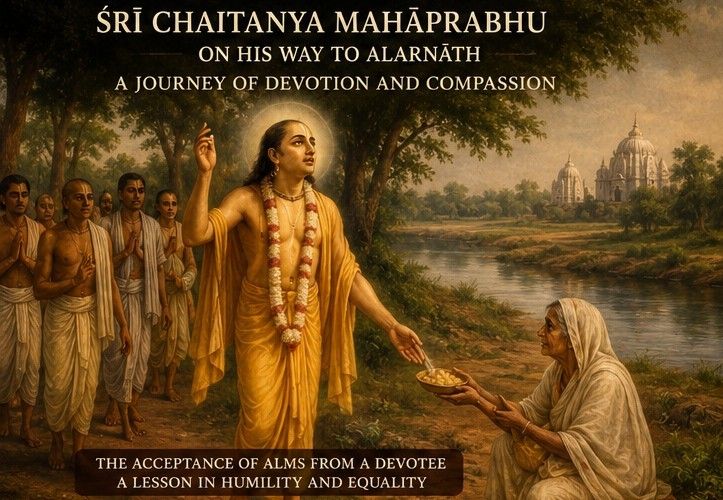
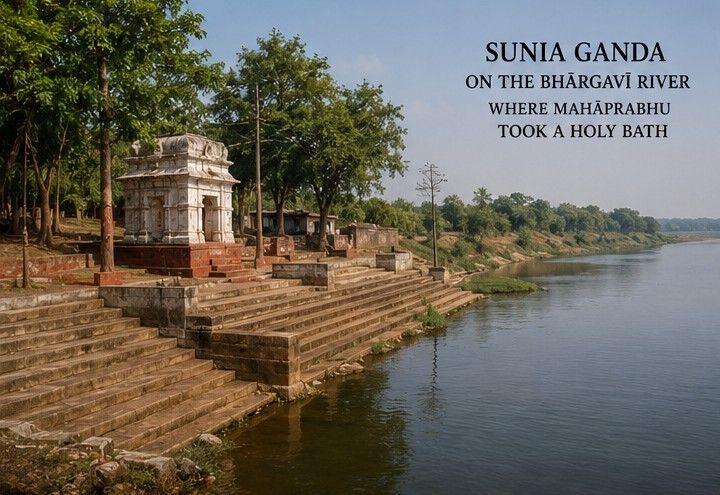
According to an enduring oral tradition preserved in the villages between Puri and Brahmagiri, it is believed that Śrī Chaitanya Mahāprabhu halted at Kāśī Jagannāthpur, bathed in the Bhārgavī River at the place locally known as Sunia Ganda, and accepted alms from the humble home of an elderly widow before continuing to the shrine of Lord Alarnāth.
This episode is not recorded in the earliest Gauḍīya texts. Yet it survives in local memory as an expression of Mahāprabhu’s simplicity, humility, and equal love for all devotees. The toponym “Kāśī Jagannāthpur” itself suggests a sacred geography, linking the village to both Kāśī, a name for Vārāṇasī, and to Jagannātha. Sunia Ganda, “the quiet ghāṭ,” remains a bathing spot on the Bhārgavī used by pilgrims traveling to Alarnāth. Elders in the village recount that the widow who offered alms had no family and sustained herself by gathering greens. Mahāprabhu’s acceptance of food from her house is narrated as evidence of his rejection of social distinctions.
- Methodology: Distinguishing History and Tradition
Historical scholarship requires textual or epigraphic attestation. The Kāśī Jagannāthpur episode lacks such documentation. It must therefore be classified as sthala-purāṇa or local kṣetra-māhātmya, a genre that records sacred associations of place through community memory. Such traditions are valuable not as empirical data but as reception history. They show how communities internalized and retold Mahāprabhu’s theology of universal grace.
The structure of the oral account mirrors patterns found in Chaitanya Charitāmṛta: travel, bathing, accepting humble hospitality, and proceeding for darśana. This suggests the local narrative was shaped by the broader hagiographic model while inserting regional detail.
- Theological Significance
Whether or not Mahāprabhu physically halted at Kāśī Jagannāthpur, the tradition preserves three core teachings: - Tīrtha as accessibility: The Bhārgavī at Sunia Ganda becomes a tīrtha because the saint bathed there, not because of prior scriptural sanction.
- Uchhiṣṭa and grace: Acceptance of alms from a marginalized widow embodies Mahāprabhu’s doctrine that bhakti transcends caste, gender, and economic status.
- Anavasara as pedagogy: The journey to Alarnāth taught devotees to see Jagannātha in all Viṣṇu forms. The detour through villages extends that pedagogy to ordinary homes.
- Conclusion
The documented history places Śrī Chaitanya Mahāprabhu in Puri from c. 1516 to 1534 CE with regular travel to Alarnāth during Anavasara. The Kāśī Jagannāthpur episode is not found in Chaitanya Charitāmṛta, Chaitanya Bhāgavata, or Murāri Gupta’s Kaḍachā. It should therefore be presented as local oral tradition rather than established historical fact.
Recording it serves two purposes. First, it honors the community that has preserved Mahāprabhu’s memory in its landscape. Second, it illustrates how the theological principles of Gauḍīya Vaiṣṇavism were localized and lived. Historical integrity and devotional sentiment are both maintained when we state clearly: this is tradition, not text, yet it continues to inspire humility and devotion.
References
- Kṛṣṇadāsa Kavirāja Gosvāmī. Śrī Chaitanya Charitāmṛta. Madhya-līlā, Ch. 13–15.
- Vṛndāvana dāsa Ṭhākura. Śrī Chaitanya Bhāgavata. Antya-khaṇḍa.
- Murāri Gupta. Śrī Kṛṣṇa Chaitanya Charitāmṛta Kaḍachā.
- Puruṣottama Chandrikā. Oriya text on Puri traditions.
- Field notes: Oral accounts collected at Kāśī Jagannāthpur, Sadar Block, Puri District, 2024–2025.