
My Fifteen-Day Grand Tour of Europe
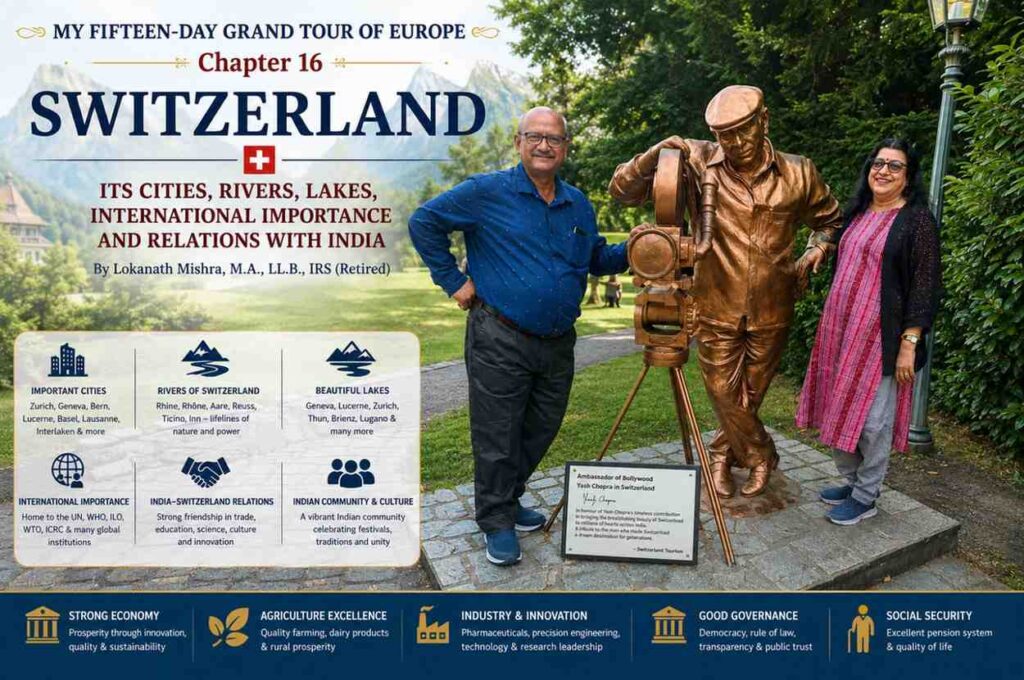
Chapter 16: Switzerland – Its Cities, Rivers, Lakes, International Importance and Relations with India:
By Lokanath Mishra, M.A., LL.B., IRS (Retired)
During our memorable stay in Switzerland, we realised that the country is not only famous for its snow-covered Alps, beautiful lakes and picturesque villages but is also one of the world’s most respected nations because of its stable democracy, economic prosperity, scientific achievements, humanitarian traditions and international diplomacy. Although geographically small, Switzerland enjoys an influence far beyond its size.
As our tour continued through the country, I became increasingly interested in understanding how Switzerland has achieved such a high standard of living while preserving its natural beauty and cultural heritage.
The Important Cities of Switzerland
Switzerland has many historic and modern cities, each with its own unique identity.
Zurich
Zurich is the largest city and the financial capital of Switzerland. It is one of the world’s leading banking and financial centres. Besides banking, Zurich is renowned for higher education, scientific research, information technology and precision engineering. The city combines medieval architecture with modern business districts and is consistently ranked among the world’s best places to live.
Geneva
Geneva is known as the “Capital of International Diplomacy.” Situated on the shores of Lake Geneva, it hosts numerous international organisations. It is home to the European headquarters of the United Nations, the World Health Organization (WHO), the International Labour Organization (ILO), the World Trade Organization (WTO), the International Committee of the Red Cross (ICRC) and many other global institutions.
Because of its international character, Geneva welcomes diplomats, scientists, lawyers and experts from almost every country in the world.
Bern
Bern is the federal capital of Switzerland.
The city is famous for its beautifully preserved medieval old town, which has been designated a UNESCO World Heritage Site. The Swiss Federal Parliament, Federal Council and important government ministries are located here.
The River Aare gracefully surrounds much of the old city, enhancing its beauty.
Lucerne
Lucerne is regarded as the cultural heart of central Switzerland. Its Chapel Bridge, Lion Monument and Lake Lucerne attract millions of tourists every year.
Basel
Basel lies at the meeting point of Switzerland, Germany and France.
It is internationally famous for its pharmaceutical industry, chemical research, universities and museums. Some of the world’s leading pharmaceutical companies have major operations here.
Lausanne
Lausanne, situated on the shores of Lake Geneva, is internationally recognised as the headquarters of the International Olympic Committee (IOC). It is also an important centre for education, sports administration and research.
Interlaken
Interlaken is one of Switzerland’s premier tourist resorts, situated between Lake Thun and Lake Brienz. It serves as the gateway to the Bernese Alps and attracts visitors throughout the year.
Lugano
Located in the Italian-speaking canton of Ticino, Lugano possesses a Mediterranean climate. Palm trees, beautiful lakes and Italian-style architecture distinguish it from other Swiss cities.
Rivers – The Lifelines of Switzerland
Switzerland is often called the “Water Tower of Europe” because many major European rivers originate in its glaciers.
The most important rivers include:
- Rhine, flowing through Switzerland, Germany and the Netherlands before entering the North Sea.
- Rhône, beginning in the Swiss Alps and flowing through Lake Geneva into France before reaching the Mediterranean Sea.
- Aare, the longest river entirely within Switzerland.
- Reuss, flowing through Lucerne and joining the Aare.
- Ticino, flowing south into Italy.
- Inn, originating in Switzerland before passing through Austria and Germany to join the Danube.
These rivers provide drinking water, hydroelectric power, irrigation, tourism, fisheries and transportation. Switzerland’s abundant water resources also enable the country to generate a significant share of its electricity from renewable hydroelectric power.
Lakes – Switzerland’s Blue Treasures
The Swiss landscape is enriched by hundreds of lakes formed by ancient glaciers.
Among the most important are:
- Lake Geneva
- Lake Lucerne
- Lake Zurich
- Lake Thun
- Lake Brienz
- Lake Lugano
- Lake Constance (Bodensee)
- Lake Neuchâtel
- Lake Zug
- Lake Biel
These lakes are used for drinking water, passenger transport, tourism, fishing, irrigation and hydroelectric power generation.
They also help regulate the local climate and support biodiversity.
Switzerland’s Role in International Affairs
Although Switzerland has maintained a policy of permanent neutrality since the nineteenth century, it plays an extraordinarily active role in international affairs.
Rather than participating in military alliances, Switzerland promotes:
- Peace negotiations.
- Humanitarian assistance.
- International arbitration.
- Diplomatic dialogue.
- Scientific cooperation.
- Human rights.
Many peace conferences and diplomatic negotiations have been held in Swiss cities because the country is widely trusted as a neutral host.
The International Committee of the Red Cross, founded in Geneva in 1863, has become one of the world’s foremost humanitarian organisations, providing assistance to victims of war, natural disasters and humanitarian crises.
Switzerland also contributes significantly to international development, disaster relief and global health initiatives.
Switzerland and India
The friendship between India and Switzerland has steadily strengthened since India gained independence in 1947.
Switzerland was among the earliest countries to establish diplomatic relations with independent India.
Today, the relationship encompasses:
- Trade and commerce.
- Scientific research.
- Higher education.
- Pharmaceutical cooperation.
- Precision engineering.
- Information technology.
- Tourism.
- Environmental protection.
Swiss companies have made substantial investments in India, particularly in engineering, food processing, pharmaceuticals, financial services and renewable energy.
Likewise, many Indian companies have established successful operations in Switzerland.
Indian professionals work in Swiss banks, universities, research institutions, pharmaceutical companies, engineering firms and information technology industries.
The two countries also cooperate in innovation, vocational education, climate research and sustainable development.
Government Employees in Switzerland
One aspect that particularly interested me was the high level of professionalism among Swiss public servants.
Government employees are generally selected through transparent recruitment procedures based on qualifications and merit.
Officials are expected to maintain high standards of honesty, efficiency and accountability.
Public administration is comparatively smaller than in many countries because digital technology, decentralisation and efficient management reduce unnecessary bureaucracy.
Government employees receive competitive salaries that reflect Switzerland’s high cost of living.
Compensation varies according to the level of government (federal, cantonal or municipal), qualifications and responsibilities.
Employees generally enjoy benefits such as:
- Health insurance contributions, depending on employer arrangements.
- Paid annual leave.
- Maternity and paternity leave as provided by law.
- Professional training opportunities.
- Flexible working arrangements in many departments.
- Occupational pension schemes.
Promotion is usually based on merit, experience, performance, additional qualifications and organisational needs rather than solely on seniority.
Continuous training and skill development are strongly encouraged throughout public service careers.
Pension System
Switzerland operates a three-pillar pension system, which is regarded as one of the strongest retirement systems in the world.
The three pillars are:
- State Old-Age and Survivors’ Insurance (AHV/AVS): A compulsory public pension that provides a basic retirement income.
- Occupational Pension: Employers and employees jointly contribute to pension funds, helping maintain living standards after retirement.
- Private Voluntary Savings: Individuals may make additional tax-advantaged savings for retirement.
This combination aims to provide financial security while encouraging personal responsibility for retirement planning.
Standard of Living
Swiss citizens enjoy one of the highest standards of living in the world.
Excellent healthcare, quality education, efficient transportation, public safety, environmental protection and strong social institutions contribute to a high quality of life.
At the same time, Swiss society expects citizens to fulfil their responsibilities through hard work, respect for the law and civic participation.
Reflections
As our journey through Switzerland progressed, I realised that the country’s true wealth lies not merely in its majestic mountains or prosperous banks, but in its disciplined institutions, well-educated people, democratic traditions and careful balance between economic development and environmental conservation.
The rivers flowing from its glaciers nourish much of Europe. Its lakes sustain life and tourism. Its cities combine history with innovation. Its international institutions work for peace and humanitarian service. Its friendship with India continues to deepen through trade, education, science and cultural exchange.
For us, Switzerland was not merely a destination of scenic beauty; it was a living example of how good governance, scientific progress, social responsibility and respect for nature can together build a peaceful and prosperous nation.
As we prepared to continue our European journey, we carried with us not only unforgettable memories of the Alps but also valuable lessons in administration, public service, environmental stewardship and international cooperation.
(To be continued in Chapter 17…)