
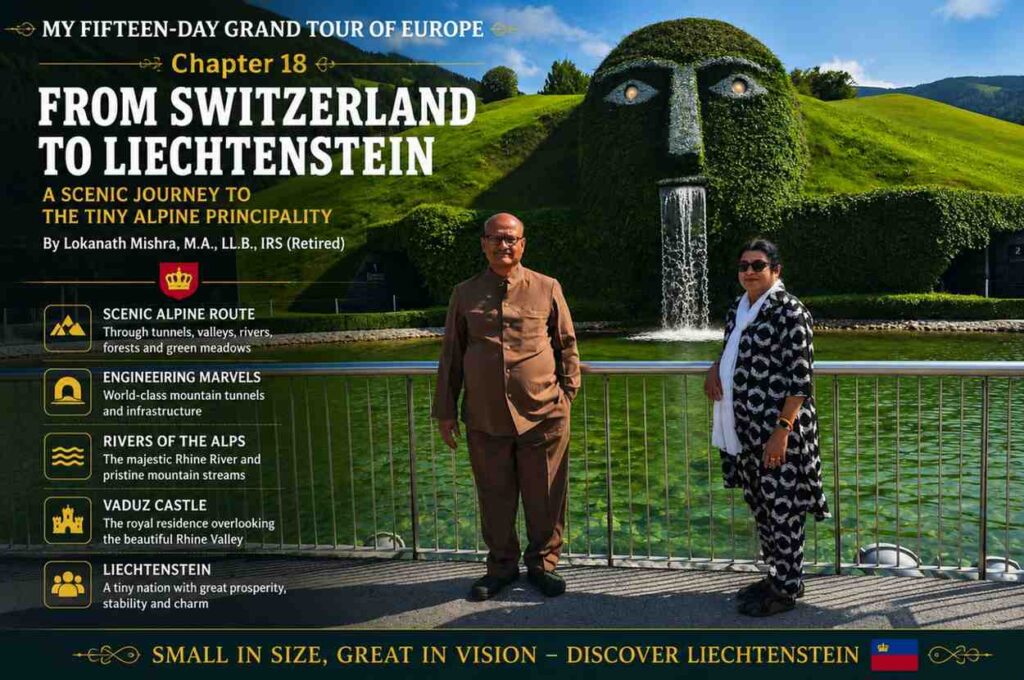
My Fifteen-Day Grand Tour of EuropeMy Fifteen-Day Grand Tour of Europe
Chapter 18: From Switzerland to Liechtenstein –
By Lokanath Mishra, M.A., LL.B., IRS (Retired)
On the morning of 19th July 2026, we bid farewell to the magnificent Swiss Alps and began our journey from Switzerland to Liechtenstein, one of the smallest and most fascinating countries in the world. Our Star Tour luxury coach travelled through the scenic Alpine valleys, and the journey itself became an unforgettable experience filled with tunnels, rivers, mountains, forests and lush green meadows.
As we left Switzerland, we were once again reminded of the extraordinary engineering skill of the Swiss people. The roads were smooth, well-maintained and carefully constructed through difficult mountainous terrain. The journey demonstrated how modern technology can harmoniously coexist with nature without destroying its beauty.
The Scenic Journey Through the Alps
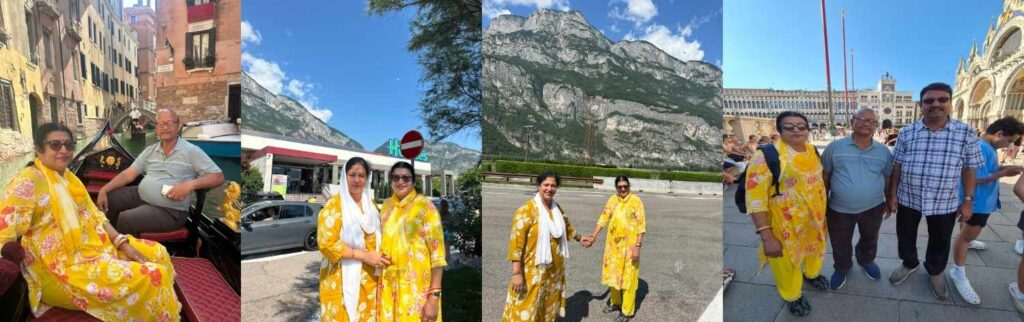
The route from Switzerland towards Liechtenstein passes through some of the most picturesque landscapes in Europe. We travelled through deep valleys surrounded by towering mountains covered with dense forests of pine, fir and spruce trees.
At several points, our coach passed through long tunnels carved directly through solid mountain rock. These tunnels are engineering marvels, built to ensure safe and efficient transportation through the rugged Alpine region.
The Alpine Tunnels
Switzerland is famous for its network of mountain tunnels, many of which are among the longest and most advanced in the world. These tunnels have been constructed to connect remote valleys, reduce travel time and provide year-round transportation despite heavy snowfall.
As we travelled, we passed through numerous road tunnels, each equipped with modern ventilation systems, emergency exits, lighting and safety measures. The construction of such tunnels requires enormous technical expertise, as engineers must drill through hard rock while ensuring stability and safety.
The tunnels also protect travellers from harsh weather conditions, landslides and avalanches, which are common in mountainous regions during winter.
Rivers Along the Journey
One of the most beautiful aspects of our journey was the sight of crystal-clear rivers flowing alongside the roads. These rivers originate from melting glaciers and snowfields in the Alps, carrying pure mountain water through valleys and plains.
The most important river in this region is the Rhine River, which forms part of the border between Switzerland and Liechtenstein. The Rhine is one of Europe’s greatest rivers, flowing from the Swiss Alps through several countries before reaching the North Sea.
The rivers we saw were remarkably clean, reflecting the surrounding mountains and forests like mirrors. Their fast-flowing waters create a soothing sound that adds to the tranquillity of the Alpine landscape.
These rivers are not only beautiful but also economically important. They provide:
Drinking water.
Hydroelectric power.
Irrigation for agriculture.
Support for fisheries.
Opportunities for tourism and recreation.
Mountains, Forests and Grass Fields
During our journey, we noticed an interesting and beautiful phenomenon: although the mountains were densely covered with trees, there were also green grass fields visible between the forests.
At first, it seemed surprising how such open meadows could exist amidst thick forests. The explanation lies in the traditional Alpine farming system.
For centuries, Swiss and Liechtenstein farmers have carefully cleared certain areas of forest to create Alpine meadows for grazing cattle. These grass fields are maintained through regular grazing and mowing, which prevents trees from growing back.
The combination of forests and meadows is also made possible by:
Fertile soil created by decaying leaves and organic matter.
Abundant rainfall and melting snow that provide natural irrigation.
Moderate summer temperatures ideal for grass growth.
Traditional land management practiced by Alpine communities for generations.
These meadows are essential for dairy farming, as they provide nutritious grass for cows. The cows grazing in these fields produce the high-quality milk used to make famous Swiss and Alpine cheeses.
Thus, the beautiful green patches we observed were not accidental; they were the result of centuries of careful human cultivation in harmony with nature.
Liechtenstein – A Tiny but Prosperous Nation
By afternoon, we entered Liechtenstein, a small independent principality nestled between Switzerland and Austria.
Liechtenstein covers an area of only about 160 square kilometres, making it one of the smallest countries in the world. Its population is approximately 40,000 people, yet it is one of the wealthiest nations per capita.
Despite its small size, Liechtenstein has achieved remarkable prosperity through:
Banking and financial services.
Precision manufacturing.
High technology industries.
Tourism.
International trade.
The country has a close economic relationship with Switzerland and uses the Swiss Franc as its official currency.
Arrival in Vaduz
Our destination was Vaduz, the capital of Liechtenstein.
Vaduz is a charming small town situated along the Rhine Valley and surrounded by magnificent mountains. Although it has a population of only about 5,500 people, it serves as the political, cultural and economic heart of the country.
Interestingly, Vaduz is not the largest municipality in Liechtenstein. The neighbouring town of Schaan has a slightly larger population. Nevertheless, Vaduz is globally renowned because it houses the country’s most important institutions.
Vaduz Castle – The Symbol of Liechtenstein
The most striking landmark of Vaduz is the majestic Vaduz Castle, perched high on a hill overlooking the town.
The castle was originally built in the twelfth century and has been expanded and renovated several times over the centuries.
Today, Vaduz Castle serves as the official residence of the Prince of Liechtenstein and the royal family. It is therefore one of the few castles in Europe that still functions as a royal residence.
From the town below, the castle appears magnificent against the backdrop of the Alps. Its elevated position provided strategic protection in medieval times and today offers breathtaking views of the Rhine Valley.
Although the interior of the castle is not generally open to the public because it is a private royal residence, visitors can admire its exterior and the surrounding landscape.
The Political Importance of Vaduz
Vaduz is the seat of the National Parliament (Landtag) of Liechtenstein.
The country is a constitutional monarchy, meaning that it is governed by a constitution while also having a reigning prince.
The political system combines democratic institutions with the traditional monarchy. Citizens elect their representatives to the Landtag, while the Prince retains certain constitutional powers.
Liechtenstein is known for its political stability, low taxes and efficient administration.
Culture and Economy of Vaduz
Despite its small size, Vaduz has a rich cultural life.
The town contains:
Museums showcasing Liechtenstein’s history and art.
Cultural centres.
Government buildings.
Financial institutions.
International businesses.
Vaduz is also an important centre for banking and finance, attracting companies and investors from around the world.
The country’s strong economy has enabled it to maintain excellent public services, high living standards and low unemployment.
A Walk Through Vaduz
As we walked through the streets of Vaduz, we were impressed by its cleanliness, orderliness and peaceful atmosphere.
The town centre is compact and easy to explore on foot. Modern buildings stand alongside traditional Alpine architecture, creating a harmonious blend of old and new.
The surrounding mountains, green valleys and fresh air made Vaduz feel like a fairy-tale town hidden in the Alps.
Reflections
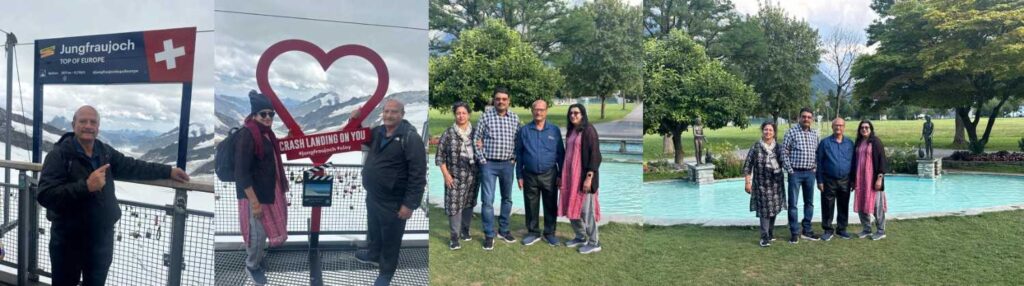
Our journey from Switzerland to Liechtenstein was a perfect combination of natural beauty and cultural discovery.
The tunnels, rivers, forests and meadows of the Alps demonstrated humanity’s ability to live in harmony with nature. The tiny principality of Liechtenstein showed us that even a very small nation can achieve remarkable prosperity through good governance, innovation and hard work.
Vaduz, with its majestic castle, peaceful streets and stunning mountain setting, left a lasting impression on all four of us. It was a reminder that greatness is not determined by the size of a country, but by the vision, discipline and determination of its people.
As evening approached, we continued our European journey with hearts full of admiration for this beautiful Alpine principality, eagerly awaiting the next adventures that awaited us on our fifteen-day tour.
(To be continued in Chapter 19…)