
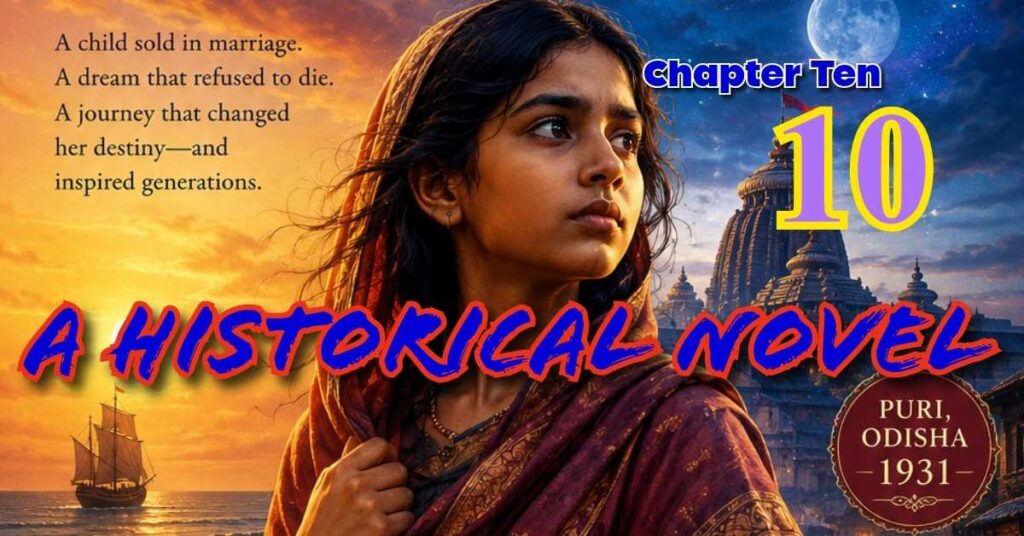
THE GIRL WHO CHOSE THE HORIZON
A Historical Novel, By Lokanath Mishra
Chapter Ten
The Clinic of Hope
Nearly twenty-five years had passed since a frightened twelve-year-old girl had slipped silently out of Puri under the cover of darkness.
Time had changed everything.
The child who had once carried only a small knife and a bundle of clothes now carried the confidence of a skilled surgeon and the compassion of a woman who understood suffering.
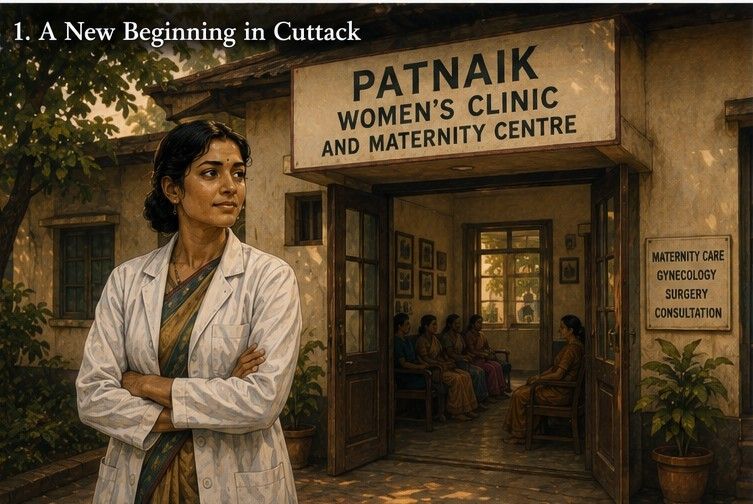
After several successful years at Gauhati Medical College, Dr. Madhabi Das Patnaik and her husband, Dr. Aniruddha Patnaik, decided that the moment had come to return to Odisha.
They chose Cuttack as the place where they would build their future.
The city was growing rapidly and needed experienced specialists in women’s healthcare.
With their savings and the support of a few friends, they purchased a modest building near the heart of the city.
A simple signboard appeared above the entrance.
“Patnaik Women’s Clinic and Maternity Centre.”
There was nothing luxurious about the clinic.
The waiting room contained only wooden benches.
The operating theatre was small.
The equipment was limited.
But the doctors possessed something far more valuable than wealth.
They possessed dedication.
From the very first day, patients began arriving.
Some came because they had heard of the doctors’ reputation from Assam.
Others arrived after unsuccessful treatments elsewhere.
Many were poor women from nearby villages who could not afford expensive hospitals.
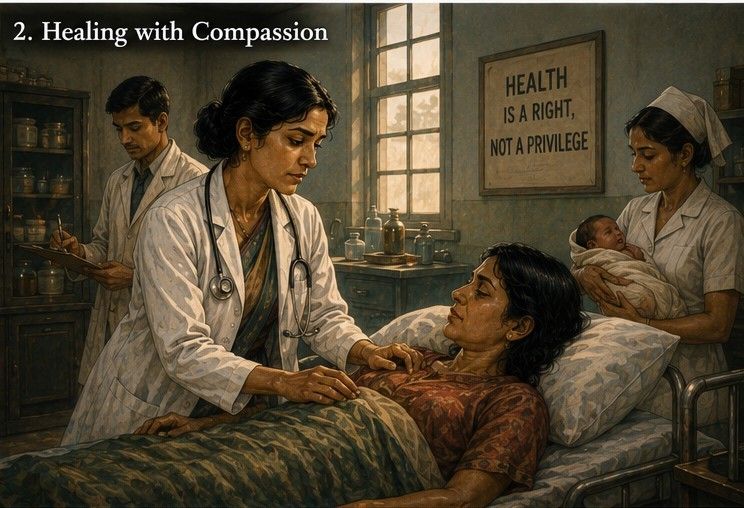
Whenever a patient admitted that she had no money, Madhabi quietly reduced the fee or waived it altogether.
“If health becomes a privilege only for the rich,” she often said, “medicine loses its soul.”
Word of their kindness spread quickly.
Within a few years, the small clinic had become one of the most respected maternity centres in the region.
Women travelled from distant districts seeking treatment.
Complicated deliveries that others feared were successfully managed.
Young doctors requested permission to observe surgeries.
Medical students came to learn not only techniques but also compassion.
One rainy afternoon an elderly man entered the clinic accompanied by a frail woman.
His clothes were worn.
His hair had turned completely white.
His hands trembled as he approached the reception desk.
When Madhabi looked up from her records, her breath caught.
The old man was Raghunath Das.
Her father.
For a moment neither spoke.
The years between them seemed to disappear.
He stared at the successful physician before him, unable to recognize the little girl he had once known.
Then recognition slowly dawned.
“Madhabi?”
She stood silently.
The old man’s eyes filled with tears.
“I searched for you… for years.”
His voice broke.
“I thought you were dead.”
The woman beside him was Kamala.
Age and hardship had weakened her, but the tenderness in her eyes remained unchanged.
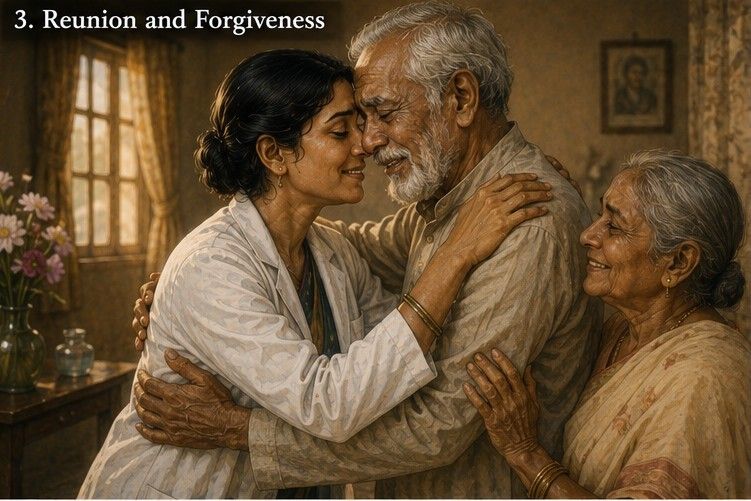
Mother and daughter embraced without words.
The clinic staff quietly withdrew.
No one wished to disturb the reunion.
Later, when they sat together in a private room, Raghunath spoke with great difficulty.
“I made the greatest mistake of my life.”
Poverty had driven him to desperation.
Debt had clouded his judgment.
For decades he had carried the burden of guilt.
“I sold my own child,” he whispered.
“I have asked God for forgiveness every day.”
Madhabi remained silent for a long time.
She remembered the fear.
The loneliness.
The nights of uncertainty.
The dangers she had survived.
Yet she also remembered everything that had followed.
Education.
Friendship.
Service.
Love.
Purpose.
Finally she took her father’s weathered hands into her own.
“If I continue to carry anger,” she said softly, “I remain imprisoned by the past.”
Tears flowed freely down Raghunath’s face.
“I forgive you.”
Those three words lifted a burden that had weighed upon both of them for twenty-five years.
From that day onward, her parents remained close to her.
Kamala often spent afternoons at the clinic, quietly blessing mothers and newborn children.
Raghunath devoted himself to charitable work, helping poor families who came seeking assistance.
He seemed determined to spend the remainder of his life correcting the mistakes of his youth.
Months later another unexpected visitor arrived.
It was an aged temple priest from Puri.
Pandit Jagabandhu Mishra.
The man to whom Madhabi had once been married as a child.
Time had humbled him.
He carried no pride.
Only regret.
He had come not to claim anything, but simply to ask forgiveness for participating in a custom that had destroyed countless young lives.
Madhabi greeted him respectfully.
She offered him water.
Then she spoke with quiet dignity.
“The child you once knew no longer exists.”
The old priest nodded.
“I can see that.”
He bowed before leaving.
No bitterness remained.
Only understanding.
As the years passed, the clinic expanded into a full hospital.
Young physicians trained under Dr. Madhabi and Dr. Aniruddha carried their principles throughout Odisha.
Many of them established maternity centres in rural districts.
Countless women survived childbirth because skilled care reached places where previously there had been none.
One evening, after completing a successful operation, Madhabi walked onto the hospital terrace.
The sun was setting beyond the Mahanadi River.
The sky glowed with shades of gold and crimson.
Aniruddha joined her quietly.
“You are thinking about the past,” he said.
She smiled.
“Yes.”
“Do you ever wish things had happened differently?”
She considered the question.
“If my childhood had been easy,” she replied, “perhaps I would never have understood suffering.”
“If I had not escaped, I would never have found freedom.”
“If I had not struggled, I might never have learned compassion.”
She looked toward the horizon.
“The road was painful.”
“But it led me exactly where I needed to be.”
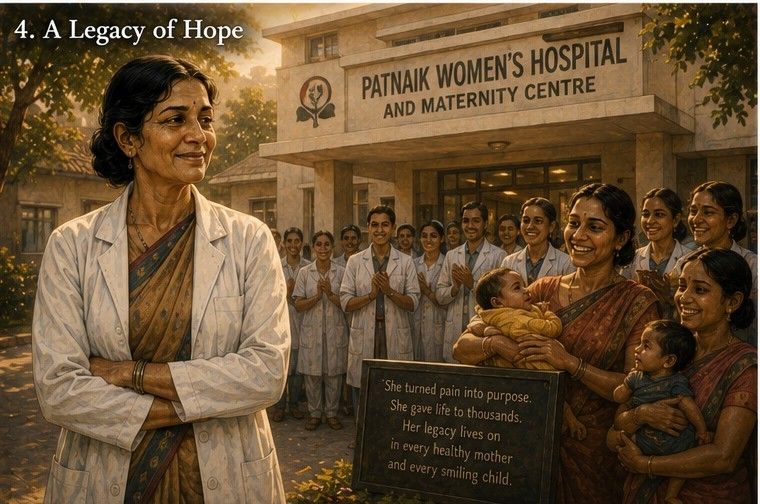
Years later, when Dr. Madhabi finally retired, the hospital organized a farewell gathering.
Former students travelled from across India.
Patients arrived carrying flowers and letters of gratitude.
Some brought children whom she had delivered decades earlier.
Others introduced grandchildren whose lives existed because of her skill.
One elderly woman stood before the audience and said,
“When everyone else saw a poor village woman, Doctor Madhabi saw a human being.”
The hall erupted in applause.
As the ceremony ended, Madhabi quietly slipped away to the hospital garden.
She sat beneath a flowering tree and watched children playing nearby.
Their laughter reminded her of the childhood she had never experienced.
Yet there was no sadness in her heart.
Only peace.
She realized that true freedom is not merely escaping one’s past.
It is choosing not to let the past define the future.
The frightened girl who once rode into the darkness had become a healer whose hands brought life into the world.
She had transformed pain into purpose.
Fear into courage.
Loss into hope.
And through thousands of mothers and children whose lives she touched, her own story would continue long after she was gone.
For some people inherit wealth.
Some inherit power.
But a rare few leave behind something greater.
They leave behind the courage to change destiny.
And among those rare souls was Dr. Madhabi Das Patnaik—
the girl who chose the horizon and, in doing so, taught countless others to believe that the horizon could be reached.
THE END