

THE GIRL WHO CHOSE THE HORIZON
A Historical Novel, By Lokanath Mishra
Chapter Nine
Two Healers, One Path
The end of internship did not mark the end of Madhabi’s education.
Rather, it opened the door to a greater challenge.
Her experiences in the maternity wards had convinced her that her life’s mission lay in the care of women and newborn children. She therefore applied for postgraduate training in obstetrics and gynecology, determined to master a field where knowledge could mean the difference between life and death.
The training was rigorous.
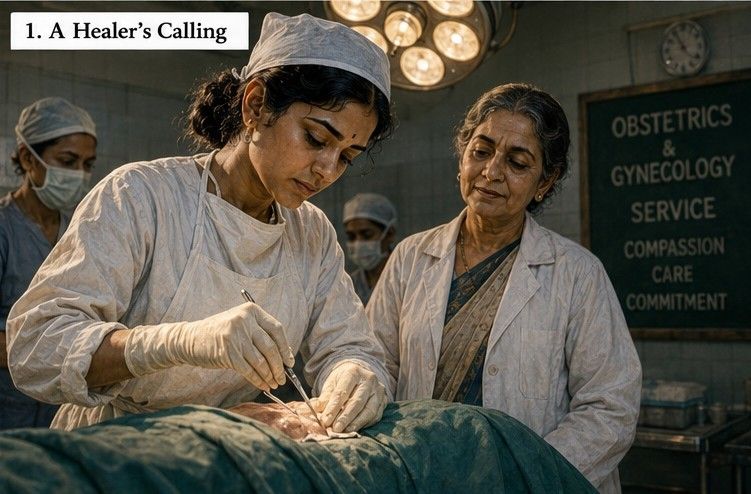
Long hours in the operating theatre were followed by sleepless nights in labour wards. Emergencies arrived without warning. Complicated deliveries demanded quick judgment and steady hands.
Many young doctors found the pressure unbearable.
Madhabi found purpose within it.
Dr. Sarala Mukherjee, now both mentor and friend, watched her progress with pride.
One afternoon, after a particularly difficult surgery that saved both mother and child, Dr. Mukherjee removed her gloves and smiled.
“You no longer think only as a student,” she said.
“You think like a physician.”
Those words became one of the greatest compliments Madhabi had ever received.
Years of disciplined study finally culminated in the successful completion of her Master of Surgery degree in gynecology.
The announcement was celebrated quietly among her colleagues.
She did not seek applause.
The diploma represented not personal glory but another opportunity to serve.
Soon afterward, an official letter arrived from the government.
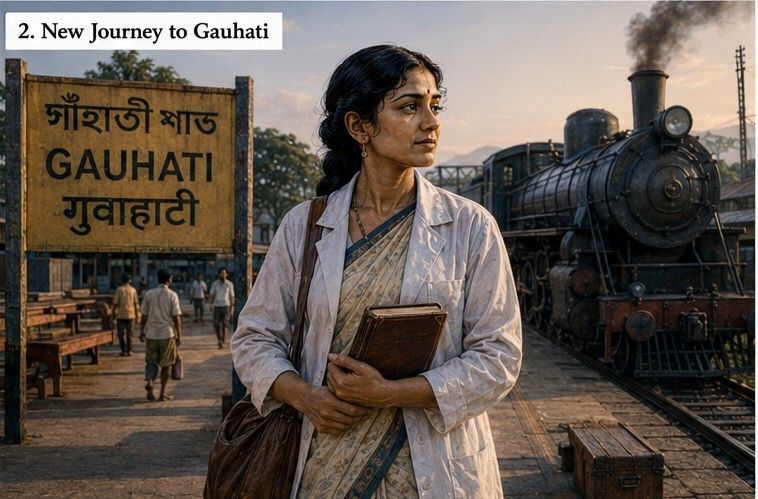
She had been appointed as an Assistant Professor of Gynecology at Gauhati Medical College.
The posting would take her far from Calcutta to the growing city of Gauhati in Assam.
Many friends advised her to remain where opportunities were plentiful.
But Madhabi believed that medical service was needed wherever people suffered.
With gratitude and hope, she accepted the appointment.
The train journey to Assam lasted several days.
As it crossed rivers, forests, and tea gardens, Madhabi gazed through the window at landscapes she had never before seen.
She thought back to another journey many years earlier.
Then she had been a frightened child escaping into uncertainty.
Now she travelled as a qualified surgeon entrusted with the lives of others.
The contrast filled her with quiet amazement.
Gauhati Medical College welcomed her warmly.
The institution was expanding, attracting talented physicians from different parts of India.
Her responsibilities included teaching medical students, supervising interns, and treating patients in the hospital.
The work was demanding but deeply rewarding.
Students admired her ability to explain complex subjects with patience.
Patients appreciated the kindness with which she listened to their fears.
She insisted that every expectant mother deserved respect, regardless of wealth or social status.
Among the faculty members was another young gynecologist, Dr. Aniruddha Patnaik.
Originally from Odisha, he possessed a calm manner, sharp intellect, and quiet sense of humor.
Unlike many men of his generation, he regarded women colleagues as equals.
During departmental meetings he valued Madhabi’s opinions.
During surgeries he trusted her judgment.
Gradually, professional respect developed into friendship.
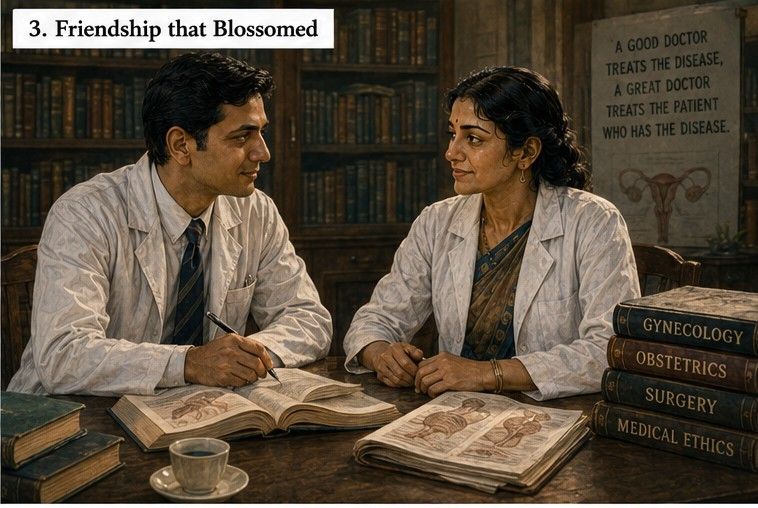
They often remained after work discussing difficult cases.
Sometimes their conversations turned to literature, philosophy, or the changing future of independent India.
One evening, after completing a successful emergency operation, they walked through the hospital gardens.
The monsoon rain had just ended.
Drops of water still clung to the leaves.
Aniruddha asked softly,
“What first inspired you to become a doctor?”
Madhabi remained silent for several moments.
Then she answered honestly.
“I once had no control over my own life.”
He looked at her with curiosity but did not interrupt.
“I wanted to help women who had no one to protect them.”
Aniruddha nodded.
“That explains why your patients trust you so completely.”
She smiled faintly.
“It also reminds me never to forget where I came from.”
As months became years, their friendship deepened.
Colleagues noticed the mutual respect between them.
Students often saw them discussing medical journals together in the library.
Neither spoke openly about personal feelings.
Both placed their profession above everything else.
Then one winter afternoon, while returning from a medical conference, Aniruddha spoke with unusual seriousness.
“Madhabi,” he said, “I have admired your strength since the day you arrived.”
She remained silent.
“I believe we could serve society better together than apart.”
The simplicity of his words touched her deeply.
There was no display of wealth.
No attempt to dominate.
Only partnership.
For several weeks she reflected carefully.
Her past made trust difficult.
The memory of a childhood forced into marriage had never completely faded.
She feared surrendering her independence.
When she finally shared these fears with Aniruddha, he listened without interruption.
Then he replied gently,
“I do not seek to own your life.
I wish only to walk beside you.”
Those words dissolved years of hidden anxiety.
She realized that this was entirely different from the marriage imposed upon her as a child.
This was a decision freely made.
For the first time, love entered her life not through obligation but through choice.
Their wedding was simple.
Close friends, colleagues, and students attended.
There were no extravagant celebrations.
No display of wealth.
Instead, the ceremony reflected mutual respect and shared purpose.
When the rituals concluded, Aniruddha quietly placed a garland around her neck.
Madhabi looked into his eyes and thought of the frightened twelve-year-old girl who had fled from Puri under the cover of darkness.
That child could never have imagined this moment.
The marriage brought companionship rather than confinement.
The two physicians continued their work at Gauhati Medical College, teaching future doctors and treating countless patients together.
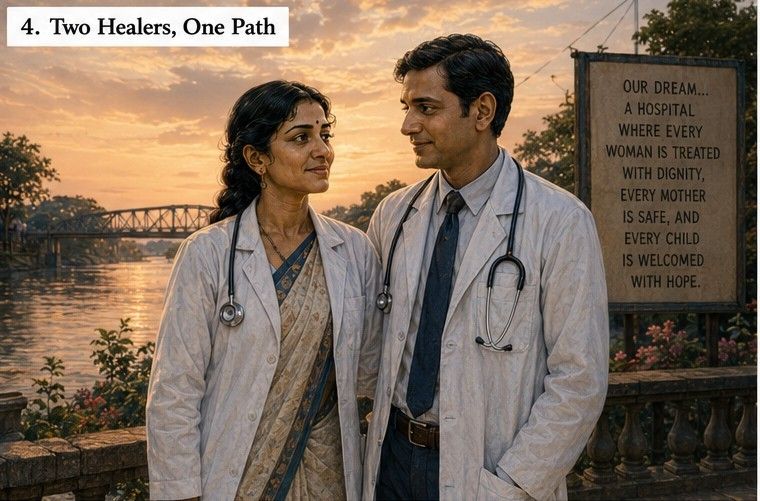
Their names gradually became known for excellence and compassion.
Yet another dream still remained.
Both longed to return to Odisha.
To establish a hospital where no woman would be denied treatment because of poverty.
To build something lasting in the land that had once witnessed so much of Madhabi’s suffering.
One evening they stood overlooking the mighty Brahmaputra River as the sun disappeared behind distant hills.
Aniruddha asked,
“If the opportunity comes, would you return home?”
Madhabi watched the flowing water before answering.
“Yes.”
“But not as the frightened girl who left.”
She smiled.
“I will return as the woman who chose her own destiny.”
The river flowed silently onward.
And somewhere beyond its distant course, the city of Cuttack awaited the arrival of two healers whose greatest work was yet to begin.