
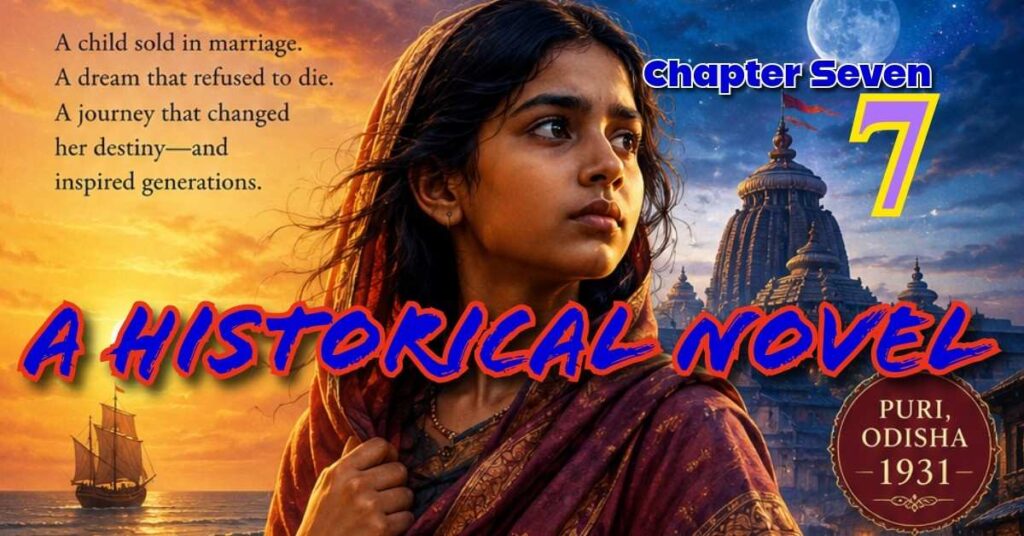
THE GIRL WHO CHOSE THE HORIZON
A Historical Novel, By Lokanath Mishra
Chapter Seven
The Anatomy Hall
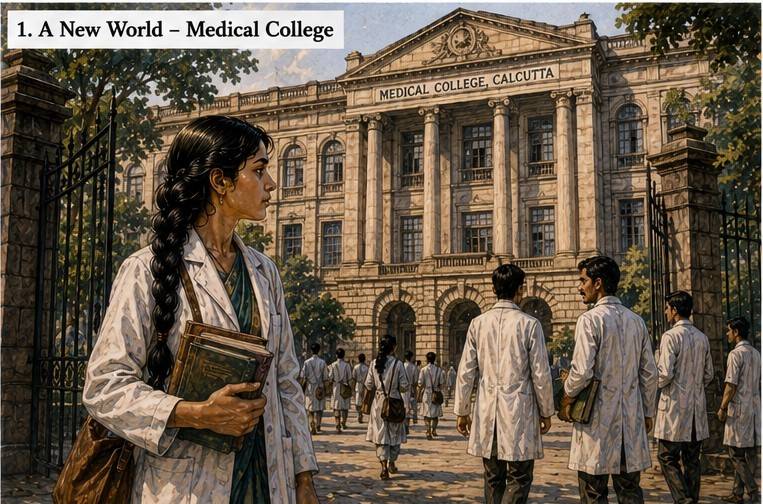
The day Madhabi entered medical college, she felt as though she had stepped into another world.
The massive stone building stood proudly in central Calcutta, its corridors echoing with the footsteps of future physicians.
Students wearing white coats hurried from one lecture hall to another.
Professors discussed diseases and treatments with scientific precision.
Hospital wards operated day and night.
For Madhabi, every corner of the institution represented a dream fulfilled.
Yet she soon discovered that entering medical college was easier than succeeding in it.
The workload was overwhelming.
Anatomy.
Physiology.
Biochemistry.
Histology.
Pathology.
Each subject demanded complete dedication.
Students often studied late into the night.
Some became exhausted.
Others failed to cope with the pressure.
But Madhabi welcomed the challenge.
She reminded herself of the difficult road that had brought her there.
Compared with the hardships of her childhood, no textbook seemed too difficult.
No examination seemed impossible.
During the first week, the students were escorted into the anatomy hall.
The room was enormous.
Long tables stood in rows beneath bright lamps.
A strange smell filled the air.
Many students became uneasy.
Several looked nervous.
Madhabi herself felt a knot forming in her stomach.
Then she saw them.
Human cadavers.
Bodies donated for medical education.
For a moment the hall became completely silent.
The reality of medicine stood before them.
Professor Dr. Nirmal Kumar Bose, the head of anatomy, addressed the students.
“These individuals were once living human beings. They have given one final gift to humanity—the opportunity for you to learn.”
His voice echoed through the hall.
“Treat them with respect. They are your first teachers.”
The words deeply affected Madhabi.
As the dissection classes began, some students struggled emotionally.
A few left the room unable to continue.
Madhabi herself found the experience difficult.
Yet she forced herself to remain focused.
Every structure of the human body fascinated her.
The intricate arrangement of muscles.
The complexity of nerves.
The remarkable architecture of bones.
She realized that understanding the human body was like learning the language of life itself.
Among her classmates she developed friendships with several students.
One was Abdul Rahman, a brilliant student from Dhaka.
Another was Joseph D’Souza, whose family had lived in Calcutta for generations.
A third was Leela Banerjee, one of the few women in the class.
Together they formed a study group.
They shared notes.
Discussed difficult concepts.
Encouraged one another during examinations.
Medical education was demanding, but friendship made the burden lighter.
As the months passed, the students gradually moved from classrooms into hospital wards.
For Madhabi, this marked a turning point.
Until now, medicine had been largely theoretical.
Now she would encounter real patients.
Real suffering.
Real lives.
The first ward she entered was filled with patients from poor backgrounds.
Many had travelled long distances seeking treatment.
Some suffered from infections.
Others from injuries.
Many had delayed seeking care because they could not afford it.
One elderly laborer thanked a doctor simply for listening to him.
That small interaction left a powerful impression on Madhabi.
She realized that medicine involved more than scientific knowledge.
Patients needed compassion.
Respect.
Dignity.
One afternoon, while accompanying a senior physician, she encountered a young woman named Shanti.
The patient appeared weak and severely ill.
She had been brought to the hospital after a difficult childbirth in a remote village.
Complications had developed because proper medical care was unavailable.
By the time she reached the hospital, her condition had become critical.
The doctors worked tirelessly.
Yet despite their efforts, Shanti died two days later.
The news deeply affected Madhabi.
She could not stop thinking about the young woman.
The patient was only a few years older than herself.
She had dreamed of becoming a mother.
Instead, she had lost her life.
That evening Madhabi sat alone in the hospital courtyard.
Rain clouds drifted across the sky.
The city lights flickered in the distance.
She remembered the countless women she had seen during her childhood in Odisha.
Women who suffered silently.
Women who lacked access to medical care.
Women whose lives were limited by poverty and social customs.
For the first time, she began to consider a specific path within medicine.
She wanted to help women.
She wanted to ensure that mothers survived childbirth.
She wanted to reduce suffering that so many accepted as inevitable.
The next day she sought advice from one of the senior physicians.
The doctor was Dr. Sarala Mukherjee, a respected gynecologist and one of the pioneering women doctors in Bengal.
Dr. Mukherjee listened carefully as Madhabi explained her thoughts.
When she finished, the senior physician smiled.
“You have chosen a difficult field.”
“I know.”
“It demands patience, skill, and emotional strength.”
“I am willing to work.”
Dr. Mukherjee studied her for a moment.
Then she nodded.
“Good. The profession needs doctors who care.”
From that day onward, Dr. Mukherjee became one of Madhabi’s mentors.
Under her guidance, Madhabi learned not only medical science but also the importance of empathy.
Years of study still lay ahead.
There would be difficult examinations.
Long nights in hospital wards.
Moments of self-doubt.
Yet a clear purpose had emerged.
The young girl who once fled a forced marriage now understood why fate had preserved her.
She had survived for a reason.
She would dedicate her life to serving women whose voices often went unheard.
One rainy evening, as she walked through the hospital corridor, she paused beside a window.
Outside, the streets of Calcutta glistened beneath the falling rain.
She thought about the long journey from Puri.
The frightened child.
The wandering pilgrim.
The determined student.
Each version of herself had contributed to the person she was becoming.
And for the first time, she could clearly see the direction of her future.
She would become a gynecologist.
She would fight ignorance with knowledge.
Fear with courage.
Suffering with compassion.
The journey was far from over.
But the path ahead had finally revealed itself.