
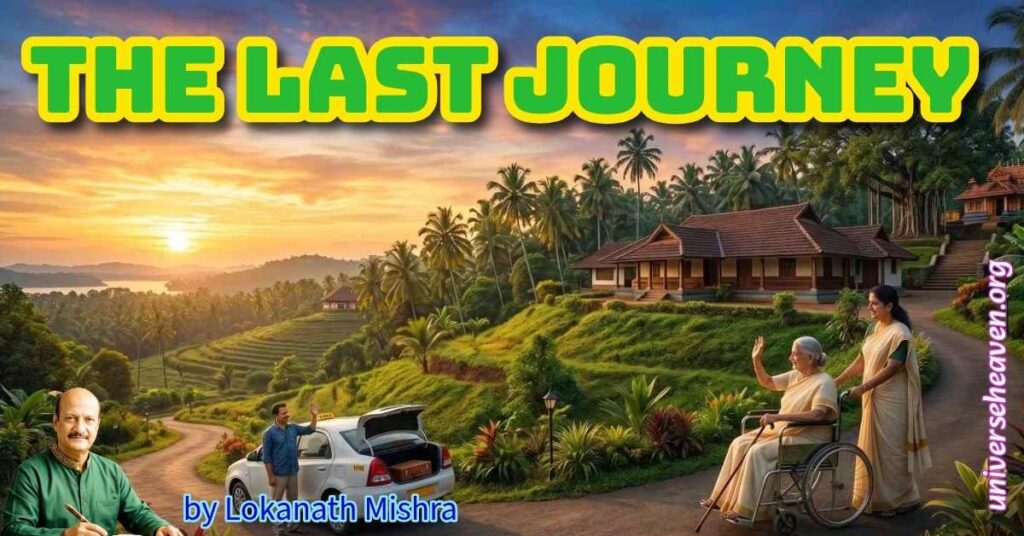
THE LAST JOURNEY
By Lokanath Mishra
The southwest monsoon had withdrawn from Kerala only a few weeks earlier, leaving behind a landscape washed clean and shining beneath the moonlight. Coconut palms swayed gently in the cool night breeze, while the backwaters reflected countless stars like scattered diamonds upon dark water. The roads of Kochi were unusually quiet after midnight, interrupted only by the occasional sound of a distant ferry horn or the hum of a late-night bus returning to its depot.
Raghavan Nair, a forty-five-year-old taxi driver, glanced at the digital clock mounted on the dashboard of his white sedan. It was nearly one o’clock in the morning. He had been driving since early afternoon and was looking forward to returning home to his small apartment in Edappally. His wife and daughter would already be asleep. He considered logging off from the taxi service app when one final booking request appeared on the screen.
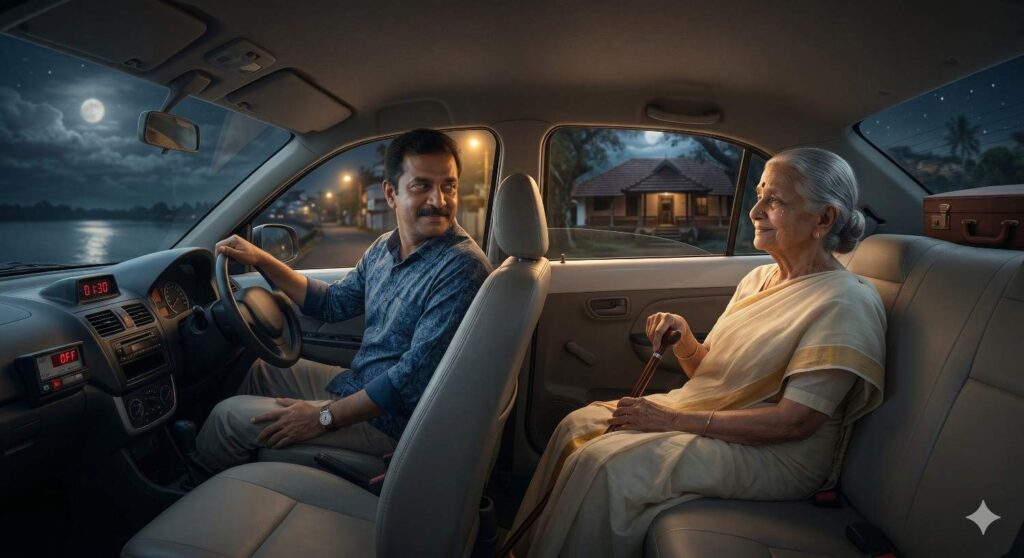
The pickup location was in an old residential neighborhood near Fort Kochi.
For a moment he hesitated.
Late-night calls from old neighborhoods often turned out to be cancellations or passengers who were not ready. Most drivers would have ignored such a request. Yet something prompted him to accept.
The narrow roads were deserted as he drove toward the address. Ancient Portuguese-style houses stood silently behind moss-covered compound walls. The sea breeze carried the faint scent of salt and jasmine. When he arrived, he noticed that only one small light was visible in a modest single-storey house at the end of the lane.
Raghavan parked and waited.
Five minutes passed.
Then ten.
No one emerged.
He was about to cancel the ride when he thought of his own ageing mother who lived in a village near Palakkad. If she ever needed assistance late at night, he hoped someone would be patient with her.
Leaving the taxi, he walked to the front door and knocked softly.
After a long pause, he heard a frail voice from inside.
“Please wait… I am coming.”
The voice belonged to an elderly woman.
Several minutes later the door opened.
Standing before him was a woman who appeared to be nearly ninety years old. Her silver hair was neatly tied in a bun. She wore a simple cream-coloured Kerala saree with a thin golden border. In one hand she held a walking stick, and beside her stood a small brown suitcase.
“You must be the taxi driver,” she said with a gentle smile.
“Yes, Amma,” Raghavan replied respectfully. “My name is Raghavan.”
“I am Devaki Menon.”
She looked at the suitcase.
“Would you help me carry this?”
“Certainly.”
As he stepped inside, he immediately sensed a strange stillness in the house.
Most of the furniture had been removed.
The walls displayed faded black-and-white photographs. One picture showed a young couple standing beside a traditional Kerala tharavadu house. Another captured a group of schoolchildren from many decades earlier. A dusty veena rested in one corner. An old wooden swing hung motionless on the verandah.
The house felt less like a residence and more like a treasury of memories.
“I have lived here for fifty-seven years,” Devaki said quietly as though reading his thoughts.
Raghavan nodded without speaking.
Together they slowly made their way to the taxi.
After helping her settle comfortably into the rear seat, he placed the suitcase in the trunk and started the engine.
“Where shall I take you, Amma?”
She handed him a slip of paper.
The destination was a hospice facility on the outskirts of Kochi.
Before he could enter the route into the navigation system, she spoke again.
“Would you mind taking a different route?”
“What route would you like?”
“Through the city.”
“It will take much longer.”
“I know.”
There was a brief silence.
Then she looked out of the window and said softly, “This will probably be my last journey through Kochi.”
Raghavan glanced at her through the rear-view mirror.
The sadness in her eyes told him everything.
“My doctors say there is not much time left.”
The words settled heavily inside the car.
For several moments neither spoke.
Then Raghavan quietly switched off the fare meter.
Devaki noticed immediately.
“What are you doing?”
“Tonight,” he replied gently, “you will guide the journey.”
Tears appeared in her eyes.
“Thank you.”
The taxi rolled slowly through the sleeping city.
Their first stop was near Mattancherry.
A narrow lane led toward a traditional ancestral house.
“I was born there in 1937,” Devaki said.
Moonlight illuminated the tiled roof.
“My father was a schoolteacher. My mother sang devotional songs every evening. During Onam, this entire courtyard would be filled with relatives.”
She smiled as though she could still hear the laughter.
For several minutes she simply looked at the house.
Then she requested him to continue.
Their next destination was a government girls’ school near Ernakulam.
The old building still stood beneath large rain trees.
“This is where I studied.”
Her eyes sparkled.
“I wanted to become a teacher.”
“Did you?”
“Yes.”
A smile spread across her face.
“For thirty-eight years.”
As they drove away, she spoke of hundreds of students whose lives had crossed hers. Some became doctors, engineers, artists and civil servants. Many still sent her letters during festivals.
“Teaching was never just a profession,” she said. “It was a privilege.”
The taxi moved along Marine Drive where the calm waters reflected the city lights.
The promenade was almost empty.
“Stop here for a moment,” she requested.
Raghavan parked.
She looked across the water.
“This is where I first met my husband, Krishnan.”
The smile on her face made her appear decades younger.
“He was an engineer working at the port. I was attending a cultural programme.”
“What happened?”
“He accidentally spilled tea on my saree.”
Raghavan laughed.
“That sounds unfortunate.”
“It was,” she replied, laughing softly. “But it led to a conversation that lasted forty-two years.”
Her laughter slowly faded.
“He passed away twelve years ago.”
The silence that followed needed no explanation.
The taxi resumed its journey.
They visited the old college where her son had studied before emigrating to Canada. They stopped near a temple where she and her husband had celebrated countless festivals. They drove past the government hospital where she had once spent sleepless nights caring for her mother.
Each location awakened another memory.
Sometimes she narrated stories.
Sometimes she remained silent.
At one point she simply gazed at an old building for nearly ten minutes without speaking a single word.
Raghavan did not interrupt.
He understood that some memories belong only to the heart.
Hours passed.
The city gradually moved toward dawn.
The eastern horizon began to brighten faintly.
Finally Devaki leaned back in her seat.
“I think I am ready now.”
Raghavan nodded.
Without another word he turned the vehicle toward the hospice.
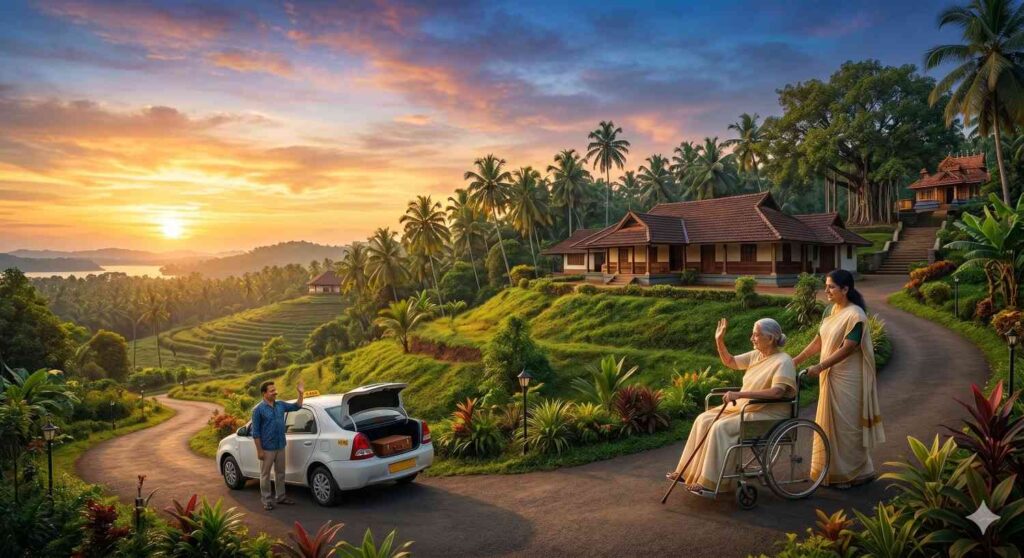
The building stood on a peaceful hillside overlooking a stretch of green countryside. Soft lights glowed from its windows. Several staff members were already waiting near the entrance.
As the taxi stopped, nurses approached with a wheelchair.
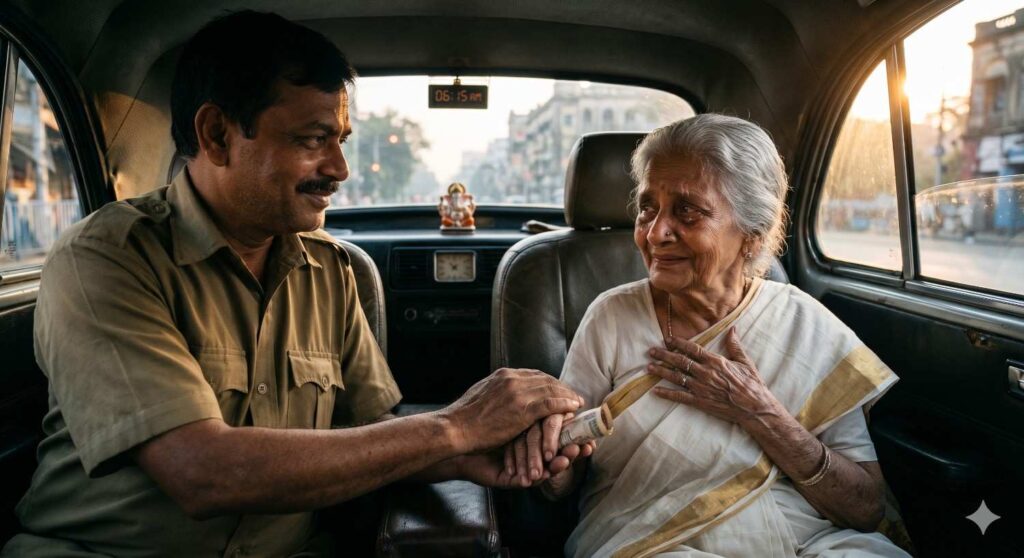
Devaki opened her handbag and took out some money.
“Please accept this.”
Raghavan gently closed her hand.
“No, Amma.”
“But you have spent the entire night driving me.”
“It was an honour.”
Tears rolled down her cheeks.
“You have given me something more valuable than money.”
The nurses waited respectfully.
Devaki slowly reached forward and held his hand.
“For many years I taught children that kindness is the greatest wealth a person can possess. Tonight you have reminded me that the lesson is true.”
Raghavan felt his eyes fill with tears.
He helped her into the wheelchair.
Before she entered the building, she opened her arms.
He bent down and embraced her warmly.
“Thank you,” she whispered.
“For what?”
“For allowing an old woman to say goodbye to her life.”
The hospice doors slowly closed behind her.
Raghavan remained standing in the early morning light.
The sky above Kerala was turning golden as the sun prepared to rise.
On the drive home he could not stop thinking about the night.
He realized that people often spend their lives chasing success, money and recognition, believing those things to be important. Yet in the final moments of life, what truly matters are memories, relationships, kindness and dignity. Sometimes the most meaningful thing one human being can offer another is not wealth, advice or power, but simply time, patience and compassion.
Years later, among all the thousands of passengers he carried across Kerala, Raghavan would remember only one journey in perfect detail—the final journey of Devaki Menon, an elderly teacher who taught him, without entering a classroom, the greatest lesson of all: that every person wishes to be seen, valued and remembered, and that even a small act of kindness can become the brightest light in someone’s last chapter of life.