
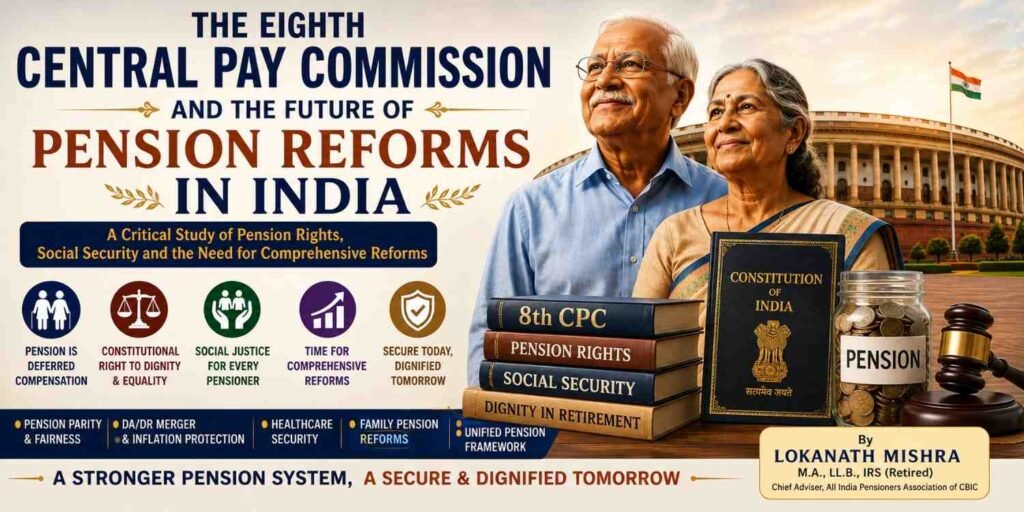
THE EIGHTH CENTRAL PAY COMMISSION AND THE FUTURE OF PENSION REFORMS IN INDIA:
By Lokanath Mishra M.A., LL.B., IRS (Retired)
A Critical Study of Pension Rights, Social Security and the Need for Comprehensive Reforms:
Part–I
Abstract
The constitution of the Eighth Central Pay Commission (8th CPC) has generated unprecedented expectations among millions of serving Central Government employees, pensioners and their families. Pensioners’ organisations across the country have submitted detailed memoranda seeking reforms in pension, healthcare, family pension, pension parity and retirement benefits. Among these organisations, the All India Pensioners Association of the Central Board of Indirect Taxes and Customs (CBIC) has placed before the Government a comprehensive charter of demands covering both serving employees and pensioners.
This paper critically examines these demands from constitutional, legal, administrative and social perspectives. It argues that pension is not merely a post-retirement financial benefit but an integral part of the constitutional vision of a welfare State. The article further examines whether the existing pension structure adequately fulfils that vision and proposes reforms for consideration by the Eighth Central Pay Commission.
Introduction
India is a welfare State committed to securing social and economic justice for all citizens. Public servants dedicate the most productive years of their lives to the service of the nation. After retirement, they depend primarily upon pension for their livelihood. Pension therefore represents not charity but deferred wages earned through long years of faithful service.
Successive Central Pay Commissions have substantially improved pay structures and retirement benefits. Nevertheless, several anomalies continue to affect retired employees. Differences between pensioners retiring on different dates, multiple pension systems operating simultaneously, increasing healthcare costs, and delays in implementation of judicial decisions have resulted in persistent dissatisfaction among pensioners.
The constitution of the Eighth Central Pay Commission provides a historic opportunity to undertake a comprehensive review of India’s pension architecture. Such a review should not be confined merely to revision of pay scales. It should address the larger question of retirement security, social justice and equality among pensioners.
Pension is Deferred Compensation:
The Supreme Court of India has repeatedly recognised that pension is not a gratuitous payment depending upon the discretion of the Government. Pension is earned by rendering long years of service and constitutes deferred compensation payable after retirement.
A retired Government servant no longer receives salary. His or her pension becomes the sole regular source of income. With advancing age, expenditure on food, housing, medicines, medical treatment and personal care increases significantly. Consequently, pension must be periodically revised to preserve the dignity and standard of living of retirees.
The philosophy underlying pension is therefore fundamentally different from welfare grants or charitable assistance. It is an enforceable service benefit arising out of the relationship between the employer and the employee.
Constitutional Philosophy:
The Constitution of India embodies the concept of a welfare State. Articles 38 and 39 require the State to minimise inequalities and promote social justice. Article 41 directs the State to provide public assistance in cases of old age and disablement within its economic capacity. Article 14 guarantees equality before law while Article 21 protects the right to live with dignity.
Although the Directive Principles are not enforceable in courts, they constitute fundamental guidelines for governance. Pension policy should therefore be interpreted in harmony with these constitutional objectives.
The dignity of retired public servants cannot be separated from the constitutional commitment to social justice.
The Landmark Judgment in D. S. Nakara:
The judgment of the Supreme Court in D. S. Nakara v. Union of India transformed the concept of pension jurisprudence in India.
The Court held that pension is neither a bounty nor an act of grace. It is a valuable right earned through service. The judgment emphasised that arbitrary discrimination among similarly situated pensioners violates Article 14 of the Constitution.
The decision established the principle that pensioners constitute one homogeneous class. Differential treatment among similarly situated pensioners requires strong constitutional justification.
Although subsequent judgments have clarified the extent of the decision in different factual contexts, D. S. Nakara continues to remain the cornerstone of Indian pension jurisprudence.
The Eighth Central Pay Commission should carefully examine the continuing relevance of this landmark judgment while recommending future pension reforms.
Why Pension Reform Has Become Urgent:
Several developments make comprehensive pension reform unavoidable.
First, life expectancy has increased substantially.
Secondly, healthcare expenditure has increased far beyond general inflation.
Thirdly, medical technology has become increasingly expensive.
Fourthly, many pensioners support dependent spouses, children with disabilities and aged parents.
Finally, multiple pension systems now operate simultaneously, resulting in varying retirement benefits among employees performing identical duties.
The cumulative effect of these factors justifies a comprehensive review of pension policy.
Chapter:1
Restore the Old Pension Scheme and Integrate NPS and UPS into a Unified Pension Framework
One of the principal demands of the All India Pensioners Association of CBIC is the restoration of the Old Pension Scheme (OPS) together with gratuity, commutation and other retirement benefits.
The demand proceeds on the premise that retirement security should not depend predominantly upon market-linked investment returns. Pension, according to this view, should provide a predictable and assured income after retirement.
The National Pension System introduced a contributory framework linked partly to market performance. Subsequently, the Unified Pension Scheme sought to provide greater certainty for eligible employees while retaining elements of the contributory model.
As a matter of public policy, it is open to stakeholders to argue that maintaining three separate pension systems for Central Government employees performing similar duties creates disparities and administrative complexity. A unified pension framework offering assured retirement income, reasonable inflation protection and long-term fiscal sustainability is one option that the Eighth Central Pay Commission could examine.
Any such transition would necessarily require detailed actuarial analysis, assessment of fiscal implications and consultation with all stakeholders. The objective should be to reconcile retirement security with responsible public finance.
Chapter: 2
Pension Revision and the Continuing Relevance of D. S. Nakara:
The Association has urged the Government to ensure pension revision for all pensioners whenever a new Central Pay Commission is implemented.
This demand is founded upon the principle that pension should maintain a reasonable relationship with contemporary pay structures. Without periodic revision, disparities inevitably widen between past and future retirees.
The Association has also questioned the continued operation of legislative measures affecting pension revision and has requested that pension policy remain consistent with the constitutional principles articulated in D. S. Nakara. Whether existing legislation should be amended or repealed is ultimately a matter for Parliament, but the underlying concern—that similarly placed pensioners should receive fair and equitable treatment—deserves careful consideration by the Government and the Eighth Central Pay Commission.
Chapter- 3
Amendment of the Terms of Reference of the Eighth Central Pay Commission:
Historically, every Central Pay Commission has examined both pay and pension.
The Association has therefore requested that the Terms of Reference explicitly require the Commission to recommend pension revision for all existing pensioners.
Such clarification would remove uncertainty and reassure pensioners that their concerns form an integral part of the Commission’s mandate.
Chapter No. 4:
Merger of 50 Per Cent Dearness Allowance and Dearness Relief with Basic Pay and Pension:
Dearness Allowance and Dearness Relief compensate inflation.
However, once inflation crosses a substantial threshold, repeated increases in DA and DR create distortions because several retirement benefits continue to depend upon the basic pay or basic pension.
The Association has therefore proposed merger of 50 per cent DA and DR with basic pay and pension to restore structural balance.
This proposal requires detailed financial examination by the Government. Nevertheless, it raises an important policy question regarding the long-term methodology for neutralising inflation and protecting pensioners from erosion of purchasing power.
Conclusion to Part–I
The first four demands placed before the Government by the All India Pensioners Association of CBIC are rooted in concerns about retirement security, pension parity and inflation protection. Whether or not each proposal is ultimately accepted, they merit careful examination by the Eighth Central Pay Commission on constitutional, administrative and fiscal grounds.
The Commission has a unique opportunity to modernise India’s pension system while balancing the legitimate expectations of employees and pensioners with the financial responsibilities of the State.
(Part II will critically examine the remaining demands relating to interim relief, restoration of commutation, implementation of judicial decisions, MACP, pay fixation and pension parity in greater detail.)
Increase the Fitment factor & implement soon
It’s too difficult for a retiree to live his/her life without having an adequate amount of monthly pension. The life of his wife/husband will certainly be painful without having an adequate amount of family pension as well. The NPS/UPS needs to be abolished. The Government should cogitate over the issue seriously and take necessary steps for reversion of NPS/UPS to OPS so as to let the retirees live a dignified life. Besides, the Government should reduce the qualifying service from 25 years to 20 years for an employee to be eligible for full pension as well.
The motto behind the Pension
“A Pensioner ought to lead his/her remaining span of LIFE as a Gentleman”.
Financial aid by the central govt to all states is a must. How and why and what way.
Better to give a thought
Every time the associations represent employees such clerks, accounts, auditors, aos, but group Ds & steno’s missed in club ing it.
Please note that group Ds & steno’s work in all departments including all ministries, govt of India inside. They take care of the sections & officers of respective departments & all India service officers. Their interest also be viewed seriously.
Very comprehensive and logical.
कम्यूटेशन की कटौती का समय 15 वर्ष से घटा कर 11 वर्ष होनी चाहिए। 11 वर्ष में 9.50% प्रतिशत से अधिक कटौती पूर्ण हो जाती हैं।
Central pensioners ( of course the working employees) should get more pension as compared to any state pensioners and bodies dependent on central funds like Universities , colleges, KVs and railways and public sector bodies.
Yes, pension is a deferred wages as outlined in the above write up and other factors are well conceived.