
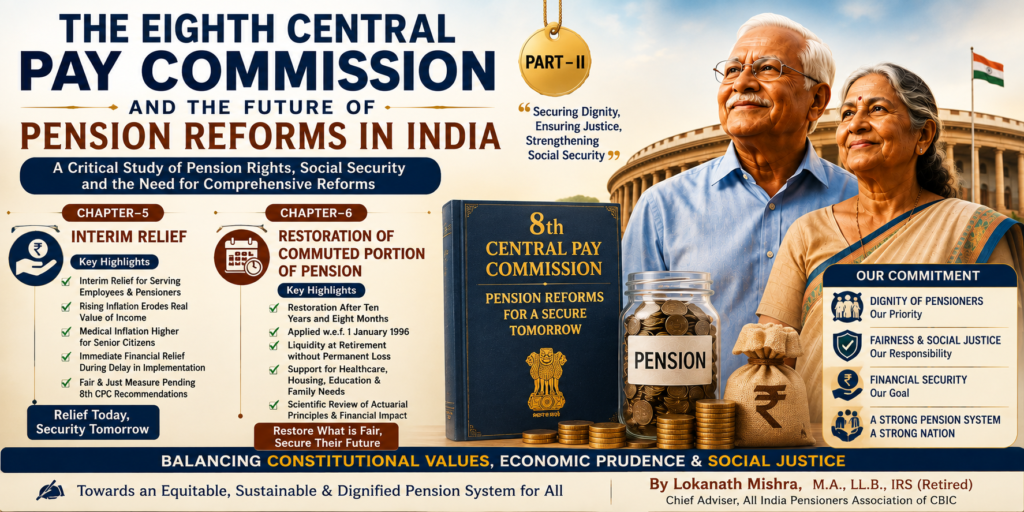
THE EIGHTH CENTRAL PAY COMMISSION AND THE FUTURE OF PENSION REFORMS IN INDIA
By Lokanath Mishra M.A., LL.B., IRS (Retired)
A Critical Study of Pension Rights, Social Security and the Need for Comprehensive Reforms:
PART – II
Chapter–5
Grant of Interim Relief Pending Submission and Implementation of the Recommendations of the Eighth Central Pay Commission:
One of the most pressing demands placed before the Government by the All India Pensioners Association of the Central Board of Indirect Taxes and Customs (CBIC) is the grant of Interim Relief to serving employees and pensioners pending the submission and implementation of the recommendations of the Eighth Central Pay Commission.
This demand deserves careful examination in the light of constitutional principles, economic realities and administrative justice.
Historically, every Central Pay Commission has taken considerable time to complete its work. After submission of its report, additional time is consumed by examination of the recommendations by the Government, approval by the Union Cabinet, issuance of implementation orders and payment of arrears. Consequently, employees and pensioners often wait for several years before actually receiving the benefits of revised pay and pension.
During this period, however, inflation does not wait.
Prices of food grains, vegetables, milk, cooking oil, electricity, transport, education, medicines and healthcare continue to rise steadily. Although Dearness Allowance (DA) and Dearness Relief (DR) provide partial compensation against inflation, they do not fully neutralise the erosion in the real value of wages and pensions. In particular, medical inflation affecting senior citizens is substantially higher than the general Consumer Price Index.
For pensioners, the impact is even more severe. Unlike serving employees, they have no opportunities for promotion, annual increments or career progression. Their pension is generally the sole assured source of income. As age advances, expenditure on medical treatment, specialised investigations, long-term medication and attendant care increases significantly. The delay in implementation of revised pension therefore imposes disproportionate hardship on elderly pensioners.
The demand for Interim Relief is not a demand for an additional benefit independent of the recommendations of the Pay Commission. Rather, it is intended to provide temporary financial assistance during the intervening period, subject to adjustment, if necessary, against the final benefits arising from the recommendations of the Commission.
From the standpoint of administrative fairness, the concept of Interim Relief is neither novel nor unprecedented. Various wage revision exercises in public sector undertakings and industrial establishments have adopted similar measures to mitigate hardship during prolonged negotiations. The principle underlying such relief is that employees and pensioners should not be required to bear the entire burden of procedural delays over which they have no control.
The Government, therefore, may examine whether a reasonable Interim Relief can be granted to both serving employees and pensioners, keeping in view prevailing economic conditions, fiscal capacity and the likely time required for completion of the work of the Eighth Central Pay Commission.
Such a measure would reinforce the confidence of employees and pensioners in the fairness of the Government while providing immediate relief against rising living costs.
Chapter–6
Restoration of Commuted Portion of Pension after Ten Years and Eight Months
Another long-standing demand repeatedly raised by pensioners’ organisations concerns restoration of the commuted portion of pension after ten years and eight months with effect from 1 January 1996.
Commutation of pension is a beneficial provision enabling a retiring Government servant to receive a lump sum amount by surrendering a specified portion of monthly pension. The object is to provide immediate financial resources at the time of retirement for meeting pressing obligations such as construction of a house, repayment of loans, education of children, marriage expenses or medical treatment.
The amount commuted is calculated on actuarial principles taking into account age, commutation value and prescribed factors.
The present system provides for restoration of the commuted portion of pension after the prescribed restoration period under the applicable rules. Pensioners’ organisations have consistently contended that the period during which the commuted amount is recovered effectively exceeds the period necessary to recover the amount advanced, particularly when viewed in the context of evolving actuarial assumptions, increased longevity and changes in economic conditions.
The demand for restoration after ten years and eight months is based on the contention that the Government recovers the commuted value within that period and that continuation of the reduction thereafter results in avoidable hardship to elderly pensioners. It is also argued that, after a decade of retirement, pensioners encounter increasing expenditure on healthcare and age-related needs, making full restoration of pension especially significant.
Supporters of the proposal emphasise that pension is intended to provide continuing financial security throughout retirement. Since the purpose of commutation is to offer liquidity at the time of retirement rather than to impose a permanent reduction in pension, they contend that restoration at an earlier stage would better serve the social welfare objective underlying pension policy.
From the Government’s perspective, however, any alteration in the restoration period requires careful actuarial and financial examination. Changes to the commutation framework affect long-term pension liabilities and therefore must be evaluated with reference to sustainability, demographic trends and public finances.
The Eighth Central Pay Commission is uniquely placed to examine this issue comprehensively. It can evaluate existing actuarial assumptions, study comparative practices, assess the financial implications and recommend whether the current restoration period requires modification.
A scientific review based on contemporary actuarial data would ensure that the commutation scheme remains equitable both for pensioners and for the public exchequer.
Concluding Observations on Chapters 5 and 6:
The demands relating to Interim Relief and restoration of the commuted portion of pension arise from genuine concerns regarding inflation, delay in implementation of Pay Commission recommendations and the financial security of retired public servants.
The Eighth Central Pay Commission should therefore undertake an evidence-based assessment of these issues by balancing three equally important considerations:
- The constitutional obligation of the State to protect the dignity and welfare of retired public servants.
- The legitimate expectation of pensioners that deferred compensation should retain its real value throughout retirement.
- The fiscal responsibility of the Government to ensure that any additional financial commitment remains sustainable over the long term.
A balanced approach founded upon constitutional values, economic prudence and social justice would strengthen public confidence in the pension system and reinforce the welfare character of the Indian State.
(Part II will continue with Chapters 7–9, dealing with implementation of judicial decisions, MACP and NFGP anomalies, revised pay fixation from 1 January 1996, payment of arrears with interest, and pension parity under the Eighth Central Pay Commission.)