
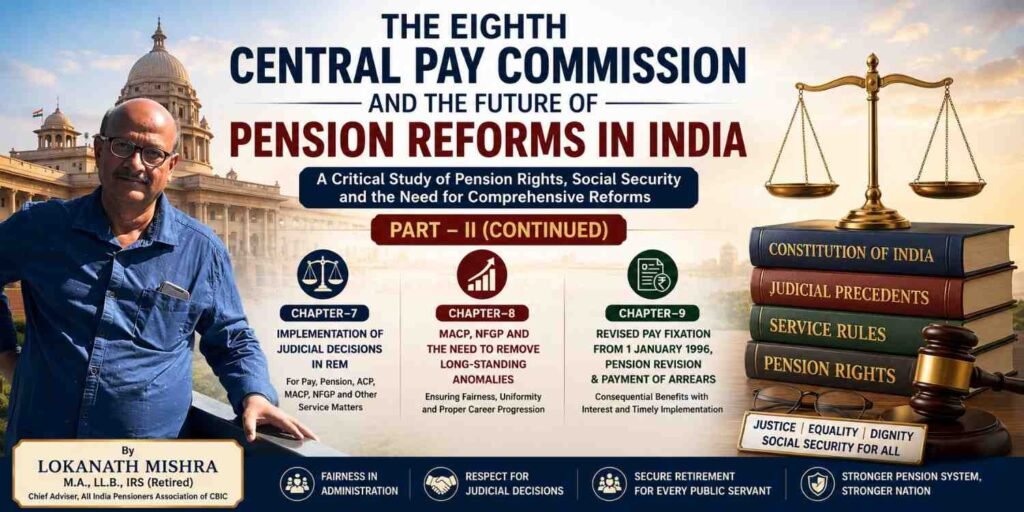
THE EIGHTH CENTRAL PAY COMMISSION AND THE FUTURE OF PENSION REFORMS IN INDIA:
By Lokanath Mishra M.A., LL.B., IRS (Retired)
A Critical Study of Pension Rights, Social Security and the Need for Comprehensive Reforms:
PART – II (Continued)
Chapter–7
Implementation of Judicial Decisions on Pay, Pension, ACP, MACP, NFGP and Other Service Matters In Rem:
One of the most significant demands made by the All India Pensioners Association of CBIC is that judicial decisions relating to pay, pension, Assured Career Progression (ACP), Modified Assured Career Progression (MACP), Non-Functional Grade Pay (NFGP) and other service matters should be implemented in rem instead of compelling every similarly placed employee or pensioner to initiate separate litigation.
This demand raises an important issue concerning equality before law, administrative fairness and good governance.
A recurring problem in service jurisprudence is that when a court grants relief to one employee or a small group of employees, the administration often confines the benefit only to the successful litigants. Other employees, although identically situated, are required to approach courts again and again for the same relief.
This practice results in unnecessary litigation, avoidable expenditure by both employees and the Government, and an enormous burden on the Central Administrative Tribunal, High Courts and the Supreme Court.
Where a judgment lays down a principle of general application interpreting statutory rules or service conditions, the Government should ordinarily examine whether the benefit can be extended administratively to all similarly situated employees and pensioners, subject to the scope of the judgment and any legal limitations. Such an approach promotes administrative efficiency and reduces repetitive litigation.
However, it is equally important to recognise that not every judgment automatically operates in rem. Many decisions are confined to the specific facts of the parties before the court, while others interpret rules in a manner that has wider implications. Determining whether a judgment should have broader application depends upon its reasoning, the applicable statutory framework and subsequent judicial guidance.
Accordingly, the Eighth Central Pay Commission may recommend that, wherever a final judgment of the Supreme Court or a binding precedent conclusively settles a service issue of general applicability, the Government should formulate a transparent mechanism to examine whether the benefit should be extended to all similarly placed employees and pensioners without compelling them to institute fresh proceedings.
Such a policy would strengthen public confidence in the administration and reduce avoidable litigation.
Chapter–8
MACP, Non-Functional Grade Pay and the Need to Remove Long-standing Anomalies:
The Modified Assured Career Progression Scheme (MACP) was introduced to mitigate stagnation by granting financial upgradations to employees who do not receive regular promotions within prescribed periods.
Similarly, Non-Functional Grade Pay (NFGP) was introduced for certain categories of employees to remove disparities arising from limited promotional opportunities.
Despite these beneficial objectives, various employee organisations have pointed out anomalies in the interaction between MACP and NFGP. One specific demand is that financial upgradation under MACP should not adversely affect entitlement to NFGP where the latter is intended to address structural stagnation rather than reward individual promotion.
Another issue concerns the treatment of Grade Pay ₹5400 in Pay Band-2 and Pay Band-3. Associations have argued that although the Grade Pay is numerically identical, differences in its treatment have resulted in disparities affecting pay fixation, career progression and pension.
These issues involve interpretation of service rules, Office Memoranda and judicial pronouncements. They have generated considerable litigation before the Central Administrative Tribunal and constitutional courts.
The Eighth Central Pay Commission should undertake a comprehensive review of these anomalies in consultation with the Department of Personnel and Training, the Department of Expenditure and stakeholder organisations. A simplified and uniform policy would reduce disputes and ensure greater consistency in service administration.
The guiding principle should be that financial progression schemes must operate fairly, transparently and without creating unintended inequalities among employees performing comparable duties.
Chapter–9
Revised Pay Fixation from 1 January 1996, Consequential Pension Revision and Payment of Arrears:
Another important demand concerns implementation of judicial decisions relating to revised pay fixation with effect from 1 January 1996, revision of consequential pension and payment of arrears together with appropriate interest.
The Association contends that where courts have interpreted pay rules in favour of employees and such interpretations attain finality, similarly situated pensioners should not be deprived of corresponding revision in pension merely because they were not parties to the original proceedings.
The issue involves two distinct questions.
The first concerns implementation of judicial decisions relating to pay fixation.
The second concerns the consequential revision of pension arising from such revised pay.
From the standpoint of pension jurisprudence, pension is ordinarily calculated with reference to the pay admissible under the applicable rules. Consequently, where pay is lawfully revised, corresponding pensionary benefits may also require reconsideration in accordance with the governing statutory provisions and judicial directions.
The claim for payment of interest on delayed arrears is founded upon the principle that retirement benefits constitute valuable service entitlements. Where payment is wrongfully withheld despite a clear legal obligation, courts have, in appropriate cases, awarded interest to compensate for delay. At the same time, the grant of interest depends upon the facts of each case, the applicable statutory framework and the nature of the judicial directions.
The Eighth Central Pay Commission may therefore recommend the establishment of a structured mechanism for the prompt implementation of final judicial decisions relating to pay and pension. Such a mechanism could include:
- Early identification of judgments having wider administrative implications.
- Time-bound examination by the concerned Ministry.
- Uniform implementation where legally permissible.
- Automatic revision of pension arising from lawful revision of pay.
- Expeditious payment of admissible arrears in accordance with law.
- Reduction of avoidable litigation through administrative action.
Such reforms would not only benefit employees and pensioners but would also reduce the financial burden associated with prolonged litigation and repeated adjudication of identical issues.
Conclusion to Part–II
The demands examined in Part–II are not merely matters of financial entitlement. They also concern the quality of public administration, respect for judicial decisions and the relationship between the State and its retired employees.
An efficient administration should not compel employees and pensioners to repeatedly litigate issues that have already been conclusively determined by competent courts. Equally, career progression schemes should be administered in a manner that removes rather than creates anomalies.
The Eighth Central Pay Commission has an opportunity to recommend reforms that simplify service jurisprudence, minimise avoidable disputes and strengthen confidence in the fairness of Government administration.
By ensuring transparent implementation of judicial decisions, rationalising career progression policies and facilitating timely revision of pay and pension, the Commission can contribute significantly to the constitutional goals of equality, administrative justice and social welfare.
(Part–III will examine the remaining demands relating to Departmental Promotion Committees, regularisation of long-standing temporary posts, comprehensive reform of CGHS and medical facilities, implementation of parliamentary committee recommendations, Option-1 of the Seventh Central Pay Commission for pension parity and the future direction of India’s pension policy.)